Skip to content
Rep & Recovery

Tracking · Recovery Wearables

The best Garmin watches for training and recovery

Garmin's pitch is simple: buy the watch, own the data, pay nothing again. Five models ranked on what you actually get for the extra money as you climb the range.

By Stephen V.Updated Published How we review
#ad

We earn a commission when you buy through our Amazon links, at no extra cost to you. It never changes a verdict, and we say so when the cheaper product is the better buy. How this works.

Garmin is the answer this site keeps arriving at from different directions: if you want recovery data — heart-rate variability status, Body Battery, training load, sleep — without a subscription, Garmin has offered it for years with no membership at any tier. Buy the watch, own the data. That single fact is why Garmin appears in almost every wearable comparison we publish.

The difficulty is the range. Garmin sells dozens of models across several families with overlapping names and prices from under a hundred to well over a thousand, and the marketing does a poor job of explaining what the extra money buys. In practice, moving up the range buys you four things, in this order: an AMOLED screen instead of a transflective one, more training analysis (readiness, load focus, recovery projections), maps and music, and better GPS hardware. It rarely buys you better recovery metrics — those are largely the same from the cheap end upward.

Ranked below by what most people should buy, not by price. If you want the wider field across brands and form factors, see best recovery wearables; for the Garmin-versus-subscription question, see Garmin vs Whoop.

The short answer

Quick picks

#ProductBest forScorePrice
01
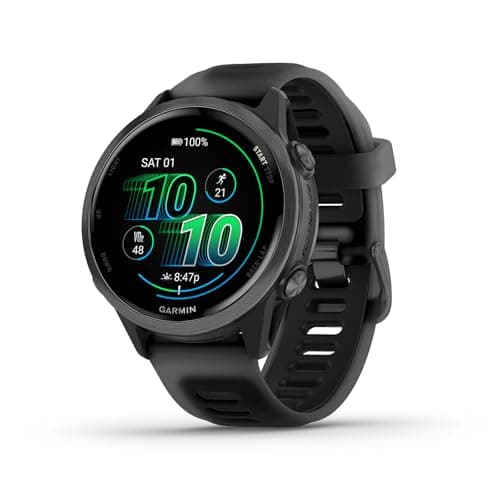
Garmin Garmin Forerunner 165
Garmin Forerunner 165

The one to buy. An AMOLED screen, multi-GNSS GPS, Body Battery, HRV Status and training load, with battery measured in days rather than hours — and no subscription for any of it. Everything above this in the range adds refinement; almost nothing above it adds a metric you will use.

Best overall
8.8
$198.70Amazon
02
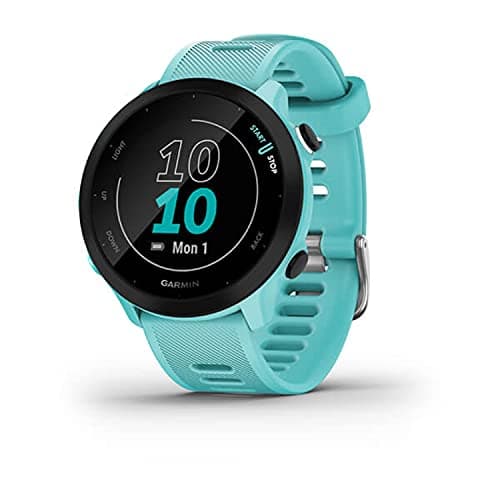
Garmin Garmin Forerunner 55
Garmin Forerunner 55

The cheapest way into real Garmin. GPS, daily suggested workouts, and up to two weeks of battery on Garmin's figures, in a light plastic case. The screen is a transflective LCD rather than AMOLED, which is exactly why the battery lasts and exactly why it looks a decade older.

Best budget
7.6
$129.00Amazon
03
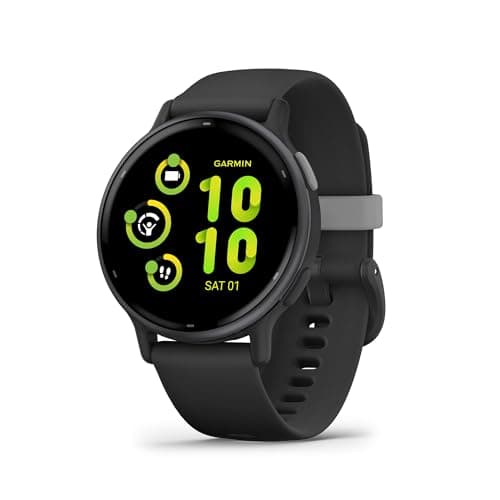
Garmin Garmin vívoactive 5
Garmin vívoactive 5

The lifestyle pick: an AMOLED health-and-fitness smartwatch rather than a running watch, with the same no-subscription recovery suite in a case that does not announce itself at dinner. Choose this over a Forerunner if training is a part of your life rather than the organizing principle of it.

Best everyday smartwatch
8.4
$189.99Amazon
04
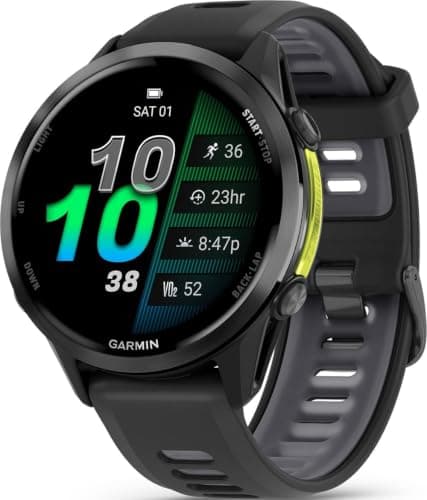
Garmin Garmin Forerunner 570
Garmin Forerunner 570

The step up that is actually worth taking if you follow a plan, and the model that replaced the Forerunner 265 in Garmin's range. Same AMOLED quality as the 165 with a deeper training stack — training readiness, granular load analysis, on-board music — plus the newer Elevate Gen 5 heart-rate sensor and a speaker and microphone the 265 never had.

Best for structured training
8.4
$549.99Amazon
05
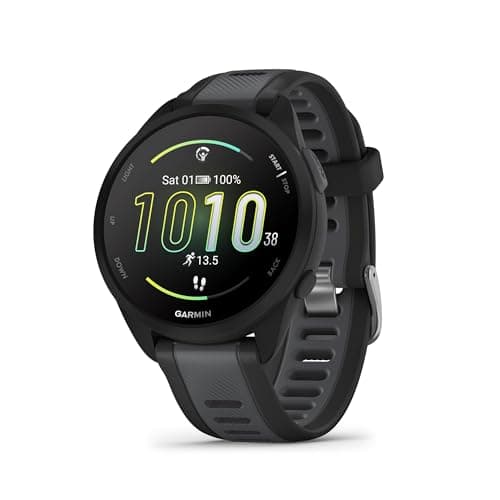
Garmin Garmin Forerunner 970
Garmin Forerunner 970

The one for people who navigate, and the model that replaced the Forerunner 965 at the top of the range. Full-color on-board maps, the brightest AMOLED Garmin has shipped behind a sapphire lens, a titanium bezel, an ECG app and a built-in flashlight. For road running it is a lot of money for hardware you will not use.

Best premium / trail and ultra
8.2
$740.00Amazon

#ad · Live prices from the Amazon Product API, as of Sep 4, 2026. Where we have no verified live price, we show none — a gap beats a number that has rotted.

In detail

The picks, in full

01
Garmin Garmin Forerunner 165

Best overall

Garmin Forerunner 165

AMOLED · multi-GNSS GPSBody Battery + HRV StatusUp to 11-day battery5 ATM · no subscription
8.8/10

The one to buy. An AMOLED screen, multi-GNSS GPS, Body Battery, HRV Status and training load, with battery measured in days rather than hours — and no subscription for any of it. Everything above this in the range adds refinement; almost nothing above it adds a metric you will use.

Recovery data
9
Training analysis
8
Display
9
Battery
8
Value
10

Pros

  • Bright AMOLED display at the lowest price Garmin offers one
  • Full recovery suite: Body Battery, HRV Status, sleep, training load
  • Up to 11 days of battery in smartwatch mode
  • 5 ATM water rating, and Garmin Pay across the range

Cons

  • Base model has no on-board music storage
  • No maps — that is a step up the range

Don't buy this if…

you want maps for trails or the deepest premium hardware — that is the Forerunner 970.

The 165 is the point in Garmin's range where the price curve and the usefulness curve cross. It has the AMOLED screen that transforms daily use, the full recovery stack, real multi-band GPS and a battery you charge weekly rather than nightly. The models above it are better watches; they are not proportionally more useful watches for anyone who is not racing or navigating.

It is also the model we point at from other pages, because it answers the recurring question on this site — how do I get HRV, readiness and sleep data without paying a monthly fee — at a price that is not absurd.

$198.70View on Amazon

$249.9921% off

Price as of Sep 4, 2026. Prices change — Amazon's at checkout is the one that counts.

#ad · we may earn a commission from this link to Garmin Forerunner 165

02
Garmin Garmin Forerunner 55

Best budget

Garmin Forerunner 55

GPS running watchUp to 2 weeks batteryDaily suggested workoutsNo subscription
7.6/10

The cheapest way into real Garmin. GPS, daily suggested workouts, and up to two weeks of battery on Garmin's figures, in a light plastic case. The screen is a transflective LCD rather than AMOLED, which is exactly why the battery lasts and exactly why it looks a decade older.

Recovery data
7
Training analysis
6
Display
5
Battery
10
Value
10

Pros

  • The lowest entry price for a genuine Garmin GPS watch
  • Up to two weeks of battery on Garmin's stated figures
  • Daily suggested workouts and core running metrics
  • Very light and unobtrusive to sleep in

Cons

  • Transflective LCD screen looks dated next to AMOLED models
  • Fewer advanced training and recovery analytics than the 165 and up

Don't buy this if…

you care how the watch looks on your wrist every day — the screen is the compromise that funds the price.

$129.00View on Amazon

$199.9935% off

Price as of Sep 4, 2026. Prices change — Amazon's at checkout is the one that counts.

#ad · we may earn a commission from this link to Garmin Forerunner 55

03
Garmin Garmin vívoactive 5

Best everyday smartwatch

Garmin vívoactive 5

AMOLED displayHealth + fitness trackingMulti-day batteryNo subscription
8.4/10

The lifestyle pick: an AMOLED health-and-fitness smartwatch rather than a running watch, with the same no-subscription recovery suite in a case that does not announce itself at dinner. Choose this over a Forerunner if training is a part of your life rather than the organizing principle of it.

Recovery data
9
Training analysis
7
Display
9
Battery
8
Value
9

Pros

  • AMOLED display in a design that works outside the gym
  • Same core Garmin recovery data with no fees
  • Multi-day battery — no nightly charging
  • Broad activity profiles for people who do several different things

Cons

  • Less running-specific analysis than a Forerunner
  • No maps

Don't buy this if…

running is your main sport and you want structured training analysis — the Forerunner line is built for that.

$189.99View on Amazon

$299.9937% off

Price as of Sep 4, 2026. Prices change — Amazon's at checkout is the one that counts.

#ad · we may earn a commission from this link to Garmin vívoactive 5

04
Garmin Garmin Forerunner 570

Best for structured training

Garmin Forerunner 570

AMOLED displayElevate Gen 5 HR sensorSpeaker + microphoneUp to 11-day battery
8.4/10

The step up that is actually worth taking if you follow a plan, and the model that replaced the Forerunner 265 in Garmin's range. Same AMOLED quality as the 165 with a deeper training stack — training readiness, granular load analysis, on-board music — plus the newer Elevate Gen 5 heart-rate sensor and a speaker and microphone the 265 never had.

Recovery data
9
Training analysis
10
Display
9
Battery
8
Value
6

Pros

  • Deeper training analysis than the 165, including readiness scoring and Triathlon Coach
  • Newer Elevate Gen 5 optical sensor and skin-temperature tracking
  • Speaker and microphone for connected calls and voice commands
  • On-board music, multi-band GPS, and still no subscription at any tier

Cons

  • Substantially more expensive than the 165 for analysis many runners ignore
  • No maps and no ECG at this tier — both are 970 features

Don't buy this if…

you run for fitness rather than to a plan — the 165 gives you every metric you will look at, for far less.

$549.99View on Amazon

Price as of Sep 4, 2026. Prices change — Amazon's at checkout is the one that counts.

#ad · we may earn a commission from this link to Garmin Forerunner 570

05
Garmin Garmin Forerunner 970

Best premium / trail and ultra

Garmin Forerunner 970

Full-color topo mapsSapphire lens + titanium bezelECG appBuilt-in LED flashlight
8.2/10

The one for people who navigate, and the model that replaced the Forerunner 965 at the top of the range. Full-color on-board maps, the brightest AMOLED Garmin has shipped behind a sapphire lens, a titanium bezel, an ECG app and a built-in flashlight. For road running it is a lot of money for hardware you will not use.

Recovery data
9
Training analysis
10
Display
10
Battery
8
Value
4

Pros

  • On-board mapping and navigation — the genuine reason to buy this tier
  • Sapphire lens and the brightest Garmin AMOLED yet, on a titanium bezel
  • Adds an ECG app, skin temperature, a speaker and microphone, and an LED flashlight over the 965
  • Every training and recovery metric Garmin offers, still no fees

Cons

  • Shorter smartwatch-mode battery than the 965 it replaced — Garmin quotes up to 15 days against the 965's 23
  • The most expensive watch here, and the maps are a feature most road runners never open
  • 47mm only, so it is more watch than a small wrist wants overnight

Don't buy this if…

you run roads and routes you already know — you are paying for navigation and premium hardware you will not open.

$740.00View on Amazon

Price as of Sep 4, 2026. Prices change — Amazon's at checkout is the one that counts.

#ad · we may earn a commission from this link to Garmin Forerunner 970

What climbing the range actually buys

Screen technology first. The single biggest day-to-day difference between a cheap Garmin and an expensive one is AMOLED versus transflective LCD. AMOLED is bright, colorful and modern; transflective is dim indoors, superb in direct sunlight, and sips power — which is why the cheapest watch here has the longest battery.

Then training analysis. Every tier gives you Body Battery, HRV Status, sleep and recovery time. Higher tiers add training readiness, load focus and race predictions. Whether that is worth hundreds depends entirely on whether you follow a plan.

Then maps, music and GPS hardware. Maps are the honest reason to buy the top of the range; on-board music is a convenience; multi-band GPS matters in cities and canyons and nowhere else.

What it does not buy: better recovery data

This is the part worth internalizing before you spend. Body Battery, HRV Status, sleep tracking and resting heart rate are broadly the same features from the bottom of the range upward. If your reason for buying a Garmin is the recovery stack — which is the reason we most often recommend one — the entry and mid models give you the same numbers as the flagship. Our guides to what HRV is and how to improve it apply identically across every model here.

The no-subscription argument

Garmin charges nothing after purchase. Not for HRV, not for sleep staging, not for training load, not for the app. Against a subscription platform, the three-year total cost of ownership is dramatically lower, and the watch keeps working if you stop paying — because there is nothing to stop paying. That is the core of the case in Garmin vs Whoop and Fitbit vs Garmin, and it is why Garmin dominates our no-subscription list.

Watch, band, or ring?

A watch is the right choice if you train and want GPS, workout metrics and a screen. If you only care about sleep and recovery, a smart ring is more comfortable overnight and less intrusive, and a slim band splits the difference at a lower price. And if you want the most accurate heart rate during hard intervals, no wrist device beats a chest strap — which any Garmin will pair with.

A note on model years

Garmin refreshes constantly and older models stay on sale, often heavily discounted, long after a successor arrives. A previous-generation watch usually keeps the same recovery features and loses a screen upgrade or a GPS refinement. Prices on this page come from the live retail feed rather than a number we typed, so check the current figure before you decide — a discounted older model is frequently the best value in the entire range.
How we picked

We did not lab-test this gear

Everyone in this category says they tested twenty products. We have not lab-tested any of these, and we say so. What we did instead: compiled the published specifications, pulled the numbers from the manufacturer manuals, ran the cost-to-run and cost-per-unit math where there was math to run, and scored each product against a published rubric. The scores are judgments from documented research — not measurements we took, because we do not have a lab and we will not pretend we do. Where a number came from someone else's work, we name them in Sources.

Questions

Frequently asked

Which Garmin watch is best for most people?
The Forerunner 165 is the point where the range stops adding things most people use: AMOLED screen, multi-GNSS GPS, Body Battery, HRV Status, training load and around eleven days of battery, with no subscription. Above it you are buying training analysis depth, maps and music rather than better recovery data.
Do Garmin watches require a subscription?
No. Every recovery and training feature — Body Battery, HRV Status, sleep tracking, training load, the Connect app — is included with the watch at every price tier. That is the main reason Garmin appears throughout our no-subscription recommendations.
Is an expensive Garmin better for recovery tracking?
Not meaningfully. The recovery stack is broadly the same from the entry models upward. What extra money buys is screen technology, deeper training analysis, on-board maps and music, and better GPS hardware. If recovery data is your reason for buying, the mid-range is the sweet spot.
Which Garmin has the best battery life?
Within this list, the Forerunner 55 — its transflective LCD screen uses far less power than AMOLED, and Garmin quotes up to two weeks. That is the trade: the cheapest watch has the longest battery and the least attractive display.
Garmin or Apple Watch for fitness?
Garmin for battery life, training depth and no subscription; Apple for everything else a wrist computer does, if you have an iPhone. Garmin is the better instrument, Apple the better gadget. We compare the recovery-tracking side of that question in Whoop vs Apple Watch and fitness tracker vs smartwatch.

Keep reading

Receipts

Sources

We do not run a testing lab, and we do not pretend to. Where a measured number came from someone else's work, we name them and link them. Where we could not verify something, we say so on the page rather than quietly leaving it out. Read our full method.