The best adjustable dumbbells, ranked by the specs that matter
Seven ways to fit a full rack of dumbbells into one corner, across all three mechanisms — dial, selector block and plate-loaded — ranked on weight range, increment size, footprint and what you actually pay per pound.
We earn a commission when you buy through our Amazon links, at no extra cost to you. It never changes a verdict, and we say so when the cheaper product is the better buy. How this works.
The best adjustable dumbbells solve one problem: a full set of fixed dumbbells eats a wall and a budget, and most people never use half of them. One adjustable pair collapses that whole rack into a footprint the size of a shoebox. The catch is that the three designs that do it — spin-a-dial selectors, selector-pin blocks and load-the-plates sets — are wildly different on price, feel, ceiling weight and how fast you can change weight. This list ranks all three honestly.
We picked and ordered these on four things: how wide the weight range is, how small the jump is between settings (small increments matter more than beginners expect), how big the thing is on your floor, and the number nobody advertises — cost per pound. Dial systems buy you speed and a tiny footprint at a high cost per pound; plate-loaded sets are the opposite; selector blocks sit in between and are the only design you can expand later. The full per-hand weight ranges and the budget tiers— what your money actually buys, from roughly $50 up to the $700-plus premium sets — are laid out in the buyer's guide below the picks. If you are still deciding between the quick-change route and the traditional one, read adjustable vs fixed dumbbells first, and if you are kitting out a room from scratch, our guide to home-gym equipment maps where dumbbells sit against bands and kettlebells.
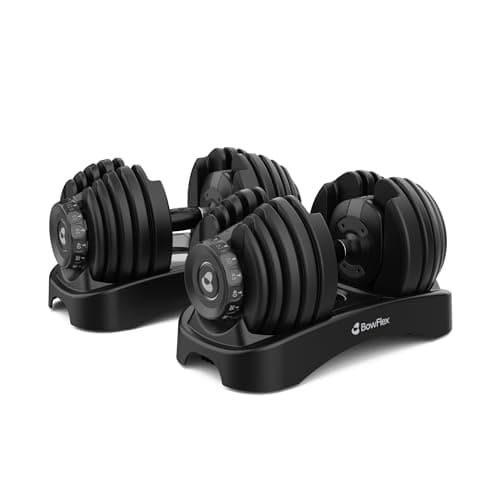
The dial system that set the standard, and still the pick for most home lifters. Each dumbbell spins from 5 to 52.5 lb and replaces 15 pairs, in 2.5 lb steps up to 25 lb. You pay a premium per pound for the speed and the footprint — and for a lot of people it is worth it.
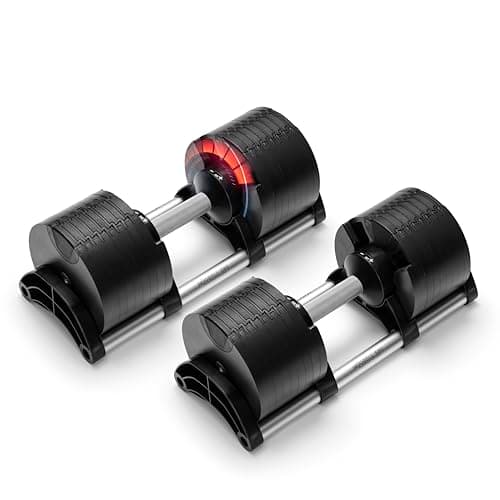
The dial system for people who have out-lifted the Bowflex. A twist of the knurled aluminum handle steps you from 5 to 80 lb per hand in 5 lb increments, replacing 16 pairs, in a shell no bigger than a fixed 80 lb dumbbell. The best-feeling adjustable dumbbell here — and by a distance the most expensive.
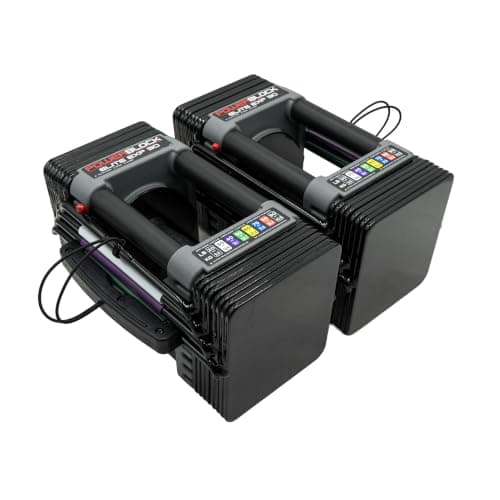
The third mechanism, and the only one you can expand rather than replace. A selector-pin block that runs 5 to 50 lb a hand out of the box, replaces 16 pairs, occupies the smallest footprint on this page, and takes Stage 2 and Stage 3 kits to reach 70 or 90 lb a hand later. The shape divides people.
The budget convertible. A load-the-plates set that tops out around 45 lb and converts into a barbell, kettlebell and push-up stand — a lot of function for very little money, as long as you do not mind swapping plates by hand.
The most iron for your money, full stop. Two handles plus a pile of baked-enamel cast-iron plates that load to a full 100 lb per dumbbell, in 5 lb steps. Tanky, dense, and it feels like a real dumbbell — you just do the loading yourself.
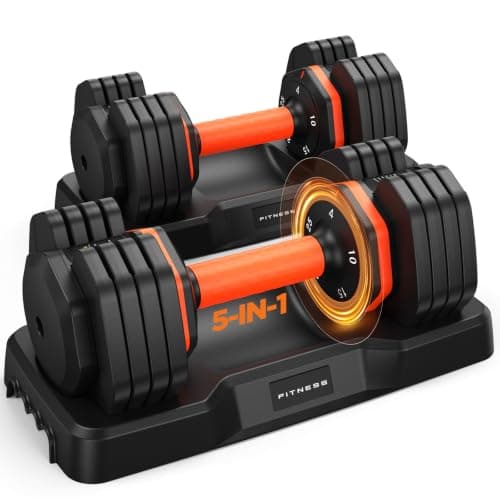
The do-everything compact kit. A ~44 lb convertible set that becomes dumbbells, a barbell, a kettlebell, push-up stands and loose weight plates, with a connecting bar. Good for a beginner in a tiny space who wants one box that covers the basics.
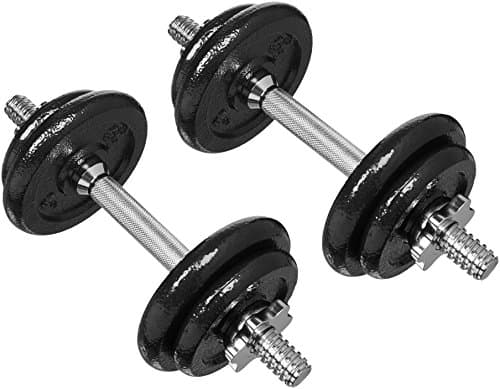
The cheapest way in. A 38 lb spin-lock set — two handles, a spread of 2.5 and 5 lb plates, and a carry case. Light-duty and slow to change, but it is a real, honest starter set for less than almost anything else that works.
#ad · Live prices from the Amazon Product API, as of October 19, 2026. Where we have no verified live price, we show none — a gap beats a number that has rotted.
The dial system that set the standard, and still the pick for most home lifters. Each dumbbell spins from 5 to 52.5 lb and replaces 15 pairs, in 2.5 lb steps up to 25 lb. You pay a premium per pound for the speed and the footprint — and for a lot of people it is worth it.
Weight range
8
Increments
9
Build
8
Footprint
9
Value
6
Feel
7
Pros
+5 to 52.5 lb per hand covers beginner through solid intermediate lifting
+Fine 2.5 lb increments up to 25 lb make small, honest progressions easy
+One pair replaces 15 sets of dumbbells — the smallest footprint here
+Dial change takes a second or two, so drop sets and supersets stay moving
Cons
−Highest cost per pound on this list by a wide margin
−The plastic-shelled cradle is bulky and can feel awkward at the lightest settings
−Above 25 lb the jump doubles to 5 lb increments
Don't buy this if…
…you want the most iron for your money, or you already out-lift 52.5 lb in one hand — a plate-loaded set gives you more, cheaper.
The 552 earns the top spot because the dial genuinely changes how you train. When swapping weight is a two-second twist instead of a trip to a rack or a minute of loading plates, you actually do the drop sets and the light-to-heavy warm-ups you know you should. The 5 to 52.5 lb range in 2.5 lb steps (up to 25 lb, then 5 lb jumps) is the sweet spot for building real strength at home without buying a wall of iron.
Be clear-eyed about the trade: this is the most expensive way per pound to own dumbbells, the cradle is chunky, and above 25 lb the increment doubles. None of that is a dealbreaker for most home lifters, but if your priority is maximum weight for minimum spend, scroll down. When you are done training, the recovery half matters too — see our best foam rollers for the cheapest way to keep sore muscles moving.
The dial system for people who have out-lifted the Bowflex. A twist of the knurled aluminum handle steps you from 5 to 80 lb per hand in 5 lb increments, replacing 16 pairs, in a shell no bigger than a fixed 80 lb dumbbell. The best-feeling adjustable dumbbell here — and by a distance the most expensive.
Weight range
10
Increments
7
Build
9
Footprint
9
Value
3
Feel
9
Pros
+80 lb a hand is 27.5 lb past the Bowflex ceiling — enough for heavy rows and RDLs
+Twist-the-handle adjustment is the fastest change of any mechanism here
+A 32 mm knurled aluminum handle feels like a gym dumbbell, not a plastic cradle
+One pair replaces 16 pairs and the trays are included
+Compact 485 x 185 x 193 mm body — no wider than the fixed dumbbell it replaces
Cons
−Roughly double the Bowflex on price for 27.5 lb more per hand — the worst cost-per-pound here
−5 lb increments throughout, so no 2.5 lb steps for smaller lifts
−Two-year warranty (extendable to four) that explicitly excludes drops and slams
−The twist mechanism has more moving parts than a plate and a collar
Don't buy this if…
…you will never press or row more than 50 lb in one hand — you are paying a large premium for a ceiling you will not reach, and the Bowflex covers you for half the money.
This is the dumbbell you buy when the Bowflex's 52.5 lb ceiling has become the thing limiting your training rather than your strength. The range runs 5-10-15 all the way to 80 lb a hand in 5 lb steps, selected by twisting the handle itself — no cradle to seat, no dial to align — and the handle is knurled aluminum at a 32 mm diameter, which is why it is the only adjustable set here that genuinely feels like a gym dumbbell in the hand.
Be unsentimental about the price, though. At roughly twice the Bowflex for an extra 27.5 lb a hand, the cost per pound is the worst on this page, and the increments never get finer than 5 lb — so for lateral raises and rear-delt work you are jumping in steps that are too big. The warranty is two years, extendable to four, and it explicitly excludes damage from dropping or slamming, which is a fair signal about how a twist mechanism should be treated. If your ceiling is comfortably under 50 lb a hand, the honest advice is to buy the winner above and spend the difference on a bench or a rack.
5-50 lb each (Stage 1)To 70 or 90 lb via kits12.5 x 7 x 7.25 inMagnetic selector pin
7.7/10
The third mechanism, and the only one you can expand rather than replace. A selector-pin block that runs 5 to 50 lb a hand out of the box, replaces 16 pairs, occupies the smallest footprint on this page, and takes Stage 2 and Stage 3 kits to reach 70 or 90 lb a hand later. The shape divides people.
Weight range
8
Increments
8
Build
7
Footprint
10
Value
7
Feel
6
Pros
+The only design here with an upgrade path — Stage 2 and 3 kits take it to 70 or 90 lb a hand
+Smallest footprint on the page at 12.5 x 7 x 7.25 inches per dumbbell
+Replaces 16 pairs, equivalent to roughly 825 lb of fixed free weights
+A 2.5 lb adder weight gives you finer steps than the 5 lb block increments alone
+Five-year residential warranty and a magnetic polypropylene selector pin with nothing to spin
Cons
−The rectangular cage shape is the most polarizing feel here — it is not a bar in your palm
−Changing weight means pulling and reseating a pin, which is slower than a twist
−Expansion kits are a separate purchase, so 90 lb a hand costs a great deal more than the entry price
−The handle sits inside the cage, which limits some wrist angles
Don't buy this if…
…the feel of the weight in your hand matters to you — the block encloses your hand, and no amount of engineering makes that feel like the Nuobell or a plate-loaded handle.
PowerBlock is the answer to a question the other two mechanisms cannot address: what happens when you outgrow the set? Stage 1 gives you 5 to 50 lb a hand from a block that measures 12.5 by 7 by 7.25 inches — smaller than anything else here — and Stage 2 and Stage 3 expansion kits later raise the same handles to 70 or 90 lb a hand. Nobody else lets you buy the ceiling in installments, and for a beginner who expects to get considerably stronger that is genuinely valuable.
The increments are better than the headline 5 lb steps suggest, because a 2.5 lb adder weight fills the gaps: the usable ladder runs 2.5, 5, 7.5, 10, 15, 17.5, 20, 25 and upward. The warranty is five years residential. What you have to accept is the shape. Your hand goes inside a rectangular cage rather than around a bar, and some people never stop noticing it. If that matters to you, buy a dial system; if footprint and expandability matter more, this is the best-thought-out design on the page.
Price as of October 19, 2026. Prices change — Amazon's at checkout is the one that counts.
#ad · we may earn a commission from this link to PowerBlock Elite EXP Adjustable Dumbbells (Stage 1, 5-50 lb)
04
Best budget
FEIERDUN Adjustable Dumbbells (45 lb)
Up to ~45 lb4-in-1 convertibleIron-sand PE platesABS handle
6.8/10
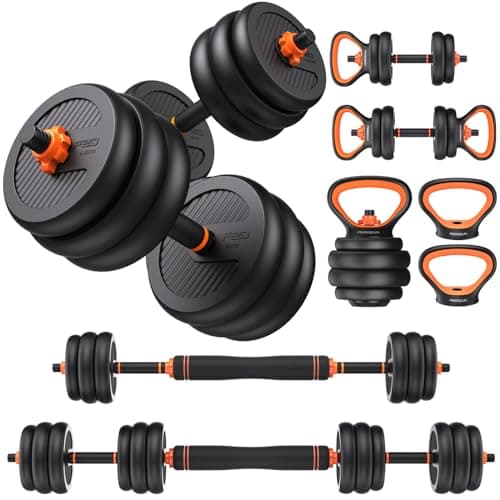
The budget convertible. A load-the-plates set that tops out around 45 lb and converts into a barbell, kettlebell and push-up stand — a lot of function for very little money, as long as you do not mind swapping plates by hand.
Weight range
6
Increments
6
Build
6
Footprint
8
Value
9
Feel
6
Pros
+One of the cheapest ways to own a real adjustable load
+Converts between dumbbell, barbell, kettlebell and push-up stand
+PE-shelled plates filled with iron sand are quiet and floor-friendly
+Compact enough to stash in a closet or under a bed
Cons
−You change weight by unscrewing and swapping plates — slow between sets
−Plastic-shelled plates and an ABS handle do not feel like solid iron
−Confirm the configuration on the listing — this is a load-set, not a matched heavy pair
Don't buy this if…
…you want fast between-set weight changes or a premium, all-metal feel — the Bowflex dial is the upgrade.
5-100 lb per hand200 lb total5 lb incrementsBaked-enamel cast iron
7.2/10
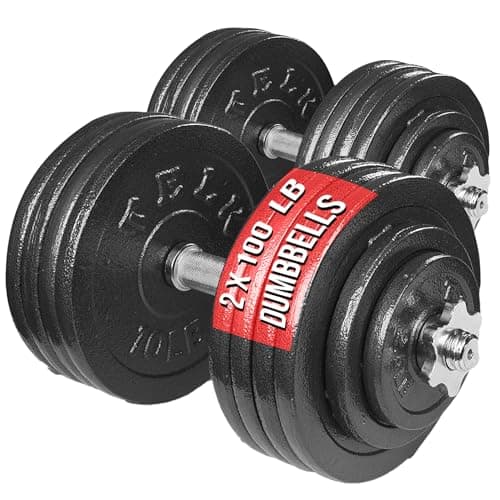
The most iron for your money, full stop. Two handles plus a pile of baked-enamel cast-iron plates that load to a full 100 lb per dumbbell, in 5 lb steps. Tanky, dense, and it feels like a real dumbbell — you just do the loading yourself.
Weight range
10
Increments
5
Build
9
Footprint
4
Value
8
Feel
7
Pros
+Loads to 100 lb per dumbbell — nearly double the dial winner's ceiling
+Roughly half the cost per pound of the Bowflex for the same money
+Baked-enamel cast iron resists rust and chipping, with nothing to break
+1.15in plates and handles are heavier-duty than thin 1in budget sets
Cons
−Changing weight means loosening collars and swapping plates every time
−A stack of 200 lb of loose plates takes real floor space and stays messy
−1.15in plates are not the standard 1in size, so generic plates will not fit
−No barbell conversion rod — this is a dumbbell-only set
Don't buy this if…
…you want to change weight in seconds or keep a tidy, single-piece setup — the loading and the loose plates will wear on you.
If total iron is your metric, nothing here comes close to a plate-loaded set. You get two handles and enough baked-enamel cast iron to build a pair of dumbbells up to 100 lb each, adjustable from 5 lb upward in 5 lb steps, held on with spin-on collars. It feels like real gym iron because it is real gym iron, and it costs roughly half per pound what the dial winner does. The tax you pay is time and tidiness: every weight change is a hands-on plate swap, the steps are 5 lb rather than the Bowflex's 2.5, and the leftover plates live in a heap on your floor. Note too that the plates are a 1.15-inch bore rather than the standard 1-inch size, so you cannot top the set up with generic plates. We break the two philosophies down in adjustable vs fixed dumbbells.
~44 lb total5-in-1 convertibleQuick-lock platesFoam-wrapped bar
6.0/10
The do-everything compact kit. A ~44 lb convertible set that becomes dumbbells, a barbell, a kettlebell, push-up stands and loose weight plates, with a connecting bar. Good for a beginner in a tiny space who wants one box that covers the basics.
Weight range
5
Increments
6
Build
5
Footprint
8
Value
7
Feel
5
Pros
+Five tools in one box — dumbbells, barbell, kettlebell, push-up stands, plates
+Quick-lock plate collars are faster than threaded spin-locks
+Foam-wrapped connecting bar is comfortable for presses and rows
+Small and light enough to live in an apartment closet
Cons
−About 44 lb total caps you fast once you get stronger
−PE plates filled with cement and iron sand are the least premium feel here
−Generic build quality varies — check recent buyer photos before you commit
Don't buy this if…
…you expect to progress past light-to-moderate weights soon — you will outgrow 44 lb and want more iron.
38 lb totalThreaded collars2.5 & 5 lb platesCarry case
6.5/10
The cheapest way in. A 38 lb spin-lock set — two handles, a spread of 2.5 and 5 lb plates, and a carry case. Light-duty and slow to change, but it is a real, honest starter set for less than almost anything else that works.
Weight range
5
Increments
7
Build
6
Footprint
7
Value
8
Feel
6
Pros
+About as low as the price of functional weights goes
A note on what dumbbells are not: they load specific muscles through a specific range, which is what builds strength, and they do nothing for the walking you already do. The complementary purchase there is a weighted vest— load you wear rather than hold, and a far cheaper way to make bodyweight work harder.
Ignore the marketing photos and judge an adjustable dumbbell on four numbers. Weight range is the obvious one: 5 to 52.5 lb a hand (the Bowflex) suits most beginners through intermediates, while a plate-loaded set that reaches ~100 lb a hand serves anyone doing heavy rows or Romanian deadlifts. Increment size is the one people underrate — small 2.5 lb jumps let you add weight gradually and keep progressing, whereas a set that only moves in 10 lb steps stalls you or forces ugly form — if your working weights are under 25 lb, that spec matters more than any other, and our best adjustable dumbbells for women ranks the same category on the light end. Footprint is why you are buying adjustable at all: a dial pair replaces up to 15 sets in a shoebox, a selector block replaces 16 in less space again, a plate set spreads a pile of iron across your floor. And the mechanism — dial, block or plates — sets everything else.
The three mechanisms, and what each one costs
A dial selector (Bowflex SelectTech, Nuobell) changes weight in a second by turning a knob or the handle itself so it picks up the right plates from a cradle. A selector block (PowerBlock) has you pull a magnetic pin and reseat it lower in a stack — a beat slower than a dial, and the only design that expands later. A plate-loaded set (TELK, FEIERDUN, Amazon Basics) makes you loosen a collar, add or remove iron, and re-tighten: a slower, hands-on ritual.
The honest tiebreaker is cost per pound, and it is not close. Plate sets deliver far more weight for the same money because you are paying for cast iron, not a mechanism. Selector blocks sit in the middle, which is why PowerBlock is the value pick among the quick-change designs. Dial systems charge a real premium for convenience and compactness, and at the top of the dial tier — the Nuobell's 80 lb a hand — you are paying roughly double a 52.5 lb dial set for 27.5 lb more per hand. Neither approach is wrong; you are buying different things.
Weight ranges: what each tier actually puts in your hand
Per-hand weight, not total set weight, is the number that decides whether a set can train you. Marketing loves the total — “200 lb set!” — because it sounds twice as impressive as the truth. Here is what the tiers on this page really give you for one hand:
Up to ~19 lb a hand. A 38 lb spin-lock starter set (Amazon Basics). Fine for shoulders, arms and rehab; a warm-up weight for rows, presses and goblet squats. You will outgrow it.
Up to ~22 lb a hand. The compact 4-in-1 and 5-in-1 convertibles (FEIERDUN, the 5-in-1 kit), where the advertised 44-45 lb is the total across both handles or a single loaded bar. Genuinely useful in a flat, genuinely limiting within a year.
5-50 lb a hand. PowerBlock Stage 1 — the point at which a set covers real compound work for most beginners and intermediates, with 2.5 lb steps available at the bottom.
5-52.5 lb a hand. The Bowflex 552, and the range most home lifters never exhaust. 2.5 lb increments up to 25 lb, then 5 lb steps.
5-80 lb a hand. The Nuobell 580 in 5 lb steps, or PowerBlock with the Stage 2 kit at 70 lb and Stage 3 at 90 lb. This is the tier for heavy rows, Romanian deadlifts and single-arm pressing.
5-100 lb a hand. Only the plate-loaded TELK set gets here, in 5 lb steps, and it does it for less money than the 80 lb dial set — you just load it by hand every time.
The practical rule: buy for the heaviest lift you will realistically do in one hand within two years, not for the number on the box. For most people that is somewhere between 40 and 55 lb a hand, which is why the 52.5 lb dial tier is the default answer and the 80 lb tier is a specialist one.
Budget tiers: what your money actually buys
Every price on this page is pulled live and date-stamped in the table above rather than typed here, because these move weekly. What does not move is the shape of the tiers, and knowing which one you are shopping in saves more money than hunting a discount.
Under about $60 — the honest starter. A spin-lock set with a case, roughly 19 lb a hand. Threaded collars, slow changes, chip-prone plates. It is real, functional weight and nothing more.
About $80 to $110 — the compact convertible. PE-shelled plates filled with iron sand, a connector bar, kettlebell and push-up attachments. You are buying versatility and a tiny footprint, not load or feel.
The high $300s — and here the road forks. This is the most interesting bracket on the page, because the same money buys two completely different things. Spend it on plate-loaded cast iron and you get roughly 100 lb a hand — the lowest cost per pound anywhere here, paid for in loading time and floor clutter. Spend it on a dial set or a selector block and you get 50 to 52.5 lb a hand that changes in a second or two. Half the weight, or a fraction of the faff: that is genuinely the decision, and most home lifters should take the quick change.
Around $700 and up — the premium dial. 80 lb a hand, knurled aluminum, and the best feel of any adjustable dumbbell. The worst cost per pound here by a wide margin, and correct only if you genuinely lift into the 60s and 70s.
How to think about cost per pound without a price tag
We never quote prices in the prose here (they move daily — check the live price on each pick), but you can reason about value qualitatively. Picture three buckets. Plate-loaded sets sit in the low cost-per-pound bucket: you get the most total iron per dollar, at the price of slow changes and clutter. Selector blocks sit in the middle: quick-ish changes, the smallest footprint, and an upgrade path instead of a replacement. Dial systems sit in the high cost-per-pound bucket: you pay noticeably more for each pound, and in return you get seconds-fast changes and the best feel in home fitness. Decide which of those you are actually paying for. If your gym is a corner of a bedroom and you value quick sets, the premium is rational. If it is a garage and you have floor to spare, buy the iron. For the full decision framework, read adjustable vs fixed dumbbells, and if you are building a first setup, start with our beginner home-gym kit.
How we picked
We did not lab-test this gear
Everyone in this category says they tested twenty products. We have not lab-tested any of these, and we say so. What we did instead: compiled the published specifications, pulled the numbers from the manufacturer manuals, ran the cost-to-run and cost-per-unit math where there was math to run, and scored each product against a published rubric. The scores are judgments from documented research — not measurements we took, because we do not have a lab and we will not pretend we do. Where a number came from someone else's work, we name them in Sources.
Questions
Frequently asked
Are adjustable dumbbells as good as fixed ones?+
For home training, yes — the resistance is identical iron either way. Fixed dumbbells feel slightly more natural and change instantly, but they cost more and eat a wall. Adjustable pairs trade a little bulk and a beat of change time for a fraction of the space. We compare them directly in adjustable vs fixed dumbbells.
What weight range should a beginner get?+
A pair that spans roughly 5 to 50 lb per hand covers almost everyone starting out. You want light enough for shoulder and arm work and heavy enough for rows, goblet squats and presses. The Bowflex 552's 5 to 52.5 lb range is a good template.
Why do small increments matter?+
Because strength climbs slowly. Being able to add 2.5 lb at a time lets you progress a lift without a form-wrecking jump. Sets that only move in 5 or 10 lb steps either stall you or push you into weight you cannot control cleanly, especially for smaller muscles.
Are dial adjustable dumbbells worth the extra money?+
If space and speed matter to you, yes. You pay a real premium per pound for a dial system, but you get seconds-fast weight changes and a footprint the size of a shoebox. If you have floor space and want maximum iron per dollar, a plate-loaded set is the smarter buy.
What is the heaviest adjustable dumbbell you can buy?+
Among quick-change designs, 80 lb a hand — the Nuobell 580 in 5 lb steps, or a PowerBlock taken to 70 lb with the Stage 2 kit and 90 lb with Stage 3. Plate-loaded sets go higher for less money: the TELK set here loads to a full 100 lb per dumbbell. The trade is that you load the plates by hand every time, and the quick-change sets at this ceiling cost roughly double a 52.5 lb pair.
PowerBlock or a dial set — which should I buy?+
Buy the PowerBlock if footprint and an upgrade path matter most: it is the smallest dumbbell here, the 2.5 lb adder weight gives fine low-end steps, and Stage 2 and 3 kits raise the ceiling later instead of forcing a replacement. Buy a dial set if the feel of the weight in your hand matters, because your hand goes around a bar rather than inside a cage. That is genuinely the whole decision, and both are correct answers.
How much should I spend on adjustable dumbbells?+
Most home lifters should shop the quick-change bracket — a dial set to 52.5 lb a hand or a selector block to 50 lb a hand — because that is where speed, footprint and a range you will not outgrow all meet. Spend less and you get real but limited weight (roughly 19-22 lb a hand at the starter end). Spend far more and you are buying an 80 lb ceiling and a nicer handle, which is the right call only if you already lift into the 60s. The live prices on each pick above are pulled daily.
Can you drop adjustable dumbbells?+
Avoid it. Dial and twist mechanisms especially are not built to be dropped — the plate-selection mechanism can crack or misalign, and the Nuobell warranty explicitly excludes drops and slams. Set them down under control. Plate-loaded cast iron is tougher, but dropping loose plates still risks your floor and your toes.
We do not run a testing lab, and we do not pretend to. Where a measured number came from someone else's work, we name them and link them. Where we could not verify something, we say so on the page rather than quietly leaving it out. Read our full method.