A dumbbell set is the unglamorous answer to home strength training and, for a lot of people, the right one. There is no mechanism to fail, no dial to turn between sets, nothing that objects to being set down hard, and the pair you want is always sitting there at the weight you want. What you pay for that is floor space and, at the heavier end, a surprisingly large sum of money.
This page is deliberately separate from best adjustable dumbbells. That page covers selectorized pairs that replace a rack; this one covers fixed sets with a rack and plate-loaded sets you assemble by hand. If your constraint is space, buy adjustable. If your constraint is patience, durability or drop tolerance — or you already have a garage — buy a set. The trade-off in full is in adjustable vs fixed dumbbells.
Ranked below on usable weight range, storage (a set without a rack is a tripping hazard, not a gym), and price per pound, which is the only honest way to compare sets that differ by hundreds of pounds of iron.
Set or adjustable? The two-question test
Do you have a permanent space you can leave equipment in? If no, buy adjustable and stop reading. Do you change weight often within a session? If yes, buy a fixed set or a fast selectorized pair, and specifically not a plate-loaded one. Those two questions settle it for almost everyone. Cost is a poor tiebreaker, because a large fixed set and a good adjustable pair land in similar territory.
Head shape and coating matter more than you think
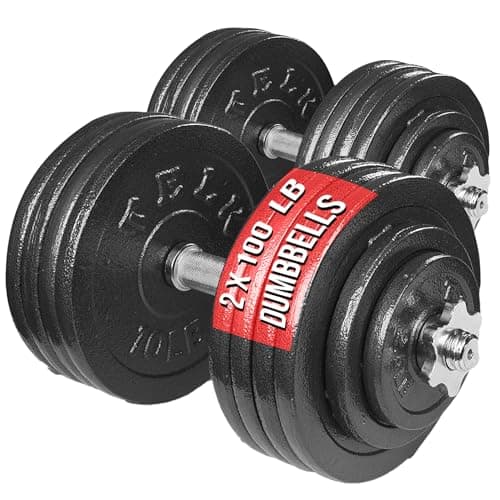
Hex heads do not roll, which sounds trivial until you have chased a dumbbell across a garage. They also stand steady for renegade rows and push-up positions. Rubber coating protects your floor, reduces noise — genuinely relevant in a flat — and is kinder when a dumbbell taps a shin. Neoprene is best at the light end for grip comfort. Bare cast iron is cheapest, loudest and hardest on floors. For most homes, rubber hex is the correct answer.
Do not buy a set without a rack
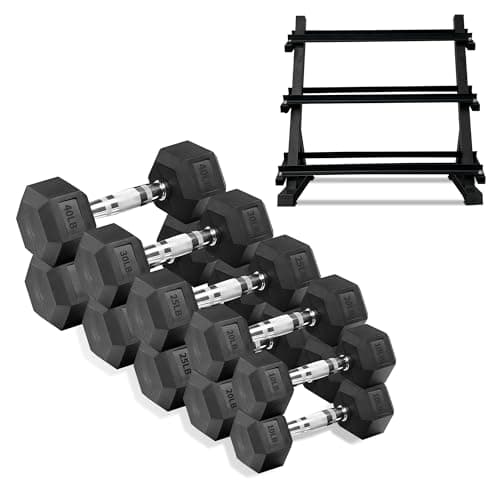
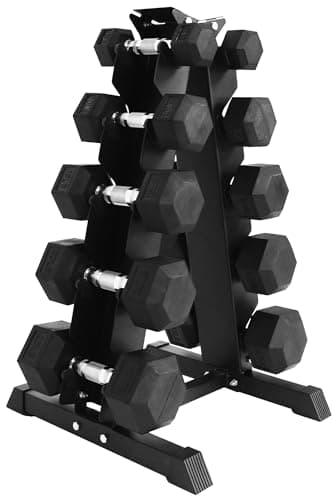
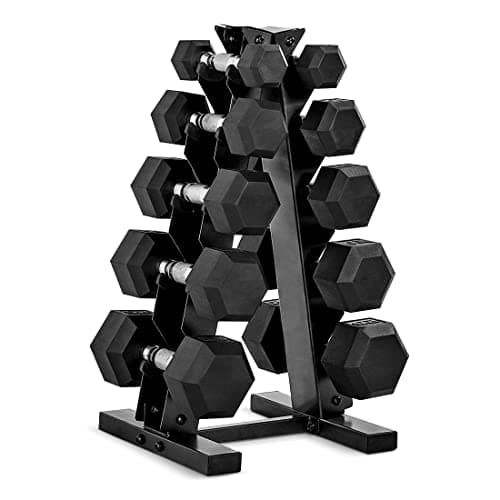
This is the most common regret in the category. A set on the floor spreads, gets kicked, becomes a hazard in a dark room, and makes the space unusable for anything else. Racks bought separately often cost as much as the discount you saved. If a set includes an A-frame or tiered rack, that is worth real money.
What weights do you actually need?
For a general strength program, most people use a surprisingly narrow band: a light pair for shoulders and rehab, a medium pair for rows and presses, and a heavy pair for squats, lunges and hinges. Pairs at roughly 10, 20, 30 and 40 lb cover an enormous amount of training, and the jump most beginners actually need is between the medium and the heavy end rather than at the extremes. That is why a 150 lb set spread across pairs is enough for most people and a 250 lb set is a strength-athlete purchase. If most of your training sits in the light pair, the finer steps of an adjustable set matter more than a rack — our best adjustable dumbbells for women ranks those on starting weight and increment size.
Where a set beats everything else
Drop tolerance. A cast-iron or rubber hex dumbbell does not care if you set it down hard at the end of a brutal set. A selectorized dumbbell very much does — that is the single biggest practical argument for fixed weights, and it is the reason we send garage-gym owners this way and apartment owners the other way in home gym for small spaces.
Speed. A pair on a rack is instantly available at the weight you want. Supersets, drop sets and circuits work properly, and no session is interrupted by a dial. For anyone training with density or intensity techniques, that is worth the floor space by itself.