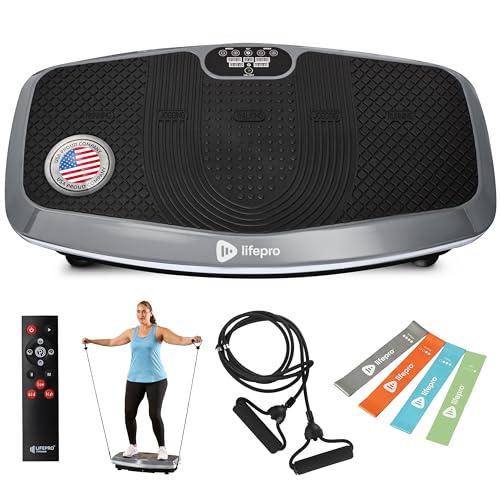
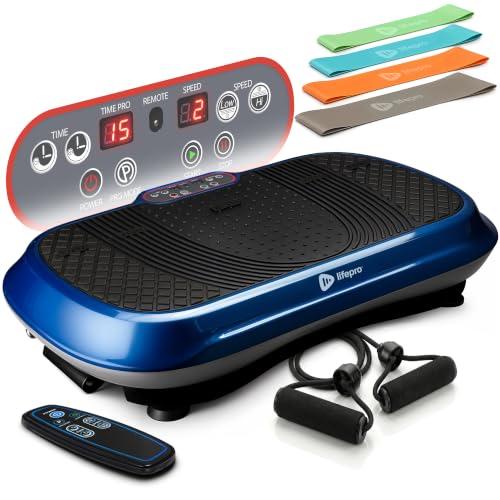
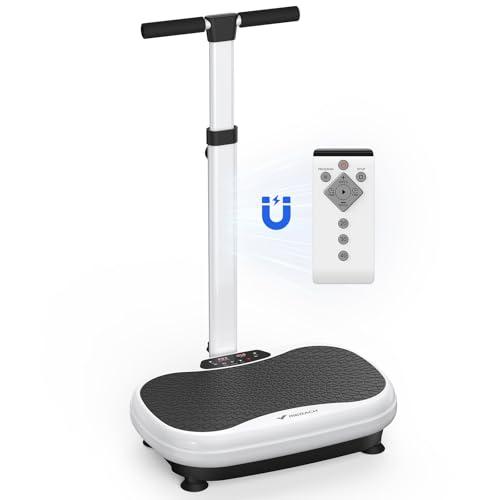
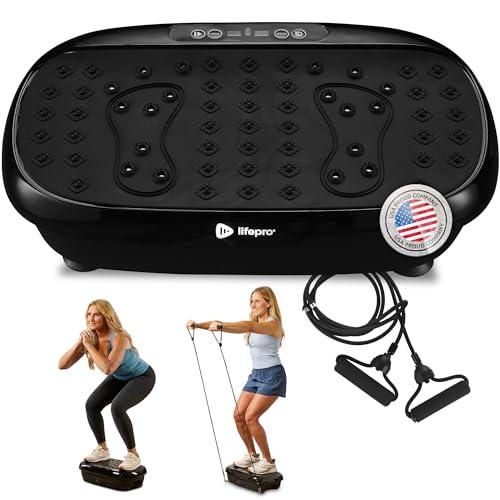
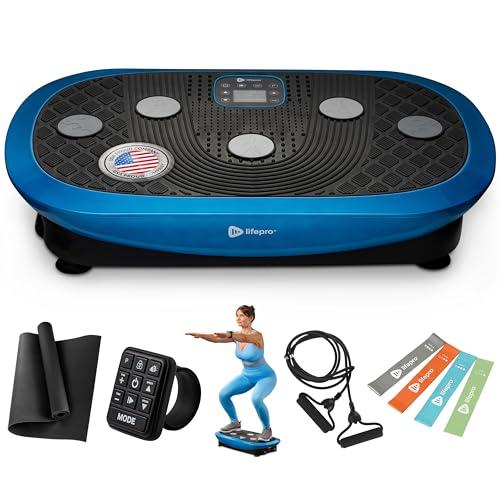
The vibration plate to buy is the Lifepro Rumblex Plus 4D. It is the only pick here that publishes a frequency range reaching 40 Hz— the part of the range the strength research actually used — and the only one rated for a 500 lb user. If that is more machine than you need, the Hovert 3Dgives you two motors and a published 4–15 Hz range for considerably less. If you cannot stand on a moving platform without holding something, go straight to the MERACH plate with the handleand ignore the rest of this ranking — support is a gate, not a preference. The budget pick is the Lifepro HexaPlate Lite, which is a quarter of the winner's price and honest about being a light, compact oscillating plate.
This is the most oversold shelf on the site. Open any vibration plate listing and you will be told it does lymphatic drainage, weight loss, body toning and shaping, usually in the product title itself. None of those words is a specification, and we are not going to repeat them as if they were. What a vibration plate actually is: a motorized platform that moves under your feet fast enough that your muscles fire reflexively to keep you upright. That is a real stimulus, it is genuinely low-effort, and it has been studied — and what the studies found is narrower and more interesting than the marketing.
The research, in one paragraph. A 2011 systematic review and meta-analysis of randomized trials in older adults found whole-body vibration beneficial for leg muscle strength, with statistically significant pooled effects on knee-extension strength and jumping height — and nooverall effect on bone mineral density in older women. A separate review of older people found vibration improved knee strength, power and balance against control groups, but that those effects largely disappeared when vibration was compared against conventional exercise rather than against doing nothing. An updated meta-analysis of 14 randomized trials and 1,447 participants reported statistically significant bone-density gains at Ward's triangle and the greater trochanter, smaller at the femoral neck, mostly as small mean differences. So: a plate is a plausible way to add a strength and balance stimulus for somebody who is not otherwise training, it is not better than training, and nothing in that literature is about losing weight or draining lymph.
Which makes the ranking axis obvious: published frequency range in Hz. Frequency is how many times a second the platform completes its cycle, and it is the spec that decides whether a plate can produce the effect the research describes at all. It is also the spec almost nobody prints. Instead you get a speed count — 55 speeds, 99 speeds, 120 levels — and a speed count tells you how many positions the dial has, not where the top of the dial is. Two plates can both advertise 99 speeds while one tops out at 12 Hz and the other at 40 Hz. One of those is a relaxation device and the other is a training device, and the listings read identically.
Ranked below on published frequency range first, published user-weight capacity second (a structural limit, not a suggestion), stability and supportthird, and footprint and price last. Every figure on this page comes from the maker's own published specification or the live Amazon listing, and where a maker does not publish a frequency range we say so and mark the plate down for it. If you want the low-impact machine that the evidence base is much stronger for, read best home cardio machines; if the reader here is an older adult, our best fitness equipment for seniors list ranks the same job on joint load and safe solo use.
Frequency, amplitude and the speed-count trick
Three numbers describe what a vibration plate physically does, and the listings consistently give you a fourth one instead.
Frequency (Hz)is cycles per second — how fast the platform completes its movement. It is the number that decides whether the plate produces the reflexive muscle activity the research is about. On this page the published ranges run from 4–12 Hz at the gentle end to 4–40 Hz at the top, and that is a difference in kind, not degree.
Amplitude (mm)is how far the platform travels in each cycle. Only one pick here publishes it (the Waver, at 0–8 mm). Frequency and amplitude together determine the acceleration your body actually experiences, which is why a plate that publishes neither is effectively unspecified.
Motor count and motion type describe the pattern. A single-motor oscillating or pivotal plate rocks around a central axis, so your feet move in opposite directions. A second motor adds lateral or linear movement; a third adds pulsation, and combinations of the three are what gets sold as “3D” and “4D.” More motors means more variety. It does not mean more evidence — the published trials used plain vibration at a stated frequency.
Speed levels— 55, 60, 99, 120 — is the number you will actually be shown, and on its own it means nothing. It counts dial positions inside a range the listing has not told you. Ninety-nine levels across 4–12 Hz and ninety-nine levels across 4–40 Hz are different machines wearing the same number. When a plate advertises a speed count and no frequency range, assume the range is modest, because a maker with 40 Hz to brag about tends to brag about it.
Published user-weight capacity is a structural limit
This is the spec most often discovered after delivery, and on a vibrating machine it matters more than it does on a bench. The frame, the bearings and the motor mounts are being cyclically loaded thousands of times a session; the stated capacity is what that assembly is built to survive, not how much weight will fit on the deck.
The figures on this page are 500 lb (Rumblex Plus 4D), 330 lb (Hovert 3D, Waver, MERACH) and 260 lb (HexaPlate Lite). Check yours against the plate before you order, and leave margin rather than sitting at the number.
One category-specific warning. Capacity figures get copied between models within a product family: retailer pages for the Rumblex Plus 4D variously state 330 lb and 500 lb, and the 330 lb figure belongs to the older, non-Plus Rumblex 4D. Where two sources disagree, the maker's own support documentation is the one to trust, and the specific listing you are buying is the one to read.
What a vibration plate does not do
It does not drain your lymphatic system. This phrase appears in the product title of nearly every plate on Amazon and it is marketing language, not a published mechanism or a cleared claim. We are not repeating it as a benefit, and no plate on this page was ranked up or down because of it.
It does not cause weight loss. Standing on a plate burns very little; the calorie arithmetic is not close. If body composition is the goal, the useful levers are diet and the kind of sustained activity the home cardio machines on this site deliver.
It does not replace exercise.This is the finding most worth knowing: the review evidence shows vibration beating a do-nothing control group on knee strength, power and balance, and those advantages largely disappearing against a group doing conventional exercise. A plate is a reasonable option for somebody who is not otherwise training, and a poor substitute for somebody who is. The CDC's adult guidance — 150 minutes a week of moderate aerobic activity plus muscle-strengthening twice a week — is the target a plate contributes to, not one it satisfies. The other passive device sold on similar language is the spike mat, and we put it through the same test in best acupressure mats— cheap, low-risk, pleasant, and not what the listing says it is.
It does not reliably build bone on its own.The bone-density evidence is mixed: one meta-analysis found no overall effect in older women, a more recent one found statistically significant but small gains at some hip sites, and most of those comparisons are against conventional exercise rather than against nothing. If bone is your reason for shopping, that is a conversation with a clinician, and loaded standing and stepping work — including the kind we cover in best weighted vests— has a clearer literature behind it.
Who should not use one, and how to start
Whole-body vibration has a long contraindication list, and it is not consistent between sources, which is itself the reason to ask rather than guess. Lists published in clinical reviews and trial protocols variously include acute thrombosis, cardiac arrhythmia, untreated hypertension, an implanted pacemaker, pregnancy, epilepsy, acute inflammation or infection, recent fractures, recent surgery or joint replacement, implanted pins and plates, severe osteoporosis, neuropathy, inner-ear or dizziness problems, kidney stones and tumors. Headaches and dizziness are the commonly reported minor effects. If any of that describes you, the answer is a clinician's, not a shopping page's.
For everyone else, the sensible starting protocol is short and low: five to ten minutes at the bottom of the plate's range, knees softly bent rather than locked (a straight leg transmits vibration up into your spine and head, which is where the headaches come from), barefoot or in thin shoes, holding something for the first few sessions. Build time before you build intensity. Most presets run far longer than you need at the start; a timer and your own judgment beat the program.
Put it on a mat
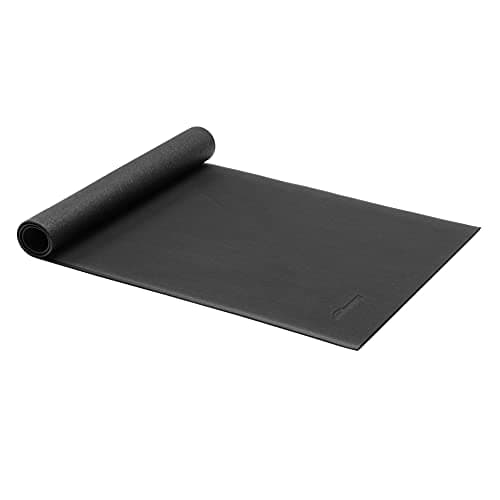
A plate on bare boards transmits every cycle into the structure of the building, which is both a noise problem in an apartment and a wear problem for the floor. A mat under the platform deals with both and costs a small fraction of any plate here — it is the same mat we rank in best exercise mats, and it is the one accessory this category genuinely needs.