Skip to content
Rep & Recovery

Strength · Home Gym

The best exercise mats and gym flooring, ranked by what goes on top

Thicker is not better. The mat that feels best under a plank is the wrong mat under a squat, and the one that survives a dropped dumbbell is not the one you want under a treadmill. Buy for the load, not the cushioning.

By Stephen V.Updated How we review
#ad

We earn a commission when you buy through our Amazon links, at no extra cost to you. It never changes a verdict, and we say so when the cheaper product is the better buy. How this works.

For most home gyms the right answer is a 1/2-inch interlocking EVA puzzle set, and the BalanceFrom 48 sq ft box is the one to buy. It is enough padding for floor work and kneeling, firm enough to stand and press on, cheap enough to cover a real training area, and it comes up again in ten minutes when you move. Buy something different only when the thing going on top of it is different: a rubber-topped tile if dumbbells are going to land on it, a single solid mat if a treadmill or a bike is going on it, a thick folding mat if the floor is where you actually train.

This is the cheapest purchase in the whole home-gym category and the one people get wrong most often, because the listings all compete on thickness and thickness is a trade rather than an upgrade. Four questions decide it.

  • What is going on top?Bodyweight work wants cushioning. A loaded barbell, a rack or a bench wants the opposite — a stable, firm surface that does not let the feet or the posts sink. A treadmill wants mass and grip, not padding. Dropped iron wants a surface that will not tear. These are four different products and no single mat is good at all of them.
  • Thickness versus stability. A 1-inch foam tile is lovely to kneel on and genuinely worse to squat on: your feet compress it unevenly, the platform moves under load, and the balance you are trying to train gets noisier. Go thick where the work is on the floor, stay at 1/2 inch or less where the work is standing with weight in your hands.
  • Surface material.Bare EVA foam is light, warm, quiet and soft enough to dent permanently under a point load — a bench foot, a rack post, the corner of a dumbbell. A rubber-topped tile costs two to three times as much and does not. Solid poly foam equipment mats sit between the two and are built to be stood on by a machine rather than a person.
  • Coverage per dollar, and the tile math.48 sq ft of 24 x 24 in tiles is twelve tiles and covers roughly 6 x 8 ft — a realistic one-person training area. Order area first and brand second, because a half-covered floor is the most common complaint on this shelf and the cheapest thing to avoid.

The warning that is not on any mat listing

If you are laying anything over luxury vinyl plank or sheet vinyl, read the care guidance for your floor before you order. Sherwin-Williams' vinyl floorcovering care guidance is explicit under its own heading — "Avoiding rubber- or latex-backed mats" — that "mats with these types of backing surfaces should be avoided" because they "can eventually create permanent stains on vinyl flooring." That staining is a chemical interaction rather than dirt: it does not clean off, and on a floor you like it is a worse outcome than the scuff you were trying to prevent.

The practical rule: on vinyl, check your flooring manufacturer's own care guide and prefer a mat the manufacturer describes as non-staining; on hardwood, laminate, tile or concrete, the mats on this page are the normal answer. Either way, lift the mat occasionally — anything trapping moisture against a floor for months is a problem in its own right.

Scores below are judgments from published specifications and aggregated owner feedback, not lab testing — see how we review. Prices are pulled live and stamped with the date they were checked. If you are still deciding what goes in the room at all, home gym for beginners sets the shortest useful list and home gym for small spaces works the footprint problem properly.

The short answer

Quick picks

#ProductBest forScorePrice
01
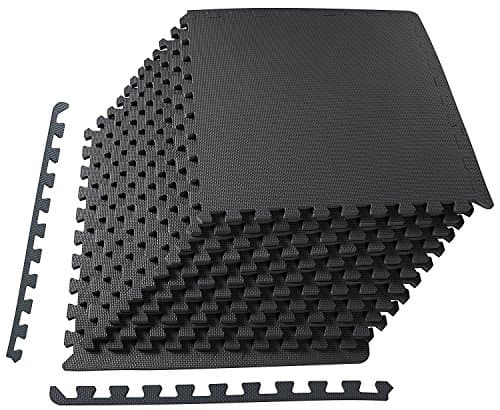
BalanceFrom BalanceFrom Puzzle Exercise Mat, 1/2 in (48 sq ft, 12 tiles)
BalanceFrom Puzzle Exercise Mat, 1/2 in (48 sq ft, 12 tiles)

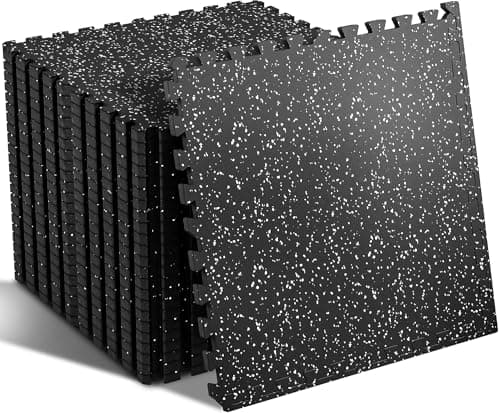
The default home-gym floor: twelve 24 x 24 in EVA tiles at 1/2 inch, covering about 6 x 8 ft for the price of a pair of resistance bands. Soft enough for floor work, firm enough to stand and press on, and it comes up in ten minutes when you move.

Best overall
7.8
$36.99Amazon
02
SUPERJARE SUPERJARE Rubber-Top Gym Flooring, 0.56 in (48 sq ft, 12 tiles)
SUPERJARE Rubber-Top Gym Flooring, 0.56 in (48 sq ft, 12 tiles)

The pick the moment iron is involved. A rubber wear layer bonded to high-density EVA, which is the combination that survives a dropped dumbbell, a rack post and a loaded bench without the dents and tears bare foam collects within a month.

Best for free weights
8.4
$119.99Amazon
03
Marcy Marcy Fitness Equipment Mat and Floor Protector (78 x 36 x 0.25 in)
Marcy Fitness Equipment Mat and Floor Protector (78 x 36 x 0.25 in)

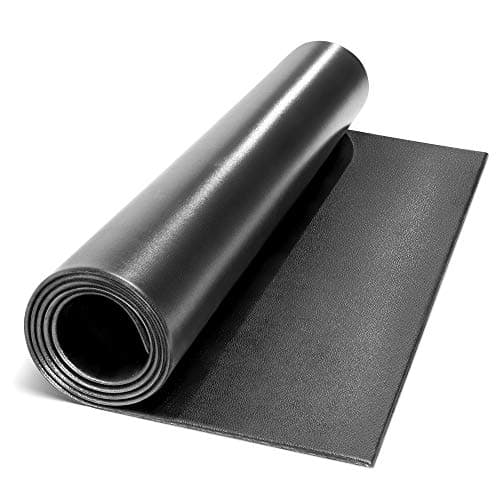
The right shape for a cardio machine: one solid 78 x 36 in sheet rather than tiles, so there are no seams for a treadmill to walk apart. Marcy sells this family on protecting hardwood, tile and carpet and on damping the noise and vibration a machine puts into a floor.

Best for treadmills and bikes
7.6
$42.29Amazon
04
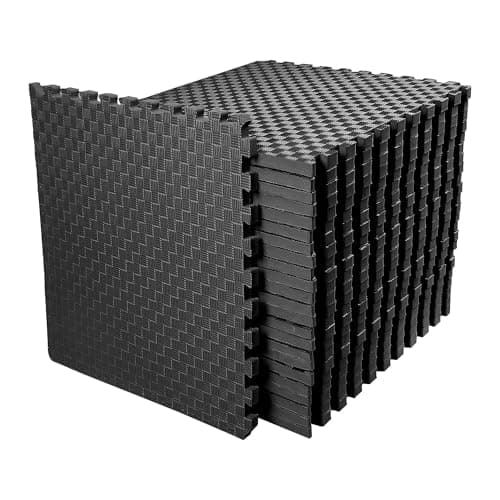
BalanceFrom BalanceFrom Puzzle Exercise Mat, 1 in (72 sq ft, 18 tiles)
BalanceFrom Puzzle Exercise Mat, 1 in (72 sq ft, 18 tiles)

The thick option, and the one to buy when the floor is the apparatus: jump landings, tumbling, kids, knees that hate concrete. Eighteen 24 x 24 in tiles at a full inch covers about 72 sq ft - and the same inch that saves your knees is what makes it the wrong floor for heavy standing work.

Best for impact and large areas
7.0
$99.99Amazon
05
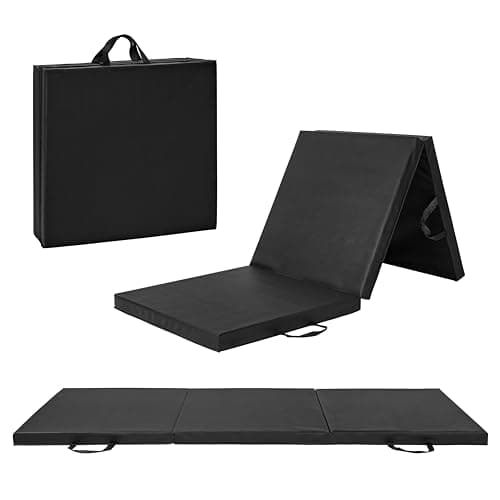
CAP Barbell CAP Barbell Folding Exercise Mat (72 x 24 x 2 in)
CAP Barbell Folding Exercise Mat (72 x 24 x 2 in)

Not flooring at all, and on this page deliberately: a 2-inch folding mat for the floor work that a 1/2-inch tile does not make comfortable. Full body length, folds away against a wall, and it is the cheapest upgrade to stretching, core work and physical therapy homework you will find.

Best for floor work and stretching
5.2
$36.97Amazon
06
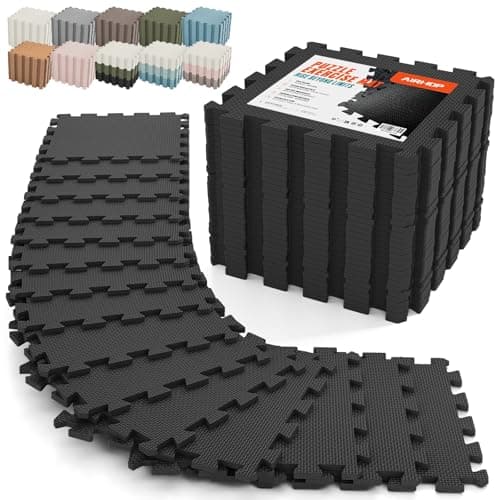
AIRHOP AIRHOP Gym Floor Mat, 0.4 in (12.6 x 12.6 in tiles)
AIRHOP Gym Floor Mat, 0.4 in (12.6 x 12.6 in tiles)

The cheapest way to put something between your knees and a concrete floor. Small 12.6 in tiles at 0.4 inch, which is the lowest spend on this page and the right experiment if you are not yet sure the corner of the garage is where you will actually train.

Best budget
6.4
$19.99Amazon

#ad · Live prices from the Amazon Product API, as of October 31, 2026. Where we have no verified live price, we show none — a gap beats a number that has rotted.

In detail

The picks, in full

01
BalanceFrom BalanceFrom Puzzle Exercise Mat, 1/2 in (48 sq ft, 12 tiles)

Best overall

BalanceFrom Puzzle Exercise Mat, 1/2 in (48 sq ft, 12 tiles)

24 x 24 in tiles1/2 in thick48 sq ft, 12 tilesInterlocking EVA
7.8/10

The default home-gym floor: twelve 24 x 24 in EVA tiles at 1/2 inch, covering about 6 x 8 ft for the price of a pair of resistance bands. Soft enough for floor work, firm enough to stand and press on, and it comes up in ten minutes when you move.

Equipment load
6
Stability underfoot
8
Floor protection
8
Coverage per dollar
10
Durability
7

Pros

  • The best thickness compromise on the shelf - padded for kneeling, still stable under a standing press
  • 24 in tiles mean fewer seams than the 12.6 in sets, which is what keeps a floor flat under movement
  • 48 sq ft is a genuine one-person training area rather than a token square
  • Lifts, stacks and reconfigures in minutes, which matters in a shared room

Cons

  • Bare EVA dents permanently under point loads - bench feet, rack posts and dumbbell corners
  • Seams can creep apart under lateral work unless the edges are boxed in by walls or trim pieces
  • Fresh EVA has a smell for the first few days and wants a window open
  • Not what you want under a treadmill, where mass and grip beat padding

Don't buy this if…

…you are going to drop dumbbells on it - foam tears where rubber shrugs, and the SUPERJARE set below is the honest answer for free weights.

The reason this wins is that 1/2 inch is the one thickness that does not force a choice. At 1/4 inch you feel the floor through your knees; at 1 inch you feel the floor move under your feet. In between, a plank is comfortable and a standing dumbbell press is still stable, which covers most of what happens in a home gym.

Two installation details are worth knowing. First, lay it inside something— a wall on two sides, or the included border pieces — because unconstrained puzzle edges are what drift apart. Second, foam takes a set: leave the tiles out flat for a day before you judge them, and expect permanent dimples anywhere a heavy point load sits for weeks. If a bench or a rack is going to live in one spot, put a plywood offcut or a rubber tile under its feet and keep the foam for the rest of the floor.

$36.99View on Amazon

$39.998% off

Price as of October 31, 2026. Prices change — Amazon's at checkout is the one that counts.

#ad · we may earn a commission from this link to BalanceFrom Puzzle Exercise Mat, 1/2 in (48 sq ft, 12 tiles)

02
SUPERJARE SUPERJARE Rubber-Top Gym Flooring, 0.56 in (48 sq ft, 12 tiles)

Best for free weights

SUPERJARE Rubber-Top Gym Flooring, 0.56 in (48 sq ft, 12 tiles)

Rubber top, EVA core0.56 in thick48 sq ft, 12 tiles24 x 24 in tiles
8.4/10

The pick the moment iron is involved. A rubber wear layer bonded to high-density EVA, which is the combination that survives a dropped dumbbell, a rack post and a loaded bench without the dents and tears bare foam collects within a month.

Equipment load
9
Stability underfoot
9
Floor protection
9
Coverage per dollar
6
Durability
9

Pros

  • Rubber wear layer takes point loads and dropped weights that permanently mark bare EVA
  • High-density core means less squash underfoot, so a standing lift feels planted
  • The right floor under a rack, a bench or a dumbbell rack rather than just around them
  • Denser build damps noise into the floor below better than light foam does

Cons

  • Roughly three times the price of a bare EVA set for the same square footage
  • Heavy - a 48 sq ft box is a two-trip carry and awkward to reconfigure
  • Rubber has a stronger initial smell than EVA and takes longer to air out
  • Overkill if nothing heavier than a kettlebell will ever touch it

Don't buy this if…

…your training is bodyweight, yoga or bands - you are paying for abrasion resistance you will never test, and the BalanceFrom set is kinder to kneel on.

The failure mode this fixes is specific and cheap to avoid. Bare EVA is a closed-cell foam: a dumbbell corner landing on it compresses the cells past their recovery point, so you get a permanent crater, and a dumbbell edge landing on it tears the skin and then the tear spreads. A bonded rubber layer spreads that impact across the tile. That is the whole argument, and it is worth the premium only in the square footage where weights actually land.

Mixing sets is the smart buy. Rubber-topped tiles where the dumbbells and the kettlebells live, cheap EVA for the stretching and floor-work half of the room. Nobody needs 48 sq ft of rubber to do Romanian deadlifts in a 6 x 8 ft space.

$119.99View on Amazon

Price as of October 31, 2026. Prices change — Amazon's at checkout is the one that counts.

#ad · we may earn a commission from this link to SUPERJARE Rubber-Top Gym Flooring, 0.56 in (48 sq ft, 12 tiles)

03
Marcy Marcy Fitness Equipment Mat and Floor Protector (78 x 36 x 0.25 in)

Best for treadmills and bikes

Marcy Fitness Equipment Mat and Floor Protector (78 x 36 x 0.25 in)

78 x 36 in single sheet0.25 in thickPoly foam constructionFor treadmills, bikes, ellipticals
7.6/10

The right shape for a cardio machine: one solid 78 x 36 in sheet rather than tiles, so there are no seams for a treadmill to walk apart. Marcy sells this family on protecting hardwood, tile and carpet and on damping the noise and vibration a machine puts into a floor.

Equipment load
8
Stability underfoot
7
Floor protection
9
Coverage per dollar
6
Durability
8

Pros

  • One continuous sheet - nothing for a vibrating machine to shuffle out of alignment
  • 78 in long covers a full-size treadmill footprint, which 48 sq ft of 24 in tiles does awkwardly
  • Marcy states this family protects hardwood, tile and carpeted floors and helps eliminate machine noise and vibration
  • Thin and dense, which is exactly right under something with wheels and feet

Cons

  • At 1/4 inch it is floor protection, not cushioning - it is unpleasant to kneel or plank on
  • A mat damps vibration into the structure; it does not quiet a motor, a belt or a fan
  • Single-purpose: one machine-sized rectangle, no reconfiguring
  • Marcy's own product page for the shorter MAT-365 in this family carries a California Proposition 65 DEHP warning

Don't buy this if…

…the mat is for human floor work - 1/4 inch of foam under a knee is barely better than the floor, and the CAP folding mat below is the honest pick for that.

A treadmill is a machine that vibrates, sheds rubber dust and drips sweat for years in one spot. What it needs underneath is a continuous, dense, easy-to-wipe layer — not padding, which lets the frame rock. Tiles under a treadmill tend to creep apart at the seams over months of use, and a seam under a belt deck is where the whole thing starts to feel unstable.

Be realistic about noise. A dense mat reduces the vibration transmitted into the structure, which is the part your downstairs neighbors hear; it does nothing for the airborne sound of the motor, the fan and your footstrike. If quiet is the actual requirement, the machine choice matters more than the mat — which is the argument in best walking pads and walking pad vs treadmill.

$42.29View on Amazon

Price as of October 31, 2026. Prices change — Amazon's at checkout is the one that counts.

#ad · we may earn a commission from this link to Marcy Fitness Equipment Mat and Floor Protector (78 x 36 x 0.25 in)

04
BalanceFrom BalanceFrom Puzzle Exercise Mat, 1 in (72 sq ft, 18 tiles)

Best for impact and large areas

BalanceFrom Puzzle Exercise Mat, 1 in (72 sq ft, 18 tiles)

1 in thick72 sq ft, 18 tiles24 x 24 in tilesInterlocking EVA
7.0/10

The thick option, and the one to buy when the floor is the apparatus: jump landings, tumbling, kids, knees that hate concrete. Eighteen 24 x 24 in tiles at a full inch covers about 72 sq ft - and the same inch that saves your knees is what makes it the wrong floor for heavy standing work.

Equipment load
5
Stability underfoot
5
Floor protection
9
Coverage per dollar
9
Durability
7

Pros

  • A full inch of foam is a real difference for jump landings, floor drills and sore knees
  • 72 sq ft covers a generous training area or a whole small room in one order
  • The best choice over concrete, where thin mats transmit the cold and the hardness straight through
  • Doubles as a play surface, which is how a lot of garage gyms actually get justified

Cons

  • An inch of foam is noticeably unstable underfoot with weight in your hands
  • Still bare EVA, so point loads and dropped iron mark it the same way the thinner set does
  • Bulky to store - eighteen 1 in tiles is a sizeable stack
  • More foam means more initial smell and a longer airing-out period

Don't buy this if…

…you lift standing up - squats, presses and deadlifts all want a firm platform, and this is the softest floor on the page.

There is a real reason to go thick and a real reason not to, and both come down to the same property: an inch of foam deforms. Under a landing that is protection — the deceleration happens over a longer distance and your knees feel it. Under a loaded standing lift it is instability, because each foot sinks a slightly different amount and the platform never settles.

So this is the right floor for a room where the training happens on the ground, and the wrong one where it happens standing with iron. If the knees are the reason you are reading this, the equipment choice does more than the flooring does — that is exercise equipment for bad knees.

$99.99View on Amazon

Price as of October 31, 2026. Prices change — Amazon's at checkout is the one that counts.

#ad · we may earn a commission from this link to BalanceFrom Puzzle Exercise Mat, 1 in (72 sq ft, 18 tiles)

05
CAP Barbell CAP Barbell Folding Exercise Mat (72 x 24 x 2 in)

Best for floor work and stretching

CAP Barbell Folding Exercise Mat (72 x 24 x 2 in)

72 x 24 in unfolded2 in thick paddingFolds for storageAnti-tear cover
5.2/10

Not flooring at all, and on this page deliberately: a 2-inch folding mat for the floor work that a 1/2-inch tile does not make comfortable. Full body length, folds away against a wall, and it is the cheapest upgrade to stretching, core work and physical therapy homework you will find.

Equipment load
3
Stability underfoot
4
Floor protection
5
Coverage per dollar
7
Durability
7

Pros

  • Two inches of padding makes long floor sessions genuinely comfortable rather than tolerable
  • Full 72 in length supports your head and hips at once, which a yoga mat does not
  • Folds flat against a wall, so it costs no permanent floor space
  • The obvious companion to physical-therapy homework and mobility work

Cons

  • A mat, not a floor - it covers 12 sq ft and does not protect the room
  • Soft enough that you should not stand and lift on it at all
  • Folded creases are exactly where a cheap cover eventually splits
  • Wipeable rather than washable, and it will absorb sweat smells if you let it

Don't buy this if…

…what you need is floor coverage - this is 12 sq ft of comfort, and the puzzle sets above are what protect a room.

This is on the page because a lot of people searching for an exercise mat do not want flooring at all — they want something comfortable to lie on, and tiles are a poor answer to that. Two inches of folding foam is the correct product for stretching, core work, mobility drills and the band work in how to use resistance bands, and it stores in a way a 48 sq ft puzzle set never will.

It is also the honest pick next to the foam rollers and massage balls this site ranks: all of that work happens on the floor, and all of it is better on padding than on tile.

$36.97View on Amazon

Price as of October 31, 2026. Prices change — Amazon's at checkout is the one that counts.

#ad · we may earn a commission from this link to CAP Barbell Folding Exercise Mat (72 x 24 x 2 in)

06
AIRHOP AIRHOP Gym Floor Mat, 0.4 in (12.6 x 12.6 in tiles)

Best budget

AIRHOP Gym Floor Mat, 0.4 in (12.6 x 12.6 in tiles)

12.6 x 12.6 in tiles0.4 in thickHigh-density EVALowest price here
6.4/10

The cheapest way to put something between your knees and a concrete floor. Small 12.6 in tiles at 0.4 inch, which is the lowest spend on this page and the right experiment if you are not yet sure the corner of the garage is where you will actually train.

Equipment load
4
Stability underfoot
7
Floor protection
7
Coverage per dollar
9
Durability
5

Pros

  • Lowest cost per square foot on the page by a wide margin
  • Small tiles fit odd corners, alcoves and around machine feet without cutting
  • Light enough to lift, stack and move single-handed
  • A sensible way to test whether a space becomes a gym before spending properly

Cons

  • Many more seams than a 24 in tile set, and seams are where a foam floor fails
  • 0.4 in is thin padding - fine for standing, marginal on bare knees
  • Bare EVA, so the same dents and tears under point loads as any foam tile
  • Published specification detail is thinner than the established brands above

Don't buy this if…

…this is the permanent floor of a real training space - the extra spend on 24 in tiles buys fewer seams and a floor that stays flat.

The honest case for the cheapest set is that most home gyms are provisional. The corner gets used for six weeks, or it becomes the place you train for five years, and nobody knows which in advance. Spending the minimum to find out is a reasonable plan, and 0.4 inch of EVA over concrete is a real improvement over nothing at all.

The cost of cheap is seams. Twelve-inch tiles mean roughly four times as many joints as 24 in tiles over the same area, and every joint is a place where the floor can lift, catch a toe or trap dust. Box the perimeter in with walls or trim, and accept that this is a floor you will replace rather than keep. The rest of the budget-first argument, category by category, is in home gym on a budget.

$19.99View on Amazon

$32.9939% off

Price as of October 31, 2026. Prices change — Amazon's at checkout is the one that counts.

#ad · we may earn a commission from this link to AIRHOP Gym Floor Mat, 0.4 in (12.6 x 12.6 in tiles)

The six, side by side

MatPublished sizeThicknessSurfaceBuy it for
BalanceFrom 1/2 in48 sq ft, 12 x 24 in tiles1/2 inBare EVAGeneral home-gym floor
SUPERJARE rubber top48 sq ft, 12 x 24 in tiles0.56 inRubber over EVADumbbells, racks, benches
Marcy equipment mat78 x 36 in single sheet0.25 inPoly foamTreadmill, bike, elliptical
BalanceFrom 1 in72 sq ft, 18 x 24 in tiles1 inBare EVAJumping, tumbling, concrete
CAP folding mat72 x 24 in folding2 inCovered foamStretching and floor work
AIRHOP budget tiles12.6 x 12.6 in tiles0.4 inBare EVACheapest usable coverage

How much do you actually need?

Work in square feet, then convert to tiles. A 24 x 24 in tile is 4 sq ft, so twelve tiles is 48 sq ft — about 6 x 8 ft. A 12.6 in tile is roughly 1.1 sq ft, so eighteen of those cover about 18 sq ft, which is a mat rather than a floor.

One person doing dumbbell and bodyweight work needs about 6 x 8 ft, which is one 48 sq ft box. A full 10 x 10 ft roomis 100 sq ft, which is twenty-five 24 in tiles — two 48 sq ft boxes plus a few spare. A treadmill or bike needs its own footprint plus clearance behind, which is why a single 78 x 36 in sheet is the right shape rather than a square of tiles. Buy one box more than you think you need if the room has any awkward geometry; the alternative is reordering and discovering a dye-lot difference.

Thickness is a trade, not an upgrade

The listings all lead with thickness because it is the easiest number to compare, and it is the number most likely to make you buy the wrong mat. More foam is better on the floor and worse on your feet.

1/4 inch and under: floor protection. Right under machines, wrong under knees.

1/2 inch: the general-purpose answer. Comfortable for kneeling and planks, stable enough for standing presses and rows.

3/4 to 1 inch: impact and comfort. Right for jump landings, tumbling and concrete floors; distinctly wobbly under a loaded squat.

2 inches, folding: not flooring. A mat for lying, stretching and core work, to be stored against a wall.

EVA foam, rubber top, or a solid equipment mat?

Bare EVA foam is the cheap, light, warm option. It is quiet, kind to knees and permanently dented by anything with a small hard foot. It is the correct floor for bodyweight work, bands, yoga and a kettlebell that gets set down rather than dropped.

Rubber-topped tiles cost more and solve one problem completely: abrasion and impact from iron. If a dumbbell will be dropped on it, or a rack, bench or dumbbell stand will stand on it, this is the surface. The denser build also transmits less thumping into the room below.

Solid poly-foam equipment matsare machine furniture. Thin, dense, seam-free and wipeable — built to take the vibration, the sweat and the rubber dust a cardio machine produces in one fixed spot.

What your floor needs protecting from

Hardwood and laminate: point loads and grit. A mat spreads the load of a bench foot and stops dropped plates denting a board. Lift and sweep under it occasionally so trapped grit is not being ground in.

Vinyl plank and sheet vinyl:staining, as above. Sherwin-Williams' vinyl care guidance says mats with rubber or latex backing "should be avoided" because they "can eventually create permanent stains." Check your floor's own care guide first and prefer a mat described as non-staining.

Carpet: the problem is stability, not damage. Puzzle tiles on carpet move, and a machine on a mat on carpet still sinks. A firm, dense mat is better than a padded one, and a plywood platform under a rack is better than either.

Concrete: cold, hard and unforgiving of dropped iron. This is where thickness earns its place, and where a rubber top earns it twice over.

Three mistakes worth avoiding

Putting a rack or bench straight onto bare foam. The posts sink, the frame rocks slightly, and the tiles are permanently marked. Plywood or a rubber tile under the feet fixes it for a few dollars.

Buying one box and hoping. Half-covered floors are the commonest regret on this shelf, and a second box ordered weeks later may not match.

Unrolling it and training on it the same hour. New foam smells, and new tiles hold the curl of the packaging. Lay everything out flat, open a window, and give it a day before you decide what you think of it.
How we picked

We did not lab-test this gear

Everyone in this category says they tested twenty products. We have not lab-tested any of these, and we say so. What we did instead: compiled the published specifications, pulled the numbers from the manufacturer manuals, ran the cost-to-run and cost-per-unit math where there was math to run, and scored each product against a published rubric. The scores are judgments from documented research — not measurements we took, because we do not have a lab and we will not pretend we do. Where a number came from someone else's work, we name them in Sources.

Questions

Frequently asked

How thick should an exercise mat be?
1/2 inch is the right default for a home gym: padded enough for kneeling and floor work, firm enough to stand and press on. Go to 1 inch if the training is jumping, tumbling or on concrete, and drop to 1/4 inch under cardio machines, where you want density rather than cushioning. Thicker is not better - it trades stability for comfort.
Will gym flooring damage vinyl plank floors?
It can, and this is the one warning worth taking seriously. Sherwin-Williams' vinyl floorcovering care guidance says under its own heading that mats with rubber or latex backing "should be avoided" because they "can eventually create permanent stains on vinyl flooring." The staining is a chemical interaction, not dirt, so it does not clean off. On vinyl, check your flooring manufacturer's care guide and prefer a mat the manufacturer describes as non-staining.
Do you need a mat under a treadmill?
It is worth having for three reasons: it protects the floor from the feet and from rubber dust, it gives the frame a consistent surface, and it reduces the vibration transmitted into the structure. Marcy states that this family of mats protects hardwood, tile and carpeted floors and helps eliminate noise and vibration from treadmills, ellipticals and bikes. What a mat will not do is quiet the motor or the belt - for that the machine matters more, which is the argument in walking pad vs treadmill.
How many tiles do I need for a 10 x 10 foot room?
100 sq ft, which is twenty-five 24 x 24 in tiles - two 48 sq ft boxes plus one spare, because corners and doorways waste a tile or two. With 12.6 in tiles you need roughly ninety, which is why the small-tile sets are better for filling a corner than for flooring a room.
Are rubber-topped gym tiles worth the extra money?
Only where iron lands or stands. A rubber wear layer resists the impacts and point loads that permanently dent and tear bare EVA, so it is the right surface under dumbbells, kettlebells, a bench or a rack. For bodyweight work, bands and yoga you are paying for abrasion resistance you will never test. Mixing the two - rubber in the lifting zone, cheap EVA for the rest - is usually the best spend.
Can you put a weight bench on foam tiles?
You can, but put something under the feet. Bench and rack feet are small and heavy, which is exactly the load bare EVA deforms under permanently, and a bench that rocks a few millimeters is unpleasant under a press. A plywood offcut or a rubber tile under each foot solves it. The bench choice itself is ranked in best weight benches.
Do foam exercise mats smell?
New EVA and new rubber both have a smell for the first few days, and rubber is the stronger of the two. Lay the tiles out flat, open a window, and give the room a day or two before judging it. The smell fades; what does not fade is sweat absorbed into an uncovered folding mat, which is why those get wiped after use.
What is the best mat for a garage gym on concrete?
Thicker foam, or a rubber-topped tile if you lift. Concrete is cold and gives nothing back, so 1/2 inch is the sensible minimum and 1 inch is comfortable for floor work. If dumbbells are getting dropped, the rubber-topped set is the only one here that survives it - foam over concrete tears at the point of impact.

Keep reading

Receipts

Sources

We do not run a testing lab, and we do not pretend to. Where a measured number came from someone else's work, we name them and link them. Where we could not verify something, we say so on the page rather than quietly leaving it out. Read our full method.