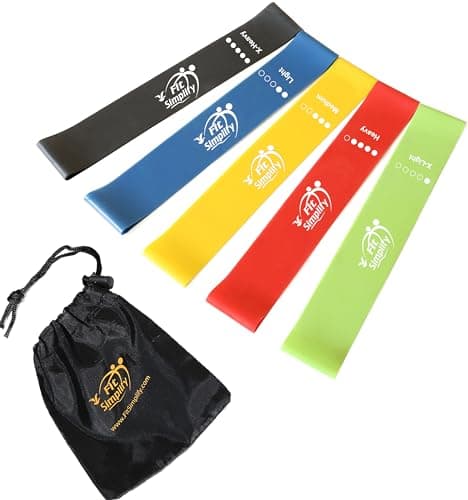
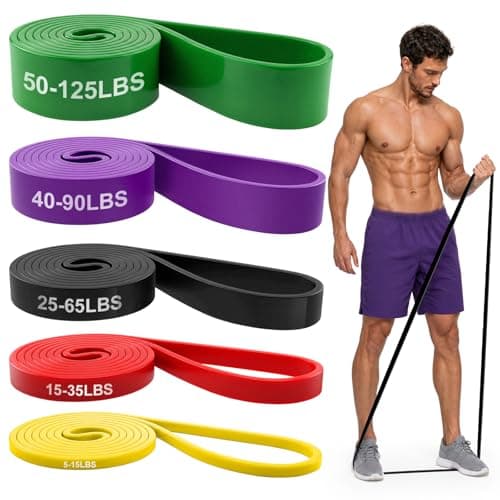
Two rules do most of the work: anchor the band so the line of pull opposes the movement, and start every rep with the band already under tension. Get those right and a band set trains a muscle the same way a dumbbell does. Get them wrong and you are doing a stretch with extra steps. If you want the set that makes both easiest, it is the WHATAFIT Resistance Bands (Premium Set)— a door anchor and ankle straps are what turn a bag of rubber into a home cable machine — but read the setup first, because the technique matters more than the purchase.
Rule one: anchor so the pull opposes the movement
A band only resists in one direction — back along its own length toward the anchor. So the anchor has to sit opposite the direction you are pushing or pulling. A row needs the anchor in front of you at chest height. A chest press needs it behind you. A lat pulldown needs it above. A kickback needs it in front of your ankle, low. If you find yourself fighting the band sideways, the anchor is in the wrong place and the target muscle is not getting the resistance.
Three anchors cover almost everything:
- A door anchor, which is the one that matters. Wedge it on the hinge side where possible, use a door that closes toward you, and make sure nobody can open it mid-set. High, middle and low positions give you pulldowns, rows and presses, and pull-throughs respectively.
- Your own feet. Stand on the band for presses, curls and upright pulls. Wider stance equals more tension; step your feet together to make the same band easier.
- A fixed object— a rack leg, a heavy table, a post. Check it will not move, and check the band cannot slide up or down it under load.
Rule two: there must be tension before the rep starts
The most common band mistake is standing in a position where the band is slack and then moving until it finally pulls. The first third of that rep trains nothing. Step further from the anchor, shorten your grip on the band, or choose a heavier band so that there is resistance from the very first inch of movement.
The flip side is the band's one real quirk: resistance risesas it stretches. A dumbbell weighs the same at the top of a curl as the bottom; a band is hardest at the end of the range. That suits movements that are strongest when they finish — hip extension, rows, triceps pushdowns — and suits deep-range movements such as a band squat less well. Match the band to the movement rather than fighting the curve.
Rule three: slow the way back down
A band wants to snap you back to the start, and most people let it. Take two to three seconds to return, under control, on every rep. That lengthening phase is where a lot of the training effect lives, and it is the single easiest thing to improve about how most people use bands. It also stops the band whipping, which is the other reason to do it.
The five mistakes that waste a set
- Too light. If you can do 25 reps comfortably, that is a warm-up. Work sets should be hard by rep 10-15, with the last two slow.
- No tension at the start, covered above — the most common of all.
- Letting it snap back. Half the rep thrown away, every rep.
- Anchoring to something that moves. A door that opens outward, a chair, a table leg that slides. This is the only genuinely dangerous mistake here.
- Never checking the band. Latex perishes. Look for nicks, cloudy patches and thin spots before heavy sets, keep bands out of sunlight, and retire anything damaged. A failing band under tension snaps toward your face.
A full-body routine to start with
Two or three times a week, 2-3 sets of 10-15 reps of each, with the last two reps genuinely hard. Squat (stand on the band, handles at the shoulders). Row (anchor at chest height, pull to the ribs). Chest press (anchor behind you at chest height). Overhead press (stand on the band). Romanian deadlift (stand on the band, hinge at the hips). Banded glute bridge (loop above the knees, press out throughout). Pallof press (anchor at chest height to your side, press straight out and resist the rotation). Progress by stacking a second tube or moving up a band, not by adding reps indefinitely.
Safety, briefly
Never stretch a band more than about two and a half to three times its resting length. Never anchor at eye level and stand in the line of fire. Never use a band with visible damage. Keep fingers out of the loop when a band is at full tension, and keep children and pets out of the anchoring path. Store them away from heat and sunlight, which is what actually kills latex.
Three sets that make all of this easy
Scored on the things this page is about: how many anchor positions you get, how finely you can control tension, how comfortable they are to hold, and whether there is anywhere to progress. Prices are live and stamped with the date they were checked.
Anchor position by exercise
| Exercise | Anchor | Common error |
|---|
| Seated or standing row | In front, chest height | Standing too close — no tension at the start |
| Chest press | Behind, chest height | Band under the armpit instead of across the back |
| Lat pulldown | High, above head | Pulling with the arms instead of the back |
| Squat / overhead press | Underfoot | Feet too close together, so tension is trivial |
| Pull-through / hip hinge | Low, behind you | Squatting the movement instead of hinging |
| Pallof press | Side, chest height | Letting the torso rotate — the point is that it does not |
| Lateral walk | No anchor — loop above knees | Band at the ankles, which loads the shin instead of the hip |
How to tell you are using enough resistance
Count the reps you could do if you had to. If the honest answer at the end of a set is “another eight”, the band is too light. Aim to finish each work set with two or three reps left, which usually means 10-15 reps total. Because band resistance is a curve rather than a number, two people can use the same band at very different effort levels just by standing further from the anchor — distance is your fine adjustment and band choice is your coarse one.
Bands versus weights, in one paragraph
Bands build strength — the pooled evidence in the 2019 SAGE Open Medicine meta-analysis puts elastic resistance training on comparable footing with conventional training for strength gains. What they do not give you is a number: no band tells you whether today was heavier than last Tuesday, which makes progressive overload a matter of judgment rather than arithmetic. That is the honest trade, and it is covered in full in do resistance bands build muscle and dumbbells vs resistance bands.
Caring for bands so they last
Store them out of direct sunlight and away from radiators — UV and heat degrade latex faster than use does. Keep them dry and away from oils and lotions. Do not leave a band stretched or knotted in storage. Inspect before heavy sets and retire anything with a nick, a cloudy patch or a thinning area. A set treated this way lasts years; a set left in a car boot through a summer does not.