Yes. A 2019 systematic review and meta-analysis in SAGE Open Medicine compared training with elastic devices against weight machines and dumbbells and found similar strength gains for both upper and lower limbs, across varied populations and protocols. A separate meta-analysis of body-composition outcomes found no superiority for either method on lean mass. Muscle responds to mechanical tension and effort; it cannot tell whether that tension arrived through steel or latex.
The useful question is therefore not whether bands work. It is why so many people own a band set and have not built anything with it. Two answers cover almost every case: the set ran out of resistance, or the training never got close enough to failure to need more. Fix those two and bands behave like any other resistance tool. Ignore them and you have bought a stretchy warm-up aid.
Below: what the research does and does not say, the mechanism and the one way band resistance genuinely differs from a dumbbell, the two failure modes in detail, and then three registry sets judged purely on how much headroom they leave you.
What the research actually shows
The headline finding is the 2019 Lopes review: across eight studies comparing elastic resistance with conventional resistance for muscular strength, there was no statistically significant superiority for either method in the upper or the lower limbs. The authors conclude that elastic resistance can produce strength gains similar to conventional training in different populations and with diverse protocols. A companion meta-analysis on body composition reached the same conclusion for lean mass, body fat and body mass: no method came out on top.
Three honest caveats, because this is a literature with real limits. The number of direct comparison trials is small. Most participants were untrained, older or clinical populations rather than experienced lifters, so the cleanest read is "bands work very well for people who are not already strong". And the trials are weeks to months long, not years — nobody has run a decade-long band-versus-barbell study, and the practical ceiling question is still open. What the evidence supports is clear enough for anyone deciding how to train at home: in the range where most people live, the tool is not the variable.
The mechanism, and the one real difference from a dumbbell
Muscle grows in response to high mechanical tension applied to fibres taken close to failure, repeated often enough to force adaptation. Everything else — the equipment, the brand, the gym — is a delivery mechanism. Bands deliver tension perfectly well.
Where they genuinely differ is the resistance curve. A dumbbell weighs the same at every point in the movement; the hard part of a curl is wherever your leverage is worst. A band gets harder as it stretches, so a band curl is easiest at the bottom and hardest at the top. That has two consequences. Band training is unusually kind to the stretched, vulnerable end of a joint's range, which is why physical therapy uses it so heavily. And it loads the top of a movement harder than a weight does, which is great for pressing and rowing lockouts and poor for exercises whose hardest point is at full stretch — a Romanian deadlift, for instance, where the band is slackest exactly where you want load. Pick exercises that match the curve instead of fighting it. We explain the same curve from the equipment side in dumbbells vs resistance bands.
Failure mode one: the set ran out of resistance
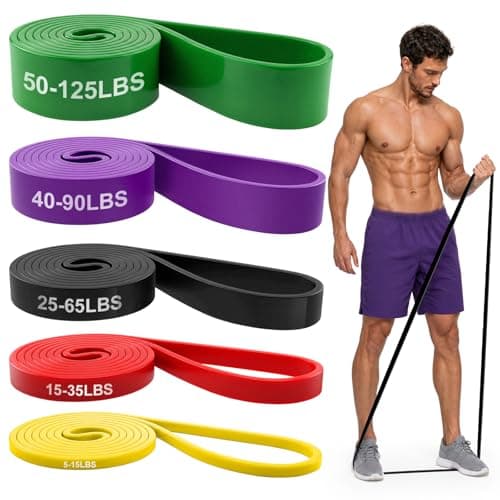
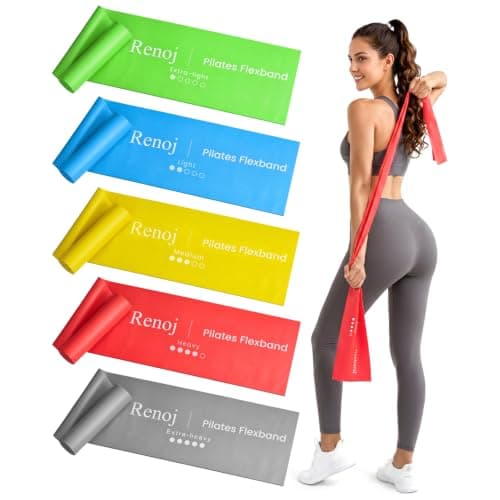
This is the big one. A five-band loop set tops out somewhere around "extra heavy" and then your training stops progressing, because there is nothing left to add. Muscle adapts to the load it meets; a load that never increases stops producing a stimulus within weeks. Mini loops are not a strength tool and the honest sellers say so.
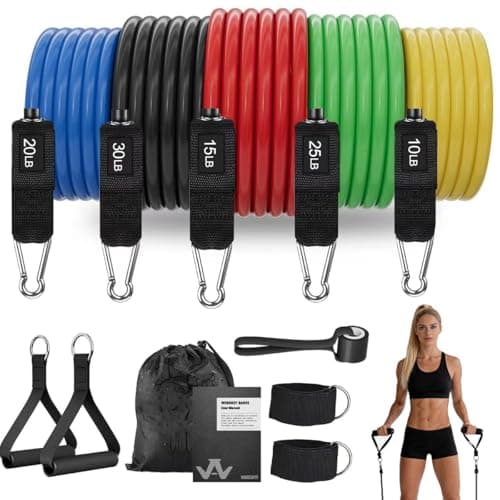
A stackable tube set solves it arithmetically. Five tubes rated 10 to 50 lb clip to the same handles, so the available resistance runs from 10 lb to a stacked 150 lb in roughly ten usable steps. That is enough progression to occupy a beginner for a year or more. Two cheaper levers extend it further: shorten the band by standing further from the anchor, or slow the lowering phase down. Both raise the effective load without buying anything.
Failure mode two: nobody trains a band to failure
A barbell announces the load. A band does not, and in the absence of a number people stop at "that felt like something". The research that finds hypertrophy finds it in sets taken to within a couple of repetitions of technical failure — the point where form would break, not where it gets uncomfortable.
The fix is to count instead of weigh. Pick a band where you reach 8 to 20 hard repetitions and the last two are genuinely difficult. Do two to four sets. When you can do more than twenty clean repetitions, move up a band or step back from the anchor. That is progressive overload, it needs no plates, and it is the whole programme.
Three band sets with enough headroom to matter
All three are judged on one thing: how much resistance is left after you get stronger. Prices are live and stamped with the date they were checked.
Most of the training effect people fail to get from bands is lost to technique rather than to the bands themselves — slack at the start of the rep, and letting the band snap back. The setup rules are in how to use resistance bands.
The programme, in five lines
This is all the prescription anyone needs, and it is the same prescription a dumbbell gets.
- Sets and reps: two to four sets of 8-20 repetitions per exercise, with the last two repetitions genuinely hard.
- Frequency: hit each muscle group two to three times a week on non-consecutive days.
- Progress by:adding a band, stepping back from the anchor to shorten it, or slowing the lowering phase to three seconds — in that order.
- Cover the whole body: a press, a row, a squat or leg press pattern, a hip hinge or hip abduction, and something overhead.
- Give it twelve weeks. Strength changes show up in weeks; visible size takes months, on any equipment.
Where bands still lose to weights
| Resistance bands | Dumbbells and barbells |
|---|
| Load you can measure | Approximate — band colour and stretch | Exact, printed on the weight |
| Resistance curve | Rises through the range; slack at full stretch | Constant through the range |
| Top-end ceiling | About 150 lb stacked, and awkward past that | Effectively unlimited |
| Heavy lower-body work | Hard to load a squat or hinge properly | The clear winner |
| Cost, footprint, travel | Pocket-sized, under the price of one dumbbell | Heavy, expensive, stays where it is |
| Joint-friendly at full stretch | Lightest exactly where the joint is most vulnerable | Heaviest wherever leverage is worst |
Read the last two rows together and the real answer appears: bands are the better tool for most people training at home, and weights are the better tool for anyone whose goal is a heavy squat, deadlift or bench. If that is you, the hub has adjustable dumbbells and power racks ranked properly.
Four mistakes that stop bands working
Buying only mini loops. They are excellent for hips, glutes and warm-ups and they cannot build whole-body muscle, because they top out light and have no upper-body options. The format decision is covered in loop bands vs tube bands.
Never increasing anything. Same band, same reps, same distance from the anchor, for months. Adaptation stops within weeks of the load becoming comfortable.
Stopping at discomfort.Without a number on the bar, "hard" has to be judged by repetitions in reserve. If you could have done five more, that set did very little.
Fighting the resistance curve.Using bands for exercises whose hardest point is at full stretch wastes the tool. Press, row, curl, extend, abduct — load the contracted end, where the band is strongest.
Safety, briefly
Band injuries are almost always anchor failures. Anchor low, never to something that can swing or be opened from the far side, and inspect for nicks and chalky patches before every session, since latex fails at a flaw rather than at a weight. Breathe out on the effort rather than holding your breath, and if you have uncontrolled blood pressure, a recent joint replacement or an unrepaired hernia, get the exercise list from a clinician first. Older adults starting from scratch should read best resistance bands for seniors, which ranks the same sets on grip and starting resistance instead.