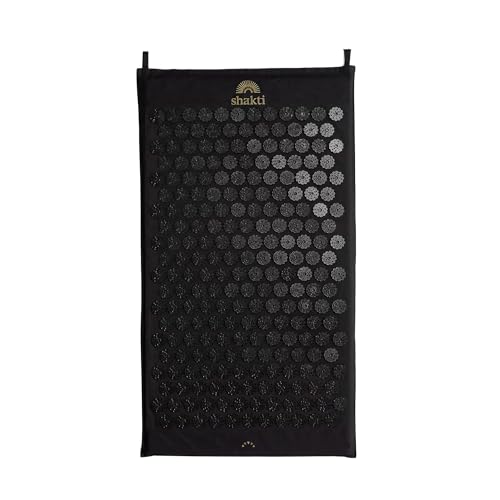
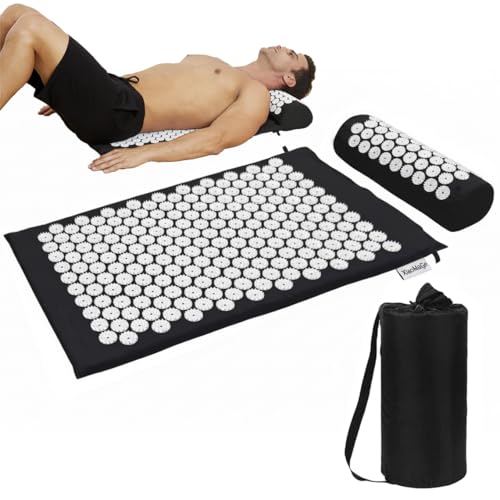
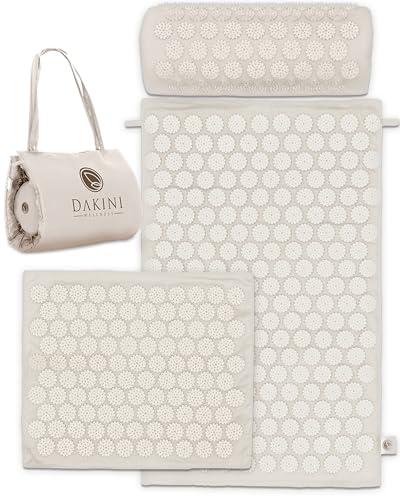
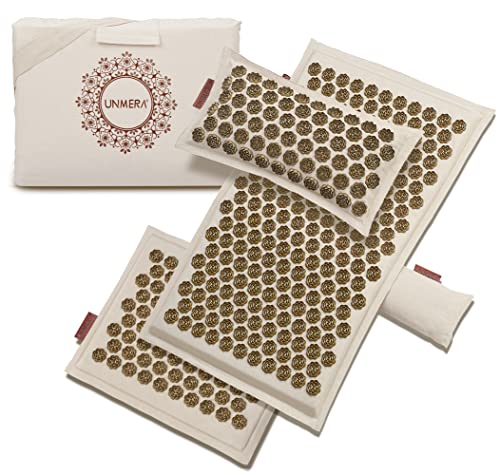
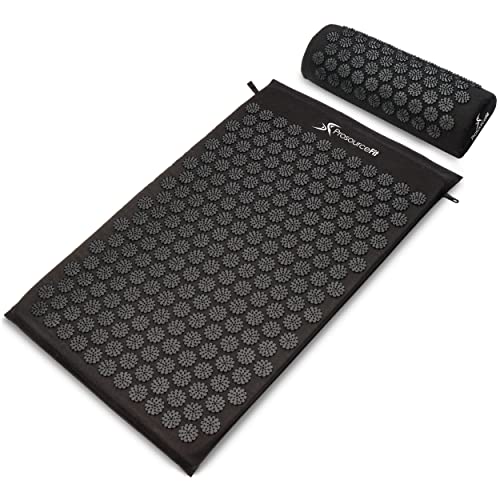
The acupressure mat to buy is the ProsourceFit mat and pillow set. It is the cheapest full set on this page, from a brand we already rank elsewhere on the site, and it does the one thing a mat has to do: cover your whole back in a single placement without you repositioning halfway through. If you want to choosehow sharp your mat is — the single most useful feature in this category — the ShaktiMat Classic is the only pick here that grades it, and it is the mat we would buy second. The budget pick is the XiaoMaGe 28.7-inch set, which publishes the longest mat figure on the page for a couple of dollars less than the winner.
Start with the thing every listing in this category gets backwards. The number shouted on the box is the spike count— 6,210 points, 8,910 points, 11,178 points — and it is presented as a potency rating. It is the reverse. Your bodyweight is a fixed load; the spikes divide it. Press the same back onto 8,000 tips and each tip carries half what it would carry on 4,000. More spikes means a gentler mat.
You do not have to take our word for it, because one brand on this shelf grades its mats properly and its own numbers run in exactly that direction: ShaktiMat's Level 1, the one it recommends to beginners, has 8,000 spikes; Level 2, described as a deeper release, has 6,000; and Level 3, the sharpest, has the fewest at 4,000. The company makes a stronger mat by taking spikes away. Every listing that sells you eleven thousand points as an upgrade is quietly advertising a softer product.
The second thing to know is that the spike count is not even a stable figure. The same ProsourceFit product line appears at 6,210 points for the half-body mat, 8,910 for a regular version and 11,178 for the full-body size, with 1,782 on the pillow, and retailer pages do not agree with each other on which number belongs to which size. A spec that changes between listings for the same product is not a spec you can shop on.
So we rank on what you can actually verify and cannot change after delivery. Mat lengthcomes first, because coverage decides whether one session reaches your whole back or only part of it — the mats here run from roughly 25 to 28.7 inches, and a long mat is the difference between lying down once and shuffling. Pressure control is second: whether the maker publishes a graded sharpness at all, which is the only honest version of the spike-count conversation. What is in the box is third, because a pillow and a carry bag bought separately cost more than the gap between most of these mats. Construction and price come last.
One more honest note before the picks, and it is the reason this page is short on certainty. Nobody has run a clinical trial on a spike mat.The evidence we have is for acupressure applied by hand or with devices at specific points, it is encouraging and it is weak — a 2020 systematic review and meta-analysis found pain relief from acupressure for low back pain but rated the trial quality as low and downgraded the evidence on GRADE. A mat is not that intervention. It is a cheap, low-risk, pleasant thing that many people find helps them wind down, and that is how we are treating it. If what you want is pressure you can aim and control, a massage ball costs less and does more.
Spike count, read correctly
This is the only thing you need to understand to shop this category well, so here it is once more in plain arithmetic. Your bodyweight is fixed. The spikes under you divide it. Pressure per spike is your weight divided by the number of spikes in contact — so doubling the count halves the pressure.
A mat advertising more acupressure points is advertising a gentler mat. ShaktiMat, the one brand here that grades its range, builds its sharpest mat by removing spikes: 8,000 on the beginner Level 1, 6,000 on Level 2, 4,000 on the hardest Level 3. Any listing selling eleven thousand points as a premium feature is selling comfort as potency, and it is worth knowing that before you decide a mat is “not strong enough.”
Two things follow. First, if your current mat feels too sharp, more spikes is the fix, not fewer. Second, the count only means something relative to the mat's area — a long mat with 11,000 spikes and a short mat with 8,000 can press almost identically. Which is one more reason to shop on length.
Mat length is the spec you cannot fix later
Measure from the top of your shoulder blades to the base of your spine. That is the span a mat has to cover in a single placement, and it is usually somewhere between 22 and 28 inches on an adult. The mats on this page publish lengths from about 25 to 28.7 inches, with full-body versions of the winner running to roughly 51 inches.
Why it matters more than it sounds: a session on a mat is twenty uninterrupted minutes of lying still. If the mat only reaches your mid-back, you either spend the session on half your back or get up and shuffle down, and the second one does not happen twice. Everything else about a mat can be worked around. Length cannot.
If you are buying for the lower back specifically rather than the whole span, a short mat placed deliberately is fine — and so is the cheaper, more targeted option we rank in best foam rollers for back pain, which puts pressure where you aim it instead of everywhere at once.
What the evidence actually says
We are not going to dress this up. No clinical trial has tested a spike mat. The research that gets cited in this category is on acupressure delivered by hand or with devices at specific acupoints, which is a different intervention from lying on several thousand plastic points at once.
That body of work is mildly encouraging and methodologically weak. A 2020 systematic review and meta-analysis found pain relief from acupressure for low back pain but rated the included trials as low quality, and GRADE assessment downgraded the evidence, with the authors calling for more research. A trial of 129 patients with chronic low back pain reported that acupressure produced significantly greater improvement than routine physical therapy both immediately and at six months. A pilot trial of 67 people found self-applied acupressure reduced low back pain more than usual care, with a reported 35 percent reduction after six weeks — from a pilot study, which is where that number belongs.
The reasonable conclusion: an acupressure mat is a cheap, low-risk thing that a lot of people find genuinely pleasant and relaxing, there is a plausible but unproven case that the pressure helps pain, and nothing in that literature justifies spending a hundred dollars on one. That is why the cheapest complete set on this page wins it.
If that pattern sounds familiar, it is the same one we found on the other passive recovery shelf: our best vibration plates ranking is built around the gap between what those listings promise and what the published research and specifications actually say. Both categories are worth buying cheaply and worth buying with your eyes open.
How to use one without hating it
Wear a thin shirt for the first few sessions. Bare skin on a new mat is the reason most of them end up unused. A t-shirt takes the edge off and you can drop it later.
Lie down in one movement, do not sit and lean back. Rolling onto the mat from your side spreads the contact instead of concentrating it on your shoulder blades.
Twenty minutes is the number everyone uses, and ten is plenty to start. The first two or three minutes are the uncomfortable part; the sensation changes after that. If it has not changed in five minutes, the mat is too sharp for you — a thicker shirt or a gentler grade, not willpower.
Use the pillow for the neck separately. Neck work and back work want different positions, and trying to get both in one lie-down usually means neither.
Keep it off broken skin.And if you have fragile skin, reduced sensation in your back or feet from diabetes or neuropathy, a bleeding disorder, or you take anticoagulants — or you are pregnant — ask a clinician before you start, because a mat is a lot of small pressure points on skin you may not feel properly. Sudden or severe back pain, pain after an injury, pain that wakes you at night, or any numbness, weakness or bladder change is a reason to see someone rather than buy something.
What to buy instead, if you are not sure
A mat is passive: you lie on it and it presses everywhere at once. That is its appeal and its limit. The cheaper tools in this hub are active — you aim them, you control the pressure, and you can work one spot until it changes.
A massage ball is the direct rival and usually the better first purchase: under fifteen dollars, it reaches a glute or the muscles either side of the spine with a pressure a mat cannot approach, and it fits in a bag. A foam roller covers more tissue per minute and does the job a mat is actually marketed for. Buy one of those first; buy the mat when what you want is twenty minutes of doing nothing.