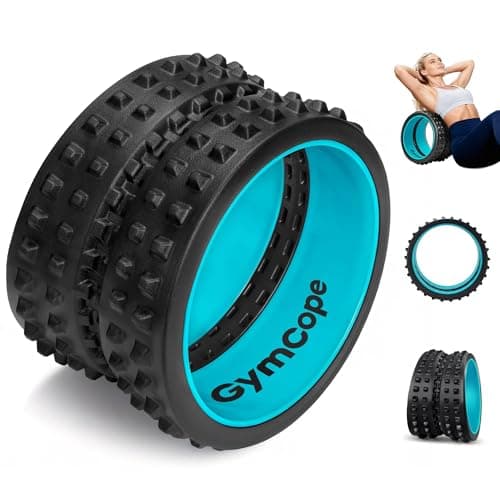
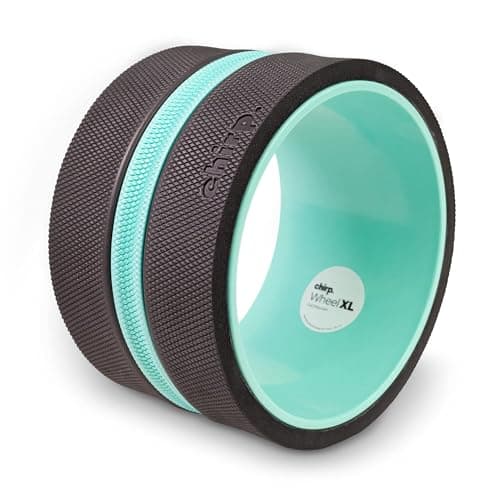
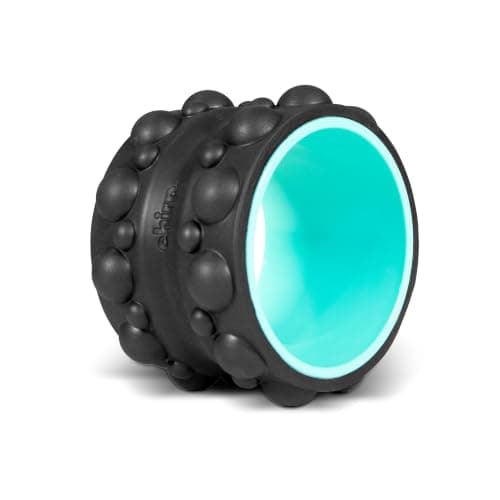
A back roller wheel looks like a foam roller that went to the gym, and the difference is not cosmetic. Two things change. First, the channel: a groove runs around the middle of the wheel so your spine sits in it while the raised edges press the erector muscles either side. Second, the rigid core: a wheel does not compress, so all of your body weight arrives at the tissue instead of being absorbed by foam.
The practical result is more extension and more concentrated pressure than any cylinder gives you, which is why this category exists at all. The mechanism is the same one that makes a peanut-shaped ball the right tool for the muscles beside the spine — a channel that keeps pressure off the bones down your midline — but applied across the whole back at once.
Diameter is the spec that decides the experience. A small wheel (roughly 6 inches) arcs your back further and concentrates pressure into a narrow band, which is intense and excellent on a specific knot. A large wheel (10 to 12 inches) gives a broader, gentler stretch and is much easier to get on and off. Buying the wrong diameter is the single most common regret in this category, which is why the multi-size sets below score well. If you want the conventional cylinder instead, see best foam rollers for back pain.
What a wheel does that a foam roller does not
Three things. Extension: the tighter arc of a wheel opens the thoracic spine further than a 5- or 6-inch cylinder, which is the whole point if your back is rounded from sitting. Concentration: a rigid shell does not compress, so body weight arrives at the tissue rather than being partly absorbed by foam. Spine clearance: the channel means the raised edges press muscle and the groove leaves the bony midline alone, which is the safety design a plain cylinder lacks.
What a wheel does worse: legs. A cylinder is far better for quads, calves, hamstrings and IT-band-adjacent tissue, and a wheel is awkward for all of them. These are complements, not substitutes — see best foam rollers for that half.
Picking a diameter
- Around 6 inches. The most intense. Tight arc, concentrated pressure, excellent on a specific knot. Hardest to balance on and to get off.
- Around 10 inches. The middle ground, and the size most people end up using most.
- Around 12 inches. The gentlest and most stable. Broad stretch, easy entry and exit, the right first wheel for a stiff back. Width does the same job from the other direction — a wider barrel gives you a base to lie back on rather than an edge to balance over, which is why our beginner pick is a seven-inch-wide barrel.
Because the difference is so pronounced and so personal, a multi-size set is often the better purchase even at a slightly higher price — you keep the one that suits you and grow into the others. The trade is that the sets sold as three-packs are usually smooth yoga wheels rather than grooved back wheels, so you gain the choice of diameter and give up the spine channel.
How to use one safely
Sit on the floor with the wheel behind you, place it under your mid-back with your spine in the channel, feet planted, and lift your hips gently so your weight settles onto the wheel. Roll slowly, from just below the shoulder blades up to the base of the neck, breathing out as you pass over a tight area. Two or three slow passes is a session.
The rules that matter: stay on the thoracic (upper and middle) back, do not roll the wheel onto your lower back or lumbar spine, and never onto your neck. Keep your head supported and do not let it drop backwards. Come off the wheel by lowering your hips to the floor rather than trying to stand up over it. And if you have osteoporosis, a diagnosed spinal condition, or you are pregnant, ask a clinician before putting your body weight over a rigid wheel — the same caution applies as for any deep back work in how to foam roll.
Wheel, roller, ball, or gun?
For an upper back that feels compressed and rounded, a wheel is the most satisfying tool in this whole category. For general back and leg coverage, a foam roller is far more versatile. For the muscles either side of the lower spine, a peanut ball is the safe and precise answer. For a single spot you want to attack quickly, a massage gun is faster. They cost very different amounts and do genuinely different things; a wheel plus a roller covers most people completely.