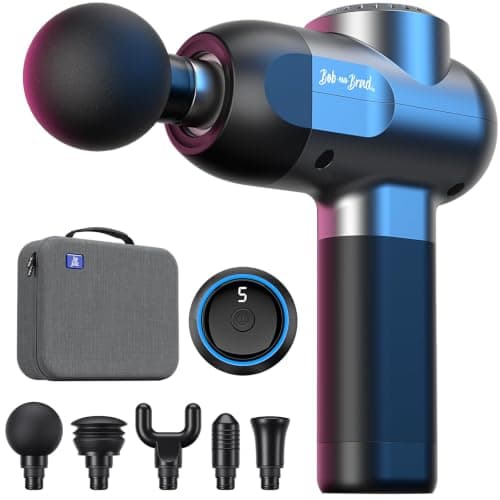
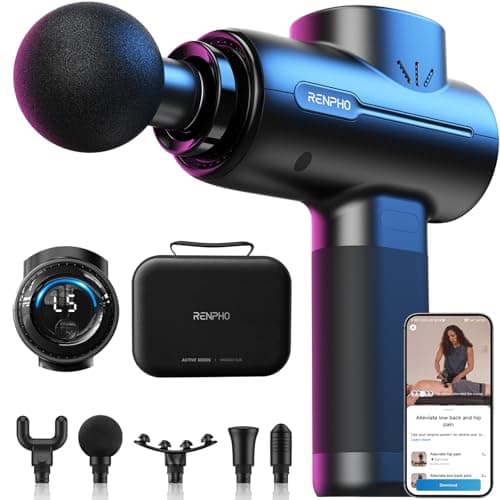
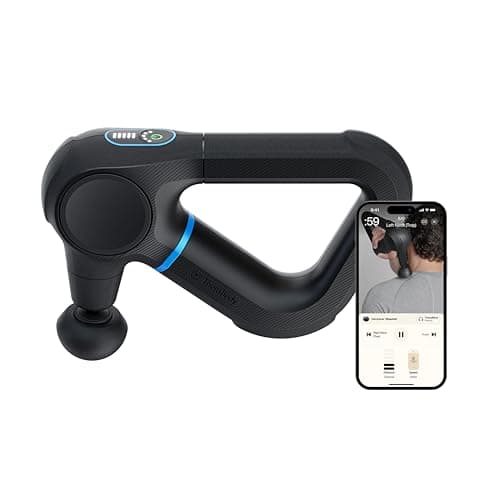
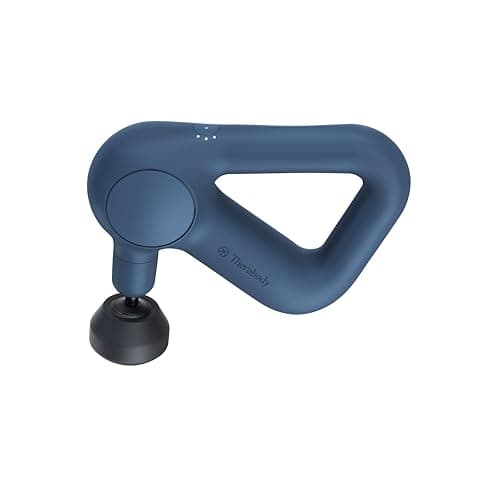
Most "best massage gun for back pain" lists rank on amplitude and stall force, which is the wrong criterion. On your own back, the limiting factor is not how hard a gun can hit — it is whether you can get the head onto the muscle at all, at a sane angle, without a partner. A gun with a triangle grip and a modest stroke will do more for a tight lower back than a heavyweight you cannot aim.
There is a second, non-negotiable point. The muscles either side of your spine — the erectors, the quadratus lumborum, the glutes that pull on all of it — are fair game on a low setting. The spine itself is not, and neither are the kidneys lower down. That rule shapes this whole page; the full list of off-limits areas is in where not to use a massage gun, and it is worth two minutes before you switch anything on.
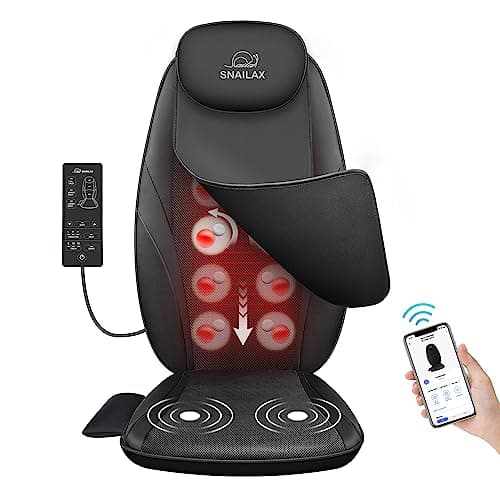
Below: three guns ranked on how well you can aim them at your own back, one premium deep-tissue option for someone with a helper or very dense tissue, and one hands-free kneading massager — because for the mid-back between the shoulder blades, no gun beats leaning back into a chair pad. If your back pain is the general, everyday, stiff-from- sitting kind, start with the winner. If it is sharp, radiating, or came from a specific incident, start with a clinician instead.
The rule that comes before everything: not on the spine
Percussion goes on muscle. The bony column down the middle of your back is not muscle, and neither is the kidney area in the lower flanks. Work the erector muscles that run in two columns either side of the spine, the glutes, and the upper trapezius ridge — and keep the head off the midline entirely. If you cannot see what you are aiming at, go slower and lighter than feels necessary. Every off-limits area is listed in where not to use a massage gun.
Why reach beats power for backs
The specs that sell massage guns — amplitude, stall force, motor watts — matter most when you can brace properly and press. On your own back you can do neither. You are holding a device at the edge of your range of motion, often overhead or twisted behind you, and the session ends when your shoulder complains rather than when the muscle is done. That is why a triangle-handled, 1.4 lb gun outperforms a 2.5 lb powerhouse here, and why the ranking above starts with reach and weight and treats depth as a tiebreaker.
Where the pain actually comes from
A great deal of lower-back tightness is not a back problem at all. The glutes and hip flexors attach to and pull on the pelvis, and when they are tight from sitting, the lower back takes the strain. Those muscles are big, dense and easy to reach, which makes them the most productive target on this whole page — this is why a strong, straightforward gun like the Renpho earns a place despite being awkward for the back itself. If you only have five minutes, spend three on the glutes and two beside the spine, not the other way round.
The tools that beat a gun for parts of your back
A gun is not the only, or always the best, option. A peanut-shaped massage ball is purpose-built to straddle the spine and press into the erectors on both sides — it is cheap, it uses your body weight instead of your shoulder, and it is arguably the single best-value back tool on this site. A foam roller covers the whole mid and upper back in one pass. And a kneading back massager does the hands-free work for the area you cannot reach. Most people with a chronically cranky back end up with two of these three, not one gun.
When to stop and see someone
Self-massage is for ordinary muscular tightness. Pain that radiates down a leg, numbness, weakness, pain that wakes you at night, pain following a fall or an accident, or anything that is getting steadily worse is not a massage-gun problem. Percussion also does not belong on an acute injury, a fresh bruise, an inflamed area, or over a suspected fracture. If you take blood thinners, have osteoporosis, or are pregnant, ask a clinician before using percussion near your back at all — the safe list is shorter for you.