Most "best fitness equipment for seniors" lists are the same general home-gym list with a stock photo of a gray-haired couple bolted on. That is the wrong starting point. The equipment an older adult should buy is decided by a different question: what will get used several times a week, without a spotter, without a sore knee the next morning, and without needing to get down onto the floor and back up again? Every pick below was chosen against that question first and price second.
The target is not arbitrary either. The CDC's guidance for adults 65 and older is three separate things, not one: at least 150 minutes a week of moderate aerobic activity, at least two days a week of muscle-strengthening work, and — the part almost every roundup forgets — activities that improve balance. Balance is not a bonus box to tick. More than one in four older adults report a fall each year, and CDC's STEADI fall-prevention program treats exercise, including balance training, as a core intervention. So this list is built to cover all three boxes, and we say plainly which pick covers which.
We ranked on five things, in this order: low impact (does it load the joints, or spare them), safety used alone (can you get on and off it without help, and does it stay put), ease of use (setup, assembly, storage, how legible the controls are), progression (does it get harder as you get fitter, or do you outgrow it in a month), and value. We have not lab-tested any of this gear — we compiled the published specifications and manufacturer documentation and say so. If you are furnishing a room from nothing, our guide to the types of home-gym equipment maps the wider category, and the beginner home-gym kit is the general-purpose version of this list.
Bands do a lot of the strength work on this list, and the format matters more for an older adult than the resistance does — which is why they get their own ranking in best resistance bands for seniors, scored on grip demand, how light the lightest band is, and whether it works sitting down.
If the specific problem is painful knees rather than age, the ranking changes: joint load and how far the knee has to bend matter more than balance or ease of storage, and we rank the shelf on exactly those axes in best exercise equipment for bad knees.
The short answer
Quick picks
| # | Product | Best for | Score | Price |
|---|
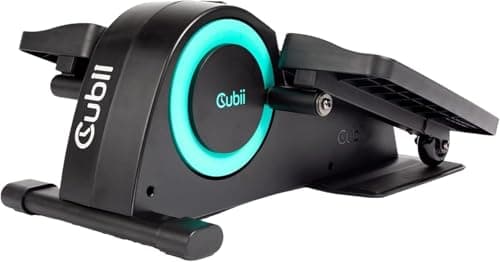
| 01 | Cubii JR1 Under Desk EllipticalThe piece most likely to be used every single day, because you never have to stand up to use it. A seated elliptical stride with eight levels of magnetic resistance, an LCD readout and enough mass to stay put on carpet. It is the priciest way to pedal sitting down, and for daily use it earns it. | Best overall | | $169.99·Amazon |
| 02 | | Best budget | | $69.99·Amazon |
| 03 | | Best for strength | | Check price → |
| 04 | Fit Simplify Resistance Loop Bands (Set of 5)The cheapest useful thing on this list and the one a physical therapist is most likely to have already handed you. Five graded latex loops for hip, glute, shoulder and ankle work — nothing to drop, nothing to store, no reason to wait. | Best cheap starter | | $9.98·Amazon |
| 05 | ProsourceFit Exercise Balance PadThe pick that covers the box every other roundup ignores. A 2.25-inch non-slip TPE foam pad that turns standing still into balance training — the training type CDC explicitly asks older adults to include, and the cheapest item here to justify. | Best for balance | | $26.99·Amazon |
| 06 | | Best full machine | | $399.99·Amazon |
#ad · Live prices from the Amazon Product API, as of October 18, 2026. Where we have no verified live price, we show none — a gap beats a number that has rotted.
In detail
Best overall
Cubii JR1 Under Desk Elliptical
8 magnetic levels25.4 lb unit23.2" x 17.6" x 9.8"LCD monitor
The piece most likely to be used every single day, because you never have to stand up to use it. A seated elliptical stride with eight levels of magnetic resistance, an LCD readout and enough mass to stay put on carpet. It is the priciest way to pedal sitting down, and for daily use it earns it.
- Low impact
- 10
- Safety
- 9
- Ease of use
- 9
- Progression
- 7
- Value
- 7
Pros
- +Elliptical stride is smoother on knees and hips than a tight pedal circle
- +Eight magnetic resistance levels give you somewhere to progress to
- +At 25.4 lb it stays where you put it instead of sliding away mid-stride
- +LCD shows strides, calories, distance, time and RPM, so progress is visible
Cons
- −Costs more than twice what a basic pedal exerciser does
- −25.4 lb is stable in use but genuinely awkward to carry between rooms
- −Needs a chair at the right height — too low a seat and your knees hit the desk
- −Cubii does not publish a maximum user weight we could verify
Don't buy this if…
…you need the cheapest possible way to move your legs while seated — the Sunny pedal exerciser below does most of this job for a fraction of the price.
The Cubii wins the top slot on the single criterion that decides whether recovery-friendly cardio actually happens: friction. It sits under a desk or in front of an armchair, it does not need to be set up, and using it requires nothing more than sitting down. That is the whole argument. Aerobic guidance for older adults is 150 minutes a week, and 20 minutes of seated pedaling while the television is on gets there in a way a piece of equipment in another room never will.
The design details matter more than the brand name. The elliptical path is a longer, flatter oval than the tight circle a basic pedal exerciser traces, which keeps the knee moving through a gentler range — worth noticing if arthritic knees are the reason you are shopping in the first place. The 25.4 lb chassis is not a downside during a session; it is the reason the unit does not creep across the carpet, which is the single most common complaint about cheap pedal exercisers. Eight magnetic resistance levels mean it does not become pointless once you are fitter.
Be clear-eyed about the trade-off. This is a low-ceiling machine — it will never load your legs the way a bike or a walk does, and nobody should buy it expecting a hard workout. It is also expensive for what it mechanically is, and the same 25.4 lb that keeps it planted makes it a two-handed lift to move. If price is the deciding factor, take the next pick without guilt.
Best budget
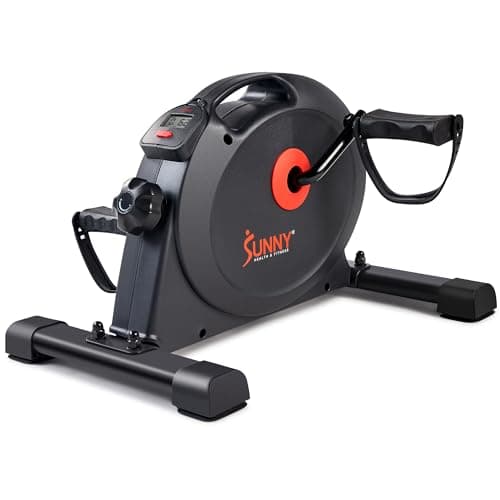
Sunny Health & Fitness Under Desk Smart Mini Pedal Exerciser (SF-B023005DGY)
Stepless resistance dialBelt drive (quiet)Legs or armsSpeed/time/distance/calories
The value answer, and for a lot of readers the sensible one. A low-profile belt-drive pedal unit with a stepless resistance dial that works under a desk for legs and on a tabletop for arms. It is light enough to carry to any room — which is also its main weakness.
- Low impact
- 9
- Safety
- 7
- Ease of use
- 8
- Progression
- 7
- Value
- 10
Pros
- +A fraction of the price of the Cubii for the same seated-cardio job
- +Stepless micro-adjustable dial goes genuinely light for rehab-level effort
- +Lifts onto a table so the same unit trains arms and shoulders
- +Belt drive is quiet enough to use while someone else is watching TV
Cons
- −Light and low-profile, so it can slide on hard floors unless you brace it against a wall
- −Resistance is a dial, not numbered levels — you cannot repeat an exact setting
- −Sunny does not publish a maximum user weight for this model that we could verify
- −The arm workout means lifting the unit onto a table, which is awkward for weak wrists
Don't buy this if…
…you have hard floors and nothing to brace against — the extra mass of the Cubii is worth paying for if the unit wandering away from you is a real risk.
This is the pick we would hand to most people asking the question for the first time. It does the important part of what the Cubii does — seated, zero-impact leg movement you can do daily — at a price low enough that it is not a decision you have to agonize over. The stepless resistance dial is genuinely useful at the bottom end: it will go light enough for someone coming back from a hip replacement, which numbered-level machines sometimes will not.
The dual-function design is the other real advantage. Lift the unit onto a table and the pedals become hand cranks, which turns it into an upper-body cardio tool — useful for anyone whose legs are the limiting factor. Sunny's belt drive keeps it quiet, and the carry handle and low profile make it a unit you can move between the bedroom and the living room without help.
The honest weakness is stability. A light unit on a hard floor will walk away from you as you pedal, and chasing it around the room is exactly the sort of thing this list exists to avoid. Brace it against a wall or a heavy chair leg, or put it on a rug. Do that and this is the best-value item here by a wide margin.
$69.99·View on AmazonPrice as of October 18, 2026. Prices change — Amazon's at checkout is the one that counts.
#ad · we may earn a commission from this link to Sunny Health & Fitness Under Desk Smart Mini Pedal Exerciser (SF-B023005DGY)
Best for strength
Amazon Basics Neoprene Dumbbell Set with Stand (3, 5, 8 lb pairs)
3, 5 and 8 lb pairs32 lb totalNeoprene coatedIncludes stand
The strength half of the CDC recommendation, in the sizes that actually get used. Three color-coded neoprene pairs — 3, 5 and 8 lb — on a small stand. Light weights done properly beat heavy weights left in a closet.
- Low impact
- 8
- Safety
- 8
- Ease of use
- 9
- Progression
- 7
- Value
- 8
Pros
- +Starts at 3 lb — light enough for shoulders that have not lifted anything in years
- +Neoprene coating is grippy and kind to arthritic hands, unlike bare knurled iron
- +Color coding makes picking the right pair unambiguous
- +The stand keeps all six off the floor, which is a trip hazard removed
Cons
- −Tops out at 8 lb, so a fitter user outgrows the heavy pair fairly quickly
- −Cost per pound is high compared with plain cast iron
- −The stand needs assembling and is not heavy-duty
Don't buy this if…
…you are already training and can comfortably press more than 8 lb per hand — buy a proper adjustable pair from our dumbbell roundup instead.
Strength training is the part of the guidance older adults are most likely to skip and least able to afford skipping — muscle mass and grip strength are what keep you getting out of a chair unaided. The equipment for it does not need to be impressive. Three pairs of light dumbbells cover seated presses, curls, rows, lateral raises and goblet squats, all of which can be done from a dining chair.
The details that make this the right set are the ones nobody advertises. Neoprene is a soft, high-friction coating, which matters a great deal if grip strength or arthritis is a limitation — bare iron knurling is unpleasant to hold and easy to drop. The 3 lb pair exists so that someone who has not lifted a weight in a decade has somewhere to start, and the stand means the set lives visibly in the room rather than in a closet, which is most of the battle.
The ceiling is the catch. Eight pounds per hand is a real training load for a beginner and a warm-up for anyone else, so a consistent user will want more within a year. That is a good problem; when you get there, our adjustable dumbbells roundup covers the step up.
Best cheap starter
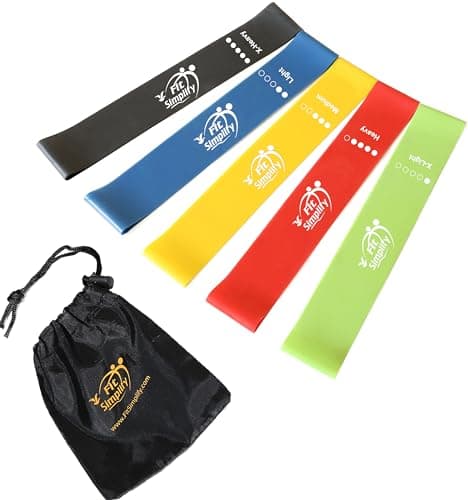
Fit Simplify Resistance Loop Bands (Set of 5)
5 graded loopsX-light to X-heavy12" x 2"Natural latex
The cheapest useful thing on this list and the one a physical therapist is most likely to have already handed you. Five graded latex loops for hip, glute, shoulder and ankle work — nothing to drop, nothing to store, no reason to wait.
- Low impact
- 9
- Safety
- 7
- Ease of use
- 7
- Progression
- 6
- Value
- 10
Pros
- +Costs about as much as a sandwich, so there is no reason to delay starting
- +Nothing heavy to drop on a foot and nothing to fall off
- +Five graded levels cover both rehab-light and genuinely challenging work
- +Fits in a drawer or a bag — the easiest piece here to keep using while traveling
Cons
- −Small loops can be fiddly to position with reduced hand strength or reach
- −Natural latex — not an option with a latex allergy
- −No handles, so upper-body pressing and rowing are limited
- −Bands perish; they need checking for nicks before each use
Don't buy this if…
…you have a latex allergy or limited hand dexterity — a tube set with handles, covered in our bands roundup, is easier to grip and anchor.
Loop bands are the standard tool of physical therapy clinics for a reason: they load a muscle without loading a joint, the resistance rises smoothly through the range rather than spiking, and there is no way to hurt yourself by dropping one. For hip abduction, glute activation, ankle work and shoulder rehab they are the correct tool, not a compromise.
They are ranked below the dumbbells here for one honest reason: positioning a 12-inch loop around both ankles requires bending and a reasonable amount of hand strength, and that is exactly the sort of small barrier that stops a piece of equipment being used. If that describes you, buy the dumbbells first and add the bands later — or go straight to a tube set with handles from our resistance bands roundup, which anchors to a door and needs no floor work at all.
Best for balance
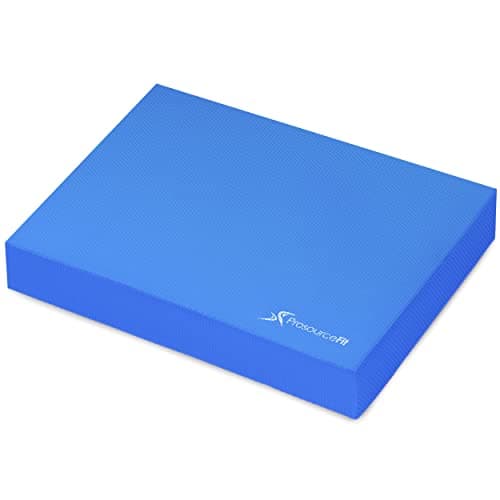
ProsourceFit Exercise Balance Pad
15.5" x 12.75" x 2.25"~12 ozNon-slip TPE foamWipe clean
The pick that covers the box every other roundup ignores. A 2.25-inch non-slip TPE foam pad that turns standing still into balance training — the training type CDC explicitly asks older adults to include, and the cheapest item here to justify.
- Low impact
- 10
- Safety
- 6
- Ease of use
- 9
- Progression
- 4
- Value
- 9
Pros
- +Directly trains balance, which the CDC lists alongside aerobic and strength work
- +Weighs about 12 oz — moved and stored by anyone, with one hand
- +Non-slip TPE surface, so the pad itself does not slide on the floor
- +Doubles as a kneeling pad for gardening or a cushion for a hard chair
Cons
- −Must be used next to a counter, rail or sturdy chair to hold — this is not a use-it-anywhere item
- −2.25 inches of foam compresses a lot under a heavier user, reducing the challenge
- −It is not a workout on its own; it makes other exercises harder
- −No instructions worth the name — you need a routine from elsewhere
Don't buy this if…
…you have had a fall in the last year or feel unsteady standing unsupported — start balance work with a physical therapist, not a foam pad bought online.
Balance is the criterion this whole category gets wrong. Aerobic fitness and strength are what get sold; balance is what keeps you out of the hospital. CDC's STEADI program exists because more than one in four older adults report falling each year, and its guidance treats exercise — including balance work — as a core prevention measure. A foam pad is the cheapest piece of equipment that trains it, because it makes the ground slightly unstable and forces the ankle, foot and hip stabilizers to work.
Use it exactly one way: beside a kitchen counter or the back of a solid chair, with a hand resting on it. Stand on the pad with feet together, then narrow the stance, then progress to one foot, then to doing it with eyes closed — always with something to grab. That is the entire program, it takes two minutes, and it is the most valuable two minutes on this page.
The honest caveats: the foam is soft enough that a heavier user will sink through most of the 2.25 inches and get less instability than a lighter one, and the pad ships with no meaningful instruction. And it is the one item here that we would not recommend using alone if you are already unsteady — that is a conversation for a physical therapist first.
Best full machine
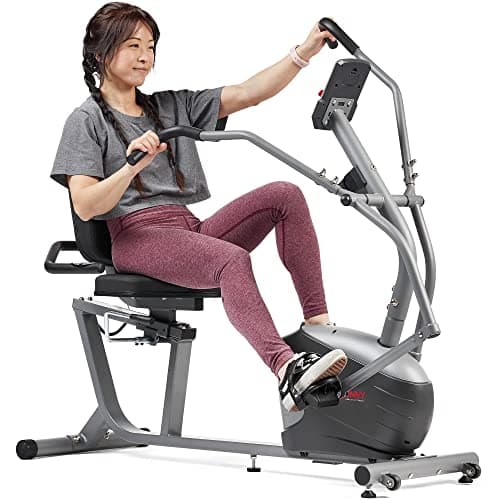
Sunny Health & Fitness Compact Performance Recumbent Bike (SF-RB420032)
8 magnetic levels265 lb user capacity63.8" x 26.4" x 49.6"Dual-motion arms
The full-size option, for the reader who wants real cardio rather than gentle movement. A supported back, a step-through frame, eight magnetic resistance levels and dual-motion arm handles. It is also 77 lb of machine that needs assembling and a permanent corner.
- Low impact
- 10
- Safety
- 9
- Ease of use
- 5
- Progression
- 8
- Value
- 5
Pros
- +Supported back and step-through frame — no balance required to get on or off
- +Dual-motion arm handles work the upper body at the same time as the legs
- +Eight magnetic resistance levels reach a genuinely useful training intensity
- +Monitor shows time, speed, RPM, distance, calories and resistance, with seat pulse sensors
Cons
- −63.8 inches long — this claims a corner of a room permanently
- −77.4 lb assembled, and assembly is a real job you may need help with
- −265 lb user capacity is modest for a machine at this price
- −Costs several times any other pick here
Don't buy this if…
…you do not have a dedicated space for it or nobody available to help assemble it — an under-desk unit gets used far more often than a machine that is in the way.
A recumbent bike is the safest way to get real cardiovascular intensity after 65. You sit in a supported seat with your back braced, step through a low frame rather than swinging a leg over a crossbar, and there is no balance requirement at any point. Eight levels of magnetic resistance and the dual-motion arm handles mean it can be a genuinely demanding session, not just movement — which is the thing the under-desk units cannot offer.
It is ranked last deliberately, and not because it is a bad machine. It is ranked last because of the failure mode this list is designed around: the equipment that does not get used. A 63.8-inch, 77 lb machine that has to be built from a box and then lives in the middle of a room is a much bigger commitment than a 25 lb unit that slides under a desk, and unused equipment scores zero on every metric that matters. Buy this if you have the space, the help to assemble it, and the intention to ride it several times a week. Otherwise buy one of the first two picks and spend the difference on nothing at all.
$399.99·View on Amazon$499.9920% off
Price as of October 18, 2026. Prices change — Amazon's at checkout is the one that counts.
#ad · we may earn a commission from this link to Sunny Health & Fitness Compact Performance Recumbent Bike (SF-RB420032)
Cover the three boxes, in this order
The guidance for adults 65 and older is three separate things, and most people buy for one of them. Aerobic work — at least 150 minutes a week of moderate activity — is covered by either under-desk pick or the recumbent bike. Muscle strengthening, at least two days a week, is covered by the light dumbbells and the bands. Balance activity, which has no minute target but is explicitly recommended, is covered by the balance pad and by nothing else on this list. If your budget only stretches to two items, buy one aerobic item and one strength item; add the pad, which costs less than a takeout lunch, the moment you can. It is the cheapest insurance here.
The five criteria we ranked on, and why they are these five
Low impact comes first because a sore knee ends a routine faster than a lack of motivation does. Safety used alone is second because most home training happens with nobody else in the house — anything requiring a spotter, a floor transfer or an unsupported balance is scored down. Ease of use covers assembly, storage and legible controls; a machine that needs building is a machine that might stay in the box. Progression asks whether the thing still challenges you in six months, which is where fixed 8 lb dumbbells lose points and eight-level resistance gains them. Value comes last on purpose: the most expensive mistake in this category is not overspending, it is buying something that never gets used.
What to skip, and be firm about it
Three categories are heavily marketed at older buyers and earn no place here. Vibration plates promise strength and bone density from standing still; the marketing is far ahead of anything you could call settled evidence, and the money is better spent on weights you actually lift. Motorized passive pedal exercisers — the ones where a motor moves your legs for you — have a legitimate niche in circulation and stiffness for people who genuinely cannot pedal themselves, but they are not exercise, and they are frequently sold as if they were. And the all-in-one "senior gym" chair-and-pulley systems sold on television bundle four mediocre tools into one bulky object at several times the cost of buying the two good ones separately. Of the six picks on this page, the one most readers should skip is the recumbent bike — not because it is bad, but because a machine that big only pays off if it is used several times a week.
Practical rules that matter more than the gear
Put the equipment where you already sit, not in a spare room. Under-desk units earn their keep because they live under the desk or in front of the armchair; the moment something has to be fetched, usage collapses. Anchor anything light — a rug, a wall or a heavy chair leg behind a pedal exerciser removes the one real hazard those units have. Keep the dumbbells on their stand and in view. And if you take blood-pressure or balance-affecting medication, have had a fall in the past year, or are recovering from surgery, talk to your doctor or a physical therapist before starting — particularly about balance work. That is not a legal disclaimer we are pasting in; it is the single highest-value step on this page, and it is free.
Recovery matters more, not less, with age
Muscle is built and joints settle during recovery, and recovery slows with age — which means the rest day is doing more of the work than it used to, not less. The cheapest useful additions here are gentle: a foam roller for easing stiff calves and quads without pressure on the joints, and, if swelling in the lower legs is the problem, compression socks versus boots is honest about when the $20 option is the right one. Neither is essential. Showing up three times next week is.
How we picked
Everyone in this category says they tested twenty products. We have not lab-tested any of these, and we say so. What we did instead: compiled the published specifications, pulled the numbers from the manufacturer manuals, ran the cost-to-run and cost-per-unit math where there was math to run, and scored each product against a published rubric. The scores are judgments from documented research — not measurements we took, because we do not have a lab and we will not pretend we do. Where a number came from someone else's work, we name them in Sources.
Questions
Frequently asked
What is the best exercise equipment for seniors at home?+
For most people, a seated cardio unit plus a set of light dumbbells. An under-desk elliptical or pedal exerciser covers the aerobic recommendation without any impact or balance demand, and 3-8 lb dumbbells cover the strength recommendation from a dining chair. Add a balance pad — it is the cheapest item here and the only one that trains balance, which the CDC lists as its own category for adults 65 and older.
How much exercise do adults over 65 need?+
The CDC recommends at least 150 minutes a week of moderate-intensity aerobic activity (such as brisk walking), at least 2 days a week of muscle-strengthening activity that works all the major muscle groups, and activities that improve balance. That can be broken into short sessions — 20 to 30 minutes most days gets you there.
Are under-desk ellipticals and pedal exercisers actually worth it?+
They are worth it for one specific reason: they get used. The intensity ceiling is low and nobody should expect a hard workout from one. But a unit that sits in front of your armchair and needs no setup accumulates far more minutes per week than a machine in another room, and total weekly minutes is what the guidance is measured in. If you want real intensity instead, a recumbent bike is the better buy.
How heavy should dumbbells be for a senior?+
Light enough that you can complete 10 to 15 controlled repetitions and heavy enough that the last two or three are hard. For most people starting out that is 3 to 8 lb per hand, which is why a graded three-pair set is a better first purchase than a single heavier pair. Progress by adding repetitions before adding weight.
What exercise equipment should seniors avoid?+
Anything that requires getting down to the floor and back up unaided, anything needing a spotter, and anything demanding unsupported balance. Beyond that, be skeptical of vibration plates and of motorized passive pedal machines sold as exercise — the motor is doing the work, not you. All-in-one "senior gym" systems generally bundle several mediocre tools for more than two good ones cost separately.
Do I need to check with a doctor before buying exercise equipment?+
If you have had a fall in the past year, take medication that affects blood pressure or balance, or are recovering from surgery or a joint replacement, yes — speak to your doctor or a physical therapist first, especially about balance training. It costs nothing and it is more valuable than any purchase on this page.
Receipts
Sources
We do not run a testing lab, and we do not pretend to. Where a measured number came from someone else's work, we name them and link them. Where we could not verify something, we say so on the page rather than quietly leaving it out. Read our full method.