The best compression socks, ranked on the number on the box
Six graduated socks and sleeves compared on compression class, profile and fit — the three things that decide whether a pair does anything. The cheapest pick wins, and the most expensive one is still worth it for runners.
We earn a commission when you buy through our Amazon links, at no extra cost to you. It never changes a verdict, and we say so when the cheaper product is the better buy. How this works.
Compression socks are the cheapest piece of recovery gear that reliably does something, and the easiest one to buy wrong. Almost every pair on Amazon claims to improve circulation; the ones that can are the ones that publish a compression class in mmHg and apply it graduated — tightest at the ankle, easing as it climbs. A sock that lists no number is a tight sock. That distinction, plus getting the size right, decides essentially the whole outcome.
The short version: 20-30 mmHg is the athletic and swelling-relief class and where most people on this page should land; 15-20 mmHg is the all-day desk, travel and pregnancy class, and it is a genuinely different product rather than a worse one. Size by calf circumference, not shoe size, because the calf is where the garment either works or slides down. And know which job you are buying for — a thin graduated sock worn during a run is doing something different from a thicker sock pulled on after it. If you are still deciding between socks and a pneumatic system, we settle that in compression boots vs compression socks — socks win on cost and hours worn, boots win on peak effect per session. Every price below is pulled live and date-stamped, and where a brand does not publish an mmHg figure we say so rather than inventing one.
Once you have a pair, the next question is how long to keep them on — all day while you are up, off at night unless a clinician says otherwise, and shorter windows for training recovery. The breakdown by use case is in how long to wear compression socks.
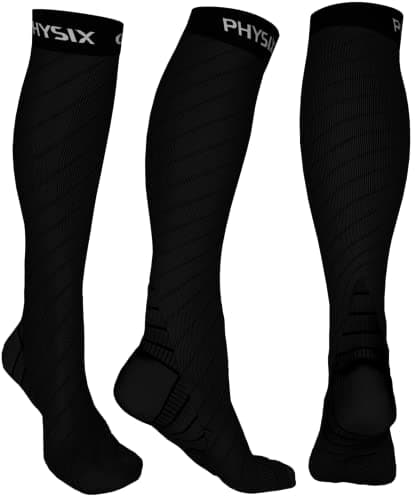
The pair we would hand almost anyone. Physix Gear's graduated 20-30 mmHg sock is the athletic class, this listing ships two pairs, and it costs less than a single pair from any performance brand here. Nothing on this page delivers more compression per dollar.
The best sock here to run in, and the only one engineered as athletic equipment rather than a medical garment with a sporty label. A published 20-30 mmHg, targeted zones at the calf, ankle, Achilles and arch, a blister-conscious toe seam and traction zones underfoot. It is also the most expensive pick on the page.
The one sock here built specifically for AFTER the session rather than during it — a thicker, plusher graduated knee-high aimed at reducing muscle oscillation and post-training soreness. Excellent at that job. 2XU does not publish an mmHg figure on this listing, which is the reason it is not higher.
A published 20-30 mmHg sock with a reinforced ankle structure, aimed at swelling and all-day wear rather than sport. Good value and a sensible build. The copper-fiber claims on the listing are marketing, and we would ignore them entirely when deciding.
The best sock here for wearing all day in normal clothes, and the only one that publishes a calf-circumference range for each size. A lighter 15-20 mmHg class — a deliberate choice, not a shortfall — in a soft nylon knit that does not look like sports equipment.
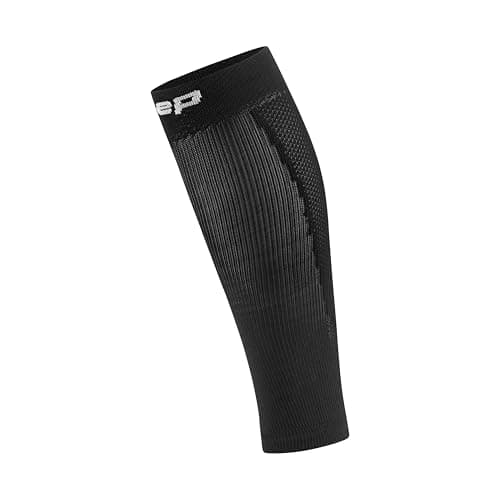
Not a sock, and on this page that is the point. A published 20-30 mmHg sleeve that compresses the calf and leaves the foot free, so you keep your own running socks and your own shoe fit. The right answer for shin splints and calf tightness; the wrong one for swelling.
#ad · Live prices from the Amazon Product API, as of October 18, 2026. Where we have no verified live price, we show none — a gap beats a number that has rotted.
In detail
The picks, in full
01
Best overall
Physix Gear Compression Socks
20-30 mmHg classGraduated profileTwo pairs per listingReinforced arch + heel
8.2/10
The pair we would hand almost anyone. Physix Gear's graduated 20-30 mmHg sock is the athletic class, this listing ships two pairs, and it costs less than a single pair from any performance brand here. Nothing on this page delivers more compression per dollar.
Compression class
9
Fit & sizing
7
Durability
7
Comfort
8
Value
10
Pros
+Two pairs in the box, which matters because you want a clean pair while the other dries
+20-30 mmHg is the class with the most support behind it for soreness and swelling
+Reinforced arch and heel support, so it holds its shape over a long day on your feet
+Cheap enough that replacing them when the elastic tires is not a real decision
Cons
−Marketplace listing copy is keyword soup and this particular variant's title omits the mmHg figure — the brand publishes 20-30 mmHg on its sibling listings
−Sizing runs by shoe size rather than calf circumference, which is the less reliable method
−Plain black athletic look; nothing you would wear with a suit
Don't buy this if…
…you have a wide calf — this is the listing most likely to feel tight at the top band, and a sock that digs in at the knee is one you will stop wearing.
This is the sock we already point at from our boots versus socks comparison, and ranking the whole category has not dislodged it. The reason is unglamorous: it is in the right compression class, the profile is graduated, it comes in pairs of two, and it costs roughly a third of what the performance brands charge. For a garment whose elastic is a consumable, that last point is not a footnote.
Set your expectations at the listing, not the brand. The copy is written for Amazon search rather than for you, and it leans on “blood pressure socks” language that we would not use — a sock does not treat blood pressure. What it does is hold graduated pressure on a tired lower leg for eight hours, which is the entire point.
20-30 mmHg publishedZoned calf / ankle / Achilles / archAir channels, quick-dryFlat toe seam + sole traction
8.4/10
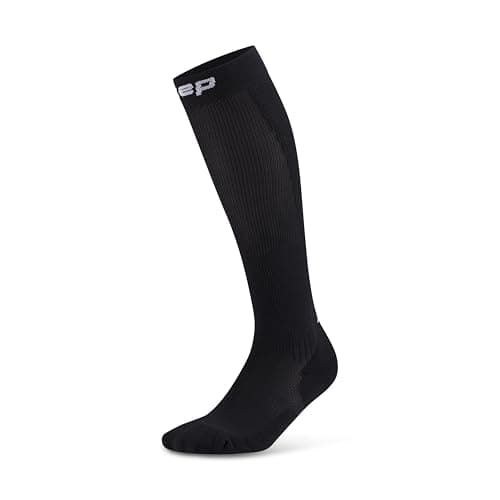
The best sock here to run in, and the only one engineered as athletic equipment rather than a medical garment with a sporty label. A published 20-30 mmHg, targeted zones at the calf, ankle, Achilles and arch, a blister-conscious toe seam and traction zones underfoot. It is also the most expensive pick on the page.
Compression class
10
Fit & sizing
9
Durability
9
Comfort
9
Value
5
Pros
+CEP publishes the 20-30 mmHg figure and states where the compression is targeted, which almost no sock does
+Breathable air channels and fast-drying yarn — the difference between a sock you race in and one you overheat in
+Smooth toe seam and impact cushioning aimed squarely at blisters and long-run foot fatigue
+Sized by leg measurement in numbered bands rather than by shoe size alone
Cons
−The most expensive pick here, and one pair per listing — three or four times the cost of the winner
−Sized and sold by gender and band (Men IV, Women III and so on), so the ASIN you land on is one specific size
−The knee-high cut is hot in summer and visibly athletic; nobody wears these to the office
Don't buy this if…
…you want compression for standing all day rather than running. The cushioning, traction and tall athletic cut are paid-for features you will not use at a desk.
CEP is the brand to beat if the sock has to work while you move. The compression is specified and zoned — calf, ankle, Achilles and arch — rather than applied as one uniform squeeze, and the construction details are the ones distance runners actually complain about: seam position, drying speed, and whether the sole slips inside the shoe. Those are not marketing adjectives, they are the reason a sock survives a marathon.
We rank it second rather than first purely on cost. If you run high mileage, buy these and ignore the rank — the per-wear cost over a season is small and the fit is better. If what you want is graduated pressure on the sofa afterwards, the winner does that job for a third of the money. For the sore-calf-specific version, CEP's own calf sleeves at the bottom of this list drop the foot entirely.
Graduated knee-highRecovery-specific buildTargeted calf / shin / Achilles panelsmmHg not published on listing
7.4/10
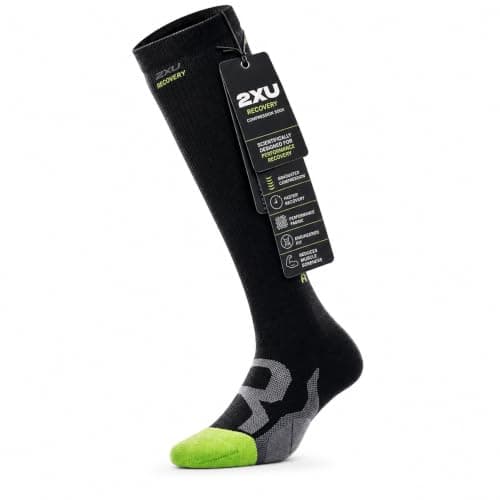
The one sock here built specifically for AFTER the session rather than during it — a thicker, plusher graduated knee-high aimed at reducing muscle oscillation and post-training soreness. Excellent at that job. 2XU does not publish an mmHg figure on this listing, which is the reason it is not higher.
Compression class
6
Fit & sizing
8
Durability
8
Comfort
9
Value
6
Pros
+Designed and sold as a recovery garment, not a running sock pressed into recovery duty
+Thicker, plusher knit than the race socks here — comfortable to leave on for hours or overnight
+Compression panels target the calf, shin and Achilles, the three areas that ache after hard running
+Unisex sizing keeps the choice simple
Cons
−No mmHg figure on the listing, so you cannot confirm the compression class before buying
−Mid-price and one pair per listing — more than twice the winner for a sock you cannot verify numerically
−Too thick to run in comfortably in warm weather
Don't buy this if…
…you want a number you can check. If a published compression class is what you are shopping for, the CEP or the Physix pairs state theirs and this one does not.
There is a real distinction between a sock you wear during exercise and one you pull on after, and almost nobody shopping for compression knows it. During exercise the job is to damp muscle vibration and manage heat, so the sock is thin and breathable. Afterwards the job is sustained venous return while you sit still, so a thicker, more comfortable knit you will leave on for three hours is better. 2XU built this for the second job and it shows.
The reason it sits mid-table is documentation. The listing describes graduated compression and targeted panels but never states a class, and we are not going to guess one on your behalf — the whole premise of this page is the number on the box. If you want the recovery-specific feel and accept that, it is a good sock. If you want the number, look up the list.
20-30 mmHg publishedReinforced ankle compression ringsCopper-infused nylon blendKnee-high, single pair
7.8/10
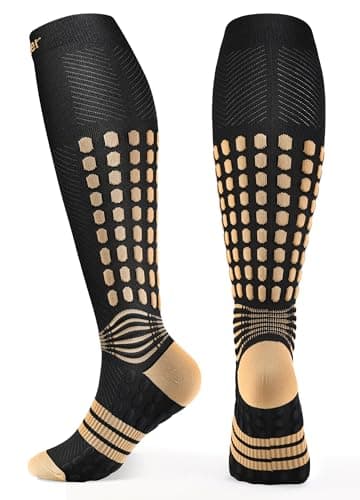
A published 20-30 mmHg sock with a reinforced ankle structure, aimed at swelling and all-day wear rather than sport. Good value and a sensible build. The copper-fiber claims on the listing are marketing, and we would ignore them entirely when deciding.
Compression class
9
Fit & sizing
7
Durability
7
Comfort
8
Value
8
Pros
+States its compression class plainly at a budget price, which is the main thing we ask of a sock
+Reinforced ankle and arch construction is the right place to put extra material for swelling
+Breathable knit that handles a ten-hour shift without turning clammy
+Widely available in standard sizes, so replacement is easy
Cons
−The copper-ion and anti-inflammatory claims are not supported by evidence we would stand behind — the compression is doing the work, not the metal
−The listing's 'Class 1 Medical Device' and 'doctors recommend' framing is the brand's own and should not be read as a clinical endorsement
−One pair per listing at a price close to the two-pair winner
Don't buy this if…
…you are buying for the copper. Strip that claim away and you have a competent 20-30 mmHg sock, priced about where a competent 20-30 mmHg sock should be.
Strip the listing down to what is checkable and this is a solid pick: a published 20-30 mmHg graduated knee-high with extra structure around the ankle, which is exactly where you want it if the complaint is end-of-day swelling rather than running performance. For nurses, warehouse work, long flights or standing all day, that specification is the one that matters.
We are flagging the marketing hard because it is the kind that works. Copper-infused fiber is a common upsell across compression wear and the evidence that it reduces inflammation or speeds recovery is not there. Buy this for the millimetres of mercury and the ankle construction, and treat the copper as a color option.
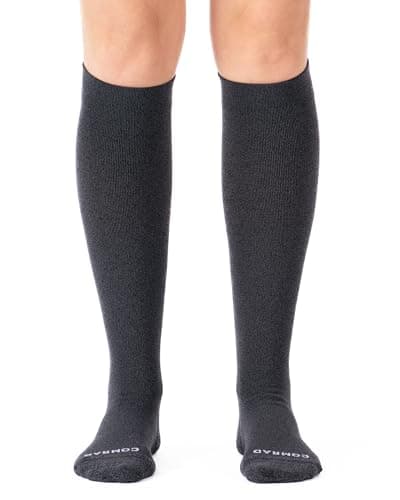
The best sock here for wearing all day in normal clothes, and the only one that publishes a calf-circumference range for each size. A lighter 15-20 mmHg class — a deliberate choice, not a shortfall — in a soft nylon knit that does not look like sports equipment.
Compression class
6
Fit & sizing
10
Durability
8
Comfort
10
Value
6
Pros
+Publishes calf circumference per size (Medium fits a 12-14 inch calf) — the single most useful sizing spec on this page
+15-20 mmHg is the right class for desk days, flights and pregnancy, where 20-30 is often too much to wear for twelve hours
+Soft, contoured nylon knit that genuinely passes as a normal sock under trousers
+Easy to get on and off, which is why people actually wear them daily
Cons
−15-20 mmHg is lighter than the athletic class — this is not the pair for post-marathon legs
−The most expensive sock here per pair after the CEP, for less compression
−One pair per listing, in a specific color and size
Don't buy this if…
…you want athletic-grade compression for recovery after hard training. Buy the 20-30 mmHg picks for that and keep these for the working day.
Comrad does the thing we wish every brand did: it tells you the calf circumference each size fits. Compression socks fail at the calf, not the foot — too loose and the gradient collapses, too tight and the top band digs a line into your leg and you stop wearing them. A 12-14 inch range for Medium is information you can act on with a tape measure.
The 15-20 mmHg class is a deliberate match for the use case. Twelve hours of 20-30 mmHg is more than most people want when they are not recovering from anything; a lighter graduated class worn all day beats a firmer one you take off at lunch. If your legs ache because you sit at a desk for nine hours, this is the pick — and a walking pad under that desk addresses the other half of the problem.
20-30 mmHg at the calfFoot left uncoveredAir channels, quick-drySized by calf band
8.0/10
Not a sock, and on this page that is the point. A published 20-30 mmHg sleeve that compresses the calf and leaves the foot free, so you keep your own running socks and your own shoe fit. The right answer for shin splints and calf tightness; the wrong one for swelling.
Compression class
9
Fit & sizing
8
Durability
9
Comfort
8
Value
6
Pros
+Keeps your preferred running sock and shoe fit — no compromise on the part that causes blisters
+Published 20-30 mmHg aimed at calf tightness, shin splints and muscle vibration
+Washes and dries fast, and lasts longer than a sock because there is no heel or toe to wear through
+Easy to pull on over a sore calf without fighting a foot section
Cons
−No foot compression, so it does nothing for ankle or foot swelling — the most common reason people buy compression at all
−Leaves a visible pressure line at the ankle on some legs
−Costs nearly as much as the full CEP sock while covering less of the leg
Don't buy this if…
…your feet and ankles are what swell. A sleeve stops at the ankle, and the graduated gradient that fights swelling has to start below it.
Sleeves and socks get shelved together and shopped interchangeably, and they are not interchangeable. A sleeve compresses the calf only. That is ideal if the complaint is calf tightness or shin splints while running, because you keep the sock and shoe combination you already know works. It is actively wrong if the complaint is swollen feet or ankles, because the gradient that moves fluid upward has to begin at the foot.
Ranked as a sleeve among socks it lands here: excellent at its narrow job, useless at the broader one. Know which problem you have before you choose the shape.
The three things that decide whether a compression sock works
Everything else on a sock listing is noise. These three are checkable before you buy, and two of them are printed on the box.
Compression class, in mmHg. The pressure the sock applies at the ankle. 8-15 mmHg is barely more than a firm sock. 15-20 mmHg is the all-day desk, travel and pregnancy class. 20-30 mmHg is the athletic and swelling-relief class, and it is where most people reading a recovery site should land. Above 30 mmHg is prescription territory and not something to self-select. A sock that publishes no number is a tight sock, and there are plenty of those.
Graduated, not uniform. The pressure must be highest at the ankle and decrease up the calf. That gradient is the mechanism — it works with the valves in your veins to move blood and fluid toward the heart. A sock that squeezes evenly, or worse squeezes hardest at the top band, can impede return rather than help it. Every pick on this page is graduated and says so.
Fit at the calf, not the shoe size. This is where compression socks actually fail. Too loose and the gradient never forms; too tight and the cuff bites, your leg marks, and the pair ends up in a drawer. Measure the widest part of your calf with a tape measure and buy against that. Comrad publishes a circumference range per size and CEP sizes by leg bands; most budget socks only give shoe size, which is why a size up is often the safer order.
The class, the cut and who each one is for
Pick
Published class
Cut
Best use
Physix Gear
20-30 mmHg (brand)
Knee-high sock, 2 pairs
General recovery and long days on your feet
CEP Core Run Tall 5.0
20-30 mmHg
Knee-high running sock
Wearing while you run
2XU Recovery
Not published
Thicker knee-high sock
After training, sitting still
NEENCA Professional
20-30 mmHg
Knee-high sock
Swelling, standing shifts, flights
Comrad Knee High
15-20 mmHg
Knee-high, street-wearable
All day at a desk, travel, pregnancy
CEP Calf Sleeves 5.0
20-30 mmHg
Calf sleeve, no foot
Calf tightness and shin splints
A note on how to read that table: a listing links one specific size and color. Compression is the one category where the size is the product, so check the brand's own chart against a tape measurement of your calf before you order, and use the search fallback if the size you need is not the one the link lands on.
What the evidence actually supports
We will not oversell this. The strongest, most consistent finding for compression garments in sport is reduced perceived muscle soreness in the day or two after hard exercise — people report that their legs feel better. Evidence that compression meaningfully improves performance, or restores power output faster, is far weaker and inconsistent. Separately, and on much firmer ground, graduated compression is standard clinical practice for venous insufficiency, swelling and long-haul travel, which is a different use with a different literature behind it.
That combination is still a good deal, because the cost is twenty dollars and the downside is essentially nil for most people. It is the same honest framing we apply to the pneumatic systems in do compression boots work? — both categories are best understood as making tired legs feel better, not as making you faster.
When NOT to wear compression socks
Compression is not universally safe, and this is the part most listings leave out. If you have peripheral arterial disease, significant peripheral neuropathy, a skin infection or open wound on the leg, or uncontrolled heart failure, graduated compression can be the wrong thing and you should ask a clinician before using it. The same goes for anyone who has been told to use a specific prescribed class. Nothing here is medical advice, and a sock that causes numbness, tingling, color change or pain should come off.
If you already own a good pair and want the next step up in recovery, that is where the pneumatic systems come in — they do in 30 minutes what a sock does over eight hours. Our budget boots shortlist is the cheapest honest entry point, and the recovery gear starter kit argues that a twenty-dollar pair of socks should come before any of it.
How we picked
We did not lab-test this gear
Everyone in this category says they tested twenty products. We have not lab-tested any of these, and we say so. What we did instead: compiled the published specifications, pulled the numbers from the manufacturer manuals, ran the cost-to-run and cost-per-unit math where there was math to run, and scored each product against a published rubric. The scores are judgments from documented research — not measurements we took, because we do not have a lab and we will not pretend we do. Where a number came from someone else's work, we name them in Sources.
Questions
Frequently asked
What mmHg compression socks should I buy?+
For recovery after training, or for swelling and long days on your feet, 20-30 mmHg is the class to buy. For all-day wear at a desk, flights or pregnancy, 15-20 mmHg is more comfortable over twelve hours and is the right choice rather than a lesser one. Anything above 30 mmHg is prescription territory. If a sock does not publish a number at all, assume it is not in a meaningful class.
What are the best compression socks for recovery?+
The Physix Gear graduated 20-30 mmHg pair is the best buy for most people — right class, two pairs per listing, and a fraction of the price of the performance brands. If you want a sock built specifically for after the session rather than during it, the 2XU Recovery sock is thicker and more comfortable to sit in, with the caveat that 2XU does not publish an mmHg figure for it.
Should you wear compression socks during or after exercise?+
Either works, and they are different products. During exercise you want a thin, breathable, zoned sock that damps muscle vibration and manages heat — that is what the CEP Core Run is. Afterwards you want a thicker, plusher knit you will leave on for a couple of hours while you sit still, which is what the 2XU Recovery sock is built for. Wearing one pair for both jobs is fine; it just will not be ideal at either.
How do I size compression socks?+
Measure the widest part of your calf with a tape measure and buy against the brand's circumference chart — not against your shoe size. The calf is where compression socks fail: too loose and the gradient never forms, too tight and the cuff cuts in and you stop wearing them. Comrad publishes a calf range per size (12-14 inches for Medium) and CEP sizes by numbered leg bands; with shoe-size-only listings, sizing up is usually the safer order.
Are compression socks or compression boots better?+
They do the same thing on different schedules. Boots apply far more pressure in a 20-30 minute session; socks apply less for eight or ten hours and cost roughly a fiftieth as much. For most people socks are the better first purchase, and boots are an upgrade once you are training hard enough to want the stronger dose. We compare them directly in boots vs socks.
Do copper compression socks work better?+
There is no evidence we would stand behind that copper-infused fiber reduces inflammation or speeds recovery. The compression is doing the work. Copper socks are often perfectly good socks — the NEENCA pair on this list is one — but buy them for the published mmHg class and the construction, not for the metal in the yarn.
Can you sleep in compression socks?+
Generally there is no need to. The gradient is designed to fight gravity while you are upright; lying down does much of that work for you. Athletes sometimes wear a lighter recovery sock overnight after a hard session and it is usually harmless, but it is not where the benefit is, and nobody should sleep in a firm 20-30 mmHg sock without being told to by a clinician.
Should you wear compression socks or calf sleeves?+
Sleeves compress the calf and leave the foot bare, so you keep your own running socks — good for calf tightness and shin splints. They do nothing for foot or ankle swelling, because the graduated gradient that moves fluid upward has to start below the ankle. If swelling is your reason for buying, choose a sock.
We do not run a testing lab, and we do not pretend to. Where a measured number came from someone else's work, we name them and link them. Where we could not verify something, we say so on the page rather than quietly leaving it out. Read our full method.