Skip to content
Rep & Recovery

Compression · Compression Boots

How long should you wear compression socks?

The honest answer is a schedule, not a number: on when you get up, off when you go to bed, and longer only when someone who has examined you says so. Here is the breakdown by use case, and the signs you have the wrong pair.

By Stephen V.Updated How we review
#ad

We earn a commission when you buy through our Amazon links, at no extra cost to you. It never changes a verdict, and we say so when the cheaper product is the better buy. How this works.

For everyday use, put them on when you get up and take them off at bedtime. Eight to twelve hours of wear while you are upright is the normal pattern, and for most healthy people there is no reason to sleep in them. Compression works against gravity, and gravity stops being the problem the moment you lie down. If you want one pair that covers the common cases, the Physix Gear 20-30 mmHg socks are the best class-per-dollar pick we rank.

Everything beyond that depends on why you are wearing them, so the useful answer is a table rather than a sentence. One caveat applies to the whole page: anything post-surgical, prescribed, or related to a diagnosed vein or circulation condition follows your clinician's instructions, not ours. Those protocols are specific to the person, frequently include overnight wear, and are not something a buying guide should be improvising.

How long, by use case

  • Desk work and long sitting: all day, 8-10 hours. A light 15-20 mmHg class is usually right. The problem you are solving is blood pooling in still legs, and that runs the whole working day.
  • Standing or walking all day: all shift, plus the commute. This is the use case compression suits best. Put them on before the shift, not after your legs already feel heavy.
  • Running or training, during: the session only. Evidence for performance benefit is thin; most runners wear them for comfort and because they reduce vibration and chafing.
  • Recovery after hard training: 1-3 hours.This is where the evidence is strongest — a Sports Medicine meta-analysis of compression garments found reduced perceived soreness afterwards rather than restored performance. A couple of hours with your feet up covers it.
  • Flights: the whole flight, plus an hour either side. On before you leave for the airport, off when you arrive. The risk period is sitting still, and it starts in the departure lounge.
  • Pregnancy: daytime wear, usually all day. Common and usually sensible, but confirm the class with your midwife or doctor rather than guessing.
  • Post-surgery, diagnosed swelling, venous insufficiency or lymphoedema: exactly as instructed. These protocols often do include overnight wear and specific classes; follow the instruction you were given.

Why not to sleep in them

Graduated compression is designed to help blood climb back up the leg against gravity. Lying flat removes that problem, so the pressure is doing much less — while the sock still has all night to bunch behind the knee, roll at the top band, or sit twisted. For a healthy person, wearing them 24 hours a day adds risk without adding benefit.

The exception is real and common: post-surgical and some medical protocols do specify overnight wear, because the goal there is clot prevention rather than comfort. If you were told to wear them at night, wear them at night.

Signs you have the wrong pair, or have worn them too long

Take them off and reassess if you get numbness, tingling or pins and needles; deep indentation lines that are still visible half an hour later; colour changes in the toes; skin that breaks or blisters at the top band; or pain rather than firmness. A well-fitted sock feels snug and supportive, and you forget about it within ten minutes.

A faint sock-line impression after a full day is normal. A deep groove is not, and usually means the band is too tight at the top or the sock is a size too small. Rolling the top band down to relieve it is the one thing never to do — a rolled band becomes a tourniquet.

Which class, and why it changes the answer

15-20 mmHg is the all-day class: desk work, flights, pregnancy, mild heaviness. It is light enough to wear for twelve hours without resenting it. 20-30 mmHg is the athletic and heavy-legs class: standing work, post-training recovery, noticeable swelling by evening. Many people find 20-30 too much for twelve straight hours and perfect for four. Above 30 mmHg is medical territory and should be fitted and prescribed, not bought on a hunch. The shelf is ranked by class in best compression socks.

How to put them on, and when

First thing in the morning, before your legs have had a chance to swell — a sock that fits at 7am can be a fight at 7pm. Turn the sock inside out to the heel, slide the foot in, then roll the leg up rather than yanking the top band. Smooth out every wrinkle; a fold concentrates pressure exactly where you do not want it. Rubber washing-up gloves make this dramatically easier and are the standard trick for anyone with weak hands or arthritis.

When to replace them

Compression comes from elastic fibres, and elastic fades. With daily wear and washing, plan on three to six monthsper pair. The tell is that they go on easily — the day a pair that used to be a struggle slides on without effort is the day it stopped delivering its rated class. Wash after every wear in cool water, and never tumble dry: heat is what kills elastane. Owning two or three pairs and rotating them extends the life of all of them.

Who should not wear them without medical advice

Peripheral arterial disease, significant neuropathy, an active skin infection or cellulitis, uncontrolled heart failure, or any open wound on the leg. In those cases firm compression can do harm, and it needs a clinician's assessment first rather than a product review.

Three pairs, matched to how long you will wear them

Scored on the things that decide whether a sock survives a full day: comfort over hours, whether the brand publishes its compression class, how confidently you can size it, and durability. Prices are live and stamped with the date they were checked.

The short answer

Quick picks

#ProductBest forScorePrice
01
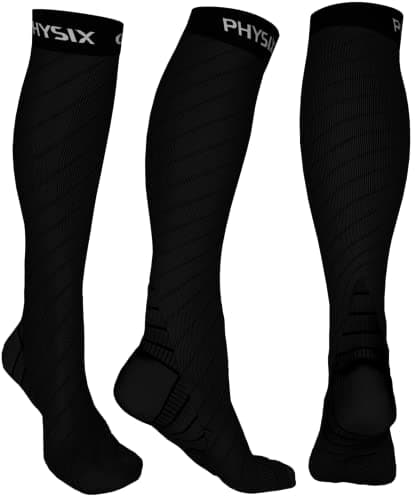
Physix Gear Physix Gear Compression Socks
Physix Gear Compression Socks

The best class-per-dollar pair we rank, and the sensible default if you are buying your first. A published graduated 20-30 mmHg — firm enough for standing shifts and post-training recovery — at a price that makes owning three pairs and rotating them realistic, which is what actually keeps compression working.

Best all-rounder
8.2
$19.20Amazon
02
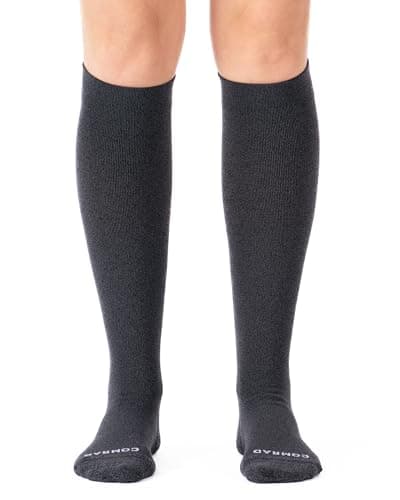
Comrad Comrad Knee High Compression Socks
Comrad Knee High Compression Socks

The pair to buy if the answer to this page's question is 'all day, every day'. A lighter 15-20 mmHg class is a deliberate choice for twelve-hour wear rather than a shortfall, and Comrad is the only brand here that publishes a calf-circumference range per size — which is the specification that decides whether a sock is comfortable at hour ten.

Best for all-day and travel wear
8.4
$33.99Amazon
03
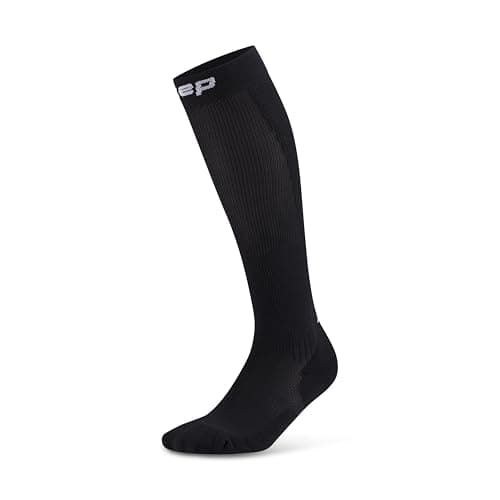
CEP CEP Core Run Tall Compression Socks 5.0
CEP Core Run Tall Compression Socks 5.0

The pair for the shortest wear window on this page: one to three hours after a hard session, or the session itself. A published 20-30 mmHg with targeted zones at the calf, ankle, Achilles and arch, built as athletic equipment rather than as a medical garment with a sporty label — and priced accordingly.

Best for training and the recovery window
7.8
$59.90Amazon

#ad · Live prices from the Amazon Product API, as of October 18, 2026. Where we have no verified live price, we show none — a gap beats a number that has rotted.

In detail

The picks, in full

01
Physix Gear Physix Gear Compression Socks

Best all-rounder

Physix Gear Compression Socks

20-30 mmHgGraduated (class 1)Nylon/spandexNo power needed
8.2/10

The best class-per-dollar pair we rank, and the sensible default if you are buying your first. A published graduated 20-30 mmHg — firm enough for standing shifts and post-training recovery — at a price that makes owning three pairs and rotating them realistic, which is what actually keeps compression working.

All-day comfort
7
Published class
9
Sizing confidence
7
Durability
8
Value
10

Pros

  • Published graduated 20-30 mmHg — tighter at the ankle, which is the whole mechanism
  • Cheap enough to own several pairs, which is how you avoid wearing a dead one
  • Works for standing work, flights, travel and post-run recovery alike
  • Washable, packable and needs nothing but legs

Cons

  • 20-30 mmHg is more than some people want for a twelve-hour day
  • Fixed pressure, so sizing has to be right or it is uncomfortable
  • Athletic cut and look — not a sock that passes unnoticed in every setting

Don't buy this if…

…you want something light enough to forget about across a full working day — the 15-20 mmHg Comrad below is the better class for that.

$19.20View on Amazon

Price as of October 18, 2026. Prices change — Amazon's at checkout is the one that counts.

#ad · we may earn a commission from this link to Physix Gear Compression Socks

02
Comrad Comrad Knee High Compression Socks

Best for all-day and travel wear

Comrad Knee High Compression Socks

15-20 mmHg publishedSized by calf circumference91% nylon / 9% spandexOdor-control treatment
8.4/10

The pair to buy if the answer to this page's question is 'all day, every day'. A lighter 15-20 mmHg class is a deliberate choice for twelve-hour wear rather than a shortfall, and Comrad is the only brand here that publishes a calf-circumference range per size — which is the specification that decides whether a sock is comfortable at hour ten.

All-day comfort
10
Published class
8
Sizing confidence
10
Durability
8
Value
6

Pros

  • Publishes calf circumference per size — Medium fits a 12-14 inch calf
  • 15-20 mmHg is the right class for desk days, flights and pregnancy
  • Soft contoured knit that passes as a normal sock under trousers
  • Easy to get on and off, which is why people actually wear them daily

Cons

  • Lighter than the athletic class — not the pair for post-marathon legs
  • Expensive per pair for less compression
  • One pair per listing, in a specific colour and size

Don't buy this if…

…you want recovery-grade compression after hard training. Keep these for the working day and buy a 20-30 mmHg pair for that.

$33.99View on Amazon

Price as of October 18, 2026. Prices change — Amazon's at checkout is the one that counts.

#ad · we may earn a commission from this link to Comrad Knee High Compression Socks

03
CEP CEP Core Run Tall Compression Socks 5.0

Best for training and the recovery window

CEP Core Run Tall Compression Socks 5.0

20-30 mmHg publishedZoned calf / ankle / Achilles / archAir channels, quick-dryFlat toe seam + sole traction
7.8/10

The pair for the shortest wear window on this page: one to three hours after a hard session, or the session itself. A published 20-30 mmHg with targeted zones at the calf, ankle, Achilles and arch, built as athletic equipment rather than as a medical garment with a sporty label — and priced accordingly.

All-day comfort
6
Published class
10
Sizing confidence
9
Durability
9
Value
5

Pros

  • Publishes both the mmHg figure and where the compression is targeted
  • Breathable air channels and quick-drying yarn for wear during exercise
  • Smooth toe seam and underfoot cushioning aimed at blisters and long-run fatigue
  • Sized by leg measurement in numbered bands rather than shoe size alone

Cons

  • The most expensive pick here, and one pair per listing
  • Sized and sold by gender and band, so a listing is one specific size
  • Hot in summer and visibly athletic — nobody wears these to the office

Don't buy this if…

…you want compression for standing all day. The cushioning, traction and tall athletic cut are paid-for features a desk day does not use.

$59.90View on Amazon

Price as of October 18, 2026. Prices change — Amazon's at checkout is the one that counts.

#ad · we may earn a commission from this link to CEP Core Run Tall Compression Socks 5.0

Duration by use case

Why you are wearing themHow longUsual classOvernight?
Desk work, long sitting8-10 hours, the working day15-20 mmHgNo
Standing or walking all dayThe whole shift plus commute15-20 or 20-30 mmHgNo
During a run or trainingThe session20-30 mmHgNo
Recovery after hard training1-3 hours20-30 mmHgNo
Long-haul flightThe flight plus an hour either side15-20 mmHgNo
PregnancyDaytime, often all dayAsk your midwife or doctorAsk
Post-surgery or a diagnosed conditionExactly as instructedPrescribedOften yes — follow the instruction

Socks, or a pump?

The duration question is really a dose question, and the two tools deliver it very differently. Socks apply a light pressure for eight or ten hours; compression boots apply a strong sequential pressure for twenty or thirty minutes. For heavy legs from standing all day, the long light dose is usually the better one — and it costs roughly a fiftieth as much. For post-training flushing, the short strong dose has more to recommend it. The direct comparison is in compression boots vs socks, and whether a pump is worth owning at all is argued in are compression boots worth it.

What the evidence supports

For athletes, the consistent finding across the compression-garment literature is reduced perceivedsoreness and fatigue after exercise; evidence that compression restores performance faster is much weaker. For sitting still on long journeys, graduated compression is a well-established measure for reducing leg swelling. For diagnosed venous disease, compression therapy is standard care — and in that setting it is prescribed, fitted and monitored, which is exactly why this page keeps handing those cases back to a clinician.

Care, so the class survives

Wash after every wear in cool water with a mild detergent. No fabric softener, no bleach, no tumble dryer — heat and softener both destroy elastane, which is where the compression lives. Air dry flat. Keep nails and rough skin away from the fabric when pulling them on, because a snagged fibre becomes a run and a run becomes a dead sock.
How we picked

We did not lab-test this gear

Everyone in this category says they tested twenty products. We have not lab-tested any of these, and we say so. What we did instead: compiled the published specifications, pulled the numbers from the manufacturer manuals, ran the cost-to-run and cost-per-unit math where there was math to run, and scored each product against a published rubric. The scores are judgments from documented research — not measurements we took, because we do not have a lab and we will not pretend we do. Where a number came from someone else's work, we name them in Sources.

Questions

Frequently asked

Can you wear compression socks all day?
Yes — all day while you are up and about is the normal pattern, typically eight to twelve hours. Take them off at bedtime unless a clinician has told you otherwise, and take them off sooner if you get numbness, tingling, colour changes in the toes or deep marks that persist.
Should you sleep in compression socks?
Not normally. Compression works against gravity and lying flat removes that problem, so overnight wear adds the risk of bunching and rolling without much benefit. Post-surgical and some medical protocols do specify overnight wear — if you were given that instruction, follow it.
How long should you wear compression socks after a workout?
One to three hours covers it. The consistent finding in the compression-garment literature is reduced perceived soreness afterwards rather than faster performance recovery, and a couple of hours with your legs up captures that. The shelf is ranked in best compression socks.
How long should you wear compression socks on a flight?
Put them on before you leave for the airport and take them off when you arrive. The risk period is sitting still, which starts well before takeoff and continues through baggage reclaim. A 15-20 mmHg class is the usual choice for travel.
How tight should compression socks be?
Snug and firm everywhere, tightest at the ankle, and forgettable within ten minutes. Numbness, tingling, toe colour changes, pain or indentation grooves that last half an hour after removal all mean the pair is too tight or too small. Never roll the top band down to relieve pressure — a rolled band behaves like a tourniquet.
How often should you replace compression socks?
Every three to six months with daily wear. The signal is that they become easy to put on: the elastane has fatigued and the rated compression has gone with it. Rotating two or three pairs extends the life of all of them.
Who should not wear compression socks?
Anyone with peripheral arterial disease, significant neuropathy, an active skin infection or cellulitis, uncontrolled heart failure, or an open wound on the leg should get medical advice before using firm compression. In those situations compression can do harm rather than good.

Keep reading

Receipts

Sources

We do not run a testing lab, and we do not pretend to. Where a measured number came from someone else's work, we name them and link them. Where we could not verify something, we say so on the page rather than quietly leaving it out. Read our full method.