Skip to content
Rep & Recovery

Mobility · Foam Rollers

The best recovery shoes and slides

A recovery shoe is a thick, soft platform with a contoured footbed and a deep heel cup. That is the entire mechanism — and it is also why a flat slide is not a recovery shoe, whatever the label on the box says.

By Stephen V.Updated How we review
#ad

We earn a commission when you buy through our Amazon links, at no extra cost to you. It never changes a verdict, and we say so when the cheaper product is the better buy. How this works.

Recovery footwear is the easiest category on this site to oversell and the easiest to get wrong. The pitch is that a sixty-dollar slide helps your legs recover. The honest version is narrower and more useful: these shoes take load off the underside of the foot and hold the heel in a fixed position, which is why standing in them after a long run, a double shift or a day in dress shoes feels dramatically better than standing barefoot on a hard floor. That is a real effect with a real mechanism. It is not the same claim as "recovers your muscles faster."

We looked for controlled evidence that recovery footwear speeds muscle recovery or reduces delayed-onset soreness and did not find any — the published soreness trials cover compression, percussion, cold water and the rest of the gear in this hub, not shoes. What does exist, and it is better than we expected, is a 2025 randomized trial in the Malaysian Journal of Medical Sciences: 66 people with plantar fasciitis, split in two, everyone getting eight weeks of physical therapy and home exercise, with half also given arch-supportive, shock-absorbing flip-flop sandals to wear. The sandal group improved significantly more on first-step-after-rest pain. Its authors ask for larger trials before anyone treats that as settled, and so do we — but it points at the same thing the product specs do.

The spec that decides everything here is the shape of the footbed, not the softness of the foam. Cleveland Clinic's plantar fasciitis guidance is blunt about it: wear "sturdy, well-cushioned shoes," and "don't wear sandals, flip-flops or other flat shoes without built-in arch support." A soft, flat slide is the exact item that advice warns about. A recovery slide earns the name when it has a molded arch, a deep cupped heel and enough platform thickness to blunt the floor — so this ranking leads on footbed contour and heel cup, and treats raw squish as a tiebreaker. The same logic runs through best foot massagers, where the cheapest tool on the page is the one the orthopedic guidance actually describes.

Two notes on how this list was built. Availability: the Hoka Ora Recovery Slide 3 and Kane Revive are the two names readers ask about after OOFOS, and neither is ranked. On the day we checked, Hoka recovery footwear was on Amazon only through marketplace sellers, above list price, in scattered sizes; Kane sells direct from its own site. We rank what you can buy through our merchant at a sane price and say so, rather than padding the list. Sizing: Amazon lists footwear as a separate product for every size and color, so the price on each button below belongs to the one variant we linked and verified. The identical sandal in another color is frequently several dollars cheaper or dearer — check the colorway strip on the listing, and use the search link if your size is not the one we linked.

The short answer

Quick picks

#ProductBest forScorePrice
01
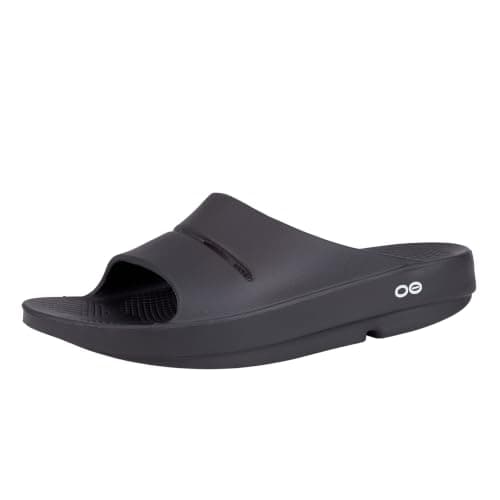
OOFOS OOFOS OOahh Recovery Slide
OOFOS OOahh Recovery Slide

The category's reference product and still the first thing most people should buy. OOFOS publishes the number nobody else does — OOfoam, it says, absorbs 37% more impact than traditional footwear foam — and pairs it with a patented cupped-heel footbed, an APMA Seal of Acceptance and a closed-cell foam you can put through a washing machine. Whole sizes only and a fixed strap are the honest limits. For a shoe you step into at the end of a session and shuffle around the house in, nothing here beats it.

Best overall
8.5
$59.95Amazon
02
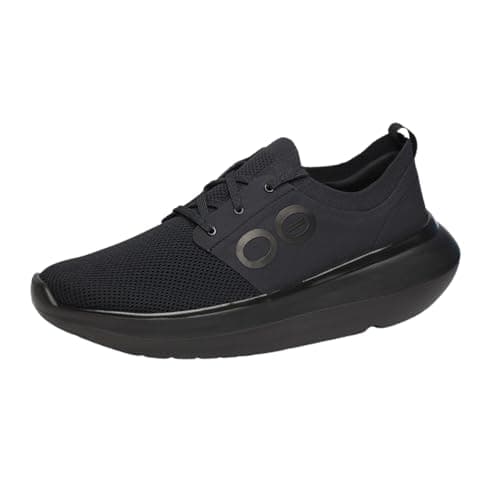
OOFOS OOFOS OOmy Stride Recovery Shoe
OOFOS OOmy Stride Recovery Shoe

The same OOfoam platform in a closed, laced shoe you can walk a city in — the pick for anyone who needs recovery cushioning during the day rather than after it. OOFOS gives it a 6 mm drop, a reshaped footbed geometry with a support cradle that rises outside the footbed to keep the foot centered, a pillowed collar that keeps the heel counter off the Achilles, and half sizes from 5 to 15. It costs about twice the slide, which is the only real argument against it.

Best for standing all day
8.3
$119.95Amazon
03
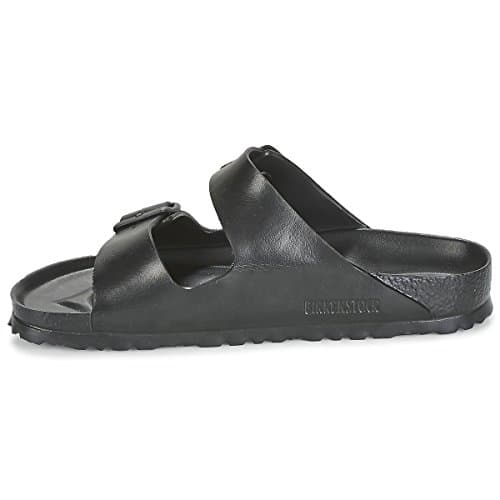
Birkenstock Birkenstock Arizona Essentials EVA
Birkenstock Arizona Essentials EVA

The support-first answer, and the opposite philosophy to everything else on this page. One piece of molded EVA carrying Birkenstock's famous footbed shape: a very deep heel cup that holds the heel bone in position, longitudinal arch supports either side plus a transverse support through the middle, and raised toe grips at the front. Firm rather than squishy, sold in two widths across the full US 4 to 16.5 range, and the pick if your feet want holding still rather than cushioning.

Best arch support
8.3
$49.95Amazon
04
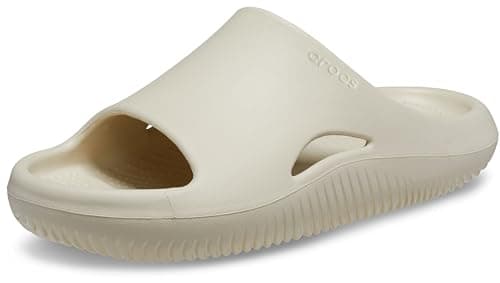
Crocs Crocs Mellow Recovery Slide
Crocs Mellow Recovery Slide

The cheapest slide here that is genuinely built around a recovery footbed rather than just soft foam. Crocs gives the Mellow a deep, cupped footbed and describes the feel as sink-in with a slow rebound, which is an accurate description of wearing them. What you give up is documentation: no published impact figure, no podiatric seal and no spec sheet, so it is graded on shape rather than numbers. For a first pair, or a spare pair by the door, that is a fair trade.

Best budget slide
7.5
$39.95Amazon
05
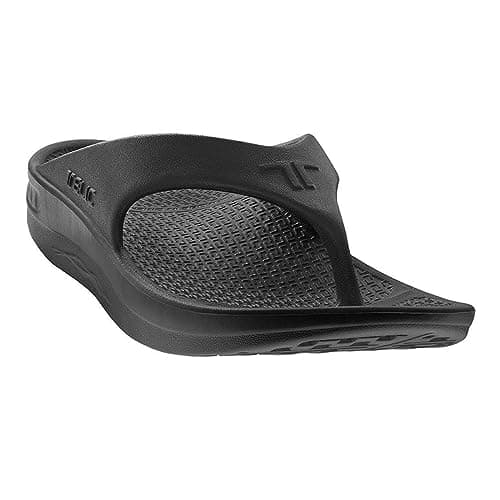
Telic Telic Energy Flip Flop
Telic Energy Flip Flop

The thong-shaped option, and the lightest thing on this page. Telic molds these from Novalon, a body-heat-activated waterproof foam, over an anatomical footbed with a deep heel cup cradle and stated medial arch and metatarsal support — the correct shape for a recovery sandal and a rarity in a flip-flop. Made in the USA, usually the cheapest pick here, and the one to buy if a strap across the forefoot bothers you.

Best thong style
7.3
$30.58Amazon
06
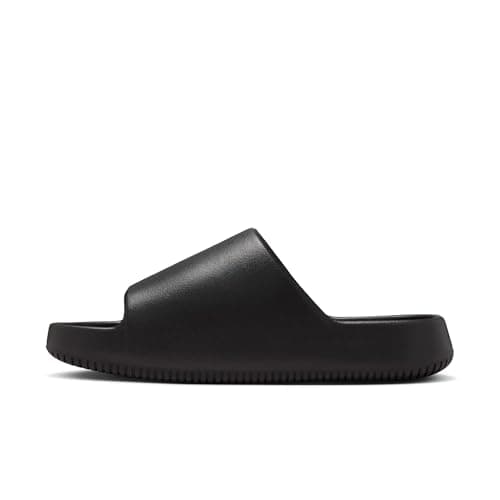
Nike Nike Calm 2.0 Slide
Nike Calm 2.0 Slide

Ranked last, and ranked honestly: this is the best of the comfortable gym-bag slides that are not recovery footwear. Nike describes a single piece of soft yet supportive foam with a textured footbed for grip, a water-friendly shell and a rubber outsole — all true, all pleasant, and none of it a contoured arch or a deep heel cup. As something soft to walk out of the gym in, it is a good slide. Bought for heel or arch pain, it is the wrong shape.

Best plain soft slide
6.2
$44.00Amazon

#ad · Live prices from the Amazon Product API, as of Oct 3, 2026. Where we have no verified live price, we show none — a gap beats a number that has rotted.

In detail

The picks, in full

01
OOFOS OOFOS OOahh Recovery Slide

Best overall

OOFOS OOahh Recovery Slide

20 mm platform9.9 oz per pairAPMA Seal of AcceptanceMachine washable
8.5/10

The category's reference product and still the first thing most people should buy. OOFOS publishes the number nobody else does — OOfoam, it says, absorbs 37% more impact than traditional footwear foam — and pairs it with a patented cupped-heel footbed, an APMA Seal of Acceptance and a closed-cell foam you can put through a washing machine. Whole sizes only and a fixed strap are the honest limits. For a shoe you step into at the end of a session and shuffle around the house in, nothing here beats it.

Impact absorption
10
Arch & heel support
9
Walkability
7
Fit range
6
Care & durability
9
Value
10

Pros

  • The only pick with a published impact-absorption figure to compare at all
  • Rounded, cupped heel plus a molded arch — the footbed shape the clinical advice asks for
  • Closed-cell foam: machine washable, air dry, and it neither soaks up sweat nor pools water
  • APMA Seal of Acceptance, meaning a panel of podiatrists reviewed it for foot health
  • At roughly sixty dollars, the cheapest way into genuinely engineered recovery foam

Cons

  • Whole sizes only (men's 3-14) and no width options — half-size feet have to choose
  • Fixed, non-adjustable strap, so a high instep or a wide forefoot gets no give
  • The 37% figure is OOFOS's own claim, not independent testing
  • An open slide holds the foot on by friction, which caps how far you can walk in it

Don't buy this if…

…you want to walk any distance — a slide with a fixed strap has nothing securing your foot, and the OOmy Stride below is the version of this foam you can actually cover ground in.

The OOahh is a single piece of molded OOfoam roughly 20 mm thick at the platform, with the arch and the heel cup built into the shape rather than added as a separate footbed. That construction is both why it works and why it cleans up: there is no fabric, no glued-in insole and no seam for sweat to live in. OOFOS publishes 9.9 oz for a pair, light enough that people genuinely pack them for travel.

Where to set expectations: the heel cup and the arch do most of the useful work and the foam does the rest. Coming off a long run or a twelve-hour shift, the difference between this and a flat flip-flop is immediate. Hoping it will take yesterday's squat soreness out of your quads is a different matter — it will not, and that is what the rest of this hub is for. Buy it as the thing you put on when the shoes come off.

$59.95View on Amazon

Price as of Oct 3, 2026. Prices change — Amazon's at checkout is the one that counts.

#ad · we may earn a commission from this link to OOFOS OOahh Recovery Slide

02
OOFOS OOFOS OOmy Stride Recovery Shoe

Best for standing all day

OOFOS OOmy Stride Recovery Shoe

6 mm dropHalf sizes 5-15Pillowed heel collarMachine washable
8.3/10

The same OOfoam platform in a closed, laced shoe you can walk a city in — the pick for anyone who needs recovery cushioning during the day rather than after it. OOFOS gives it a 6 mm drop, a reshaped footbed geometry with a support cradle that rises outside the footbed to keep the foot centered, a pillowed collar that keeps the heel counter off the Achilles, and half sizes from 5 to 15. It costs about twice the slide, which is the only real argument against it.

Impact absorption
10
Arch & heel support
9
Walkability
10
Fit range
9
Care & durability
7
Value
5

Pros

  • A closed shoe, so the cushioning is available on a commute or a shift, not just at home
  • Half sizes across a full men's and women's range — by far the best fit coverage here
  • A support cradle outside the footbed keeps the foot centered on a very soft platform
  • Pillowed collar and a 6 mm drop keep pressure and tension off the Achilles insertion
  • Still machine washable, with an antimicrobial footbed lining

Cons

  • Roughly double the price of the OOahh slide for the same foam technology
  • A knit upper and laces take far longer to dry than a solid foam slide
  • OOFOS publishes no weight or stack-height numbers for it, so you cannot compare on paper
  • A walking and standing shoe — it is not built to run or train in

Don't buy this if…

…you only want something for the hour after training — that is a sixty-dollar slide's job, and this is three figures.

Recovery footwear usually fails the moment you have to go somewhere. A slide is held on by friction, so your toes grip, your calf works, and the thing meant to unload your foot quietly loads it instead. A closed shoe with a lacing system removes that problem, which is the whole argument for the Stride over the slide. OOFOS describes the footbed as an extended, rounded heel for longer strides with an integrated support cradle that raises up just outside the footbed — plain language for "this much soft foam needs a wall to stop the foot sliding off it."

The 6 mm drop deserves one honest caveat, because the Achilles crowd will ask. A heel lift does measurably reduce Achilles tendon strain, but the 2025 LIFT trial — a blinded randomized trial of heel lifts for midportion Achilles tendinopathy — found the pain benefit over a sham insert small enough that its authors state the results do not support heel lifts as the primary management of the condition. Treat the drop as comfort, not treatment.

$119.95View on Amazon

Price as of Oct 3, 2026. Prices change — Amazon's at checkout is the one that counts.

#ad · we may earn a commission from this link to OOFOS OOmy Stride Recovery Shoe

03
Birkenstock Birkenstock Arizona Essentials EVA

Best arch support

Birkenstock Arizona Essentials EVA

One-piece molded EVADeep heel cup + arch supportsRegular & narrow widthsWashable
8.3/10

The support-first answer, and the opposite philosophy to everything else on this page. One piece of molded EVA carrying Birkenstock's famous footbed shape: a very deep heel cup that holds the heel bone in position, longitudinal arch supports either side plus a transverse support through the middle, and raised toe grips at the front. Firm rather than squishy, sold in two widths across the full US 4 to 16.5 range, and the pick if your feet want holding still rather than cushioning.

Impact absorption
5
Arch & heel support
10
Walkability
8
Fit range
9
Care & durability
9
Value
9

Pros

  • The most structured footbed here by a distance — deep heel cup, longitudinal and transverse arch support
  • Two adjustable pin buckles, so instep height and forefoot width are genuinely adjustable
  • Two widths and a size range from US 4-4.5 to 16-16.5, which no other pick approaches
  • Washable, water-friendly and effectively indestructible for the money
  • Firm support is the right call for flat or collapsing arches, where soft foam just sinks

Cons

  • Firm, not cushioned: Birkenstock makes no impact-absorption claim and does not call this recovery footwear
  • The footbed either suits the shape of your foot or it does not, and there is no softness to hide a mismatch
  • No APMA seal listed for it
  • EU-numbered sizing with US conversions, a common source of returns

Don't buy this if…

…what your feet want after a hard session is squish — this is the opposite trade, a firm shape that holds the foot still, and people who want cushioning find it unforgiving.

$49.95View on Amazon

Price as of Oct 3, 2026. Prices change — Amazon's at checkout is the one that counts.

#ad · we may earn a commission from this link to Birkenstock Arizona Essentials EVA

04
Crocs Crocs Mellow Recovery Slide

Best budget slide

Crocs Mellow Recovery Slide

Deep cupped footbedSlow-rebound Mellow foamRoomy fit - size downWhole sizes
7.5/10

The cheapest slide here that is genuinely built around a recovery footbed rather than just soft foam. Crocs gives the Mellow a deep, cupped footbed and describes the feel as sink-in with a slow rebound, which is an accurate description of wearing them. What you give up is documentation: no published impact figure, no podiatric seal and no spec sheet, so it is graded on shape rather than numbers. For a first pair, or a spare pair by the door, that is a fair trade.

Impact absorption
8
Arch & heel support
7
Walkability
6
Fit range
6
Care & durability
8
Value
10

Pros

  • Deep cupped footbed, so the heel is held rather than sitting on a flat pad
  • Slow-rebound foam delivers the sink-in feel people buy recovery slides for
  • The lowest price of any recovery-marketed slide we could verify in stock
  • Single-piece foam rinses clean and does not absorb water

Cons

  • No published impact-absorption figure to compare against OOFOS
  • No APMA seal listed, and Crocs markets comfort rather than recovery mechanics
  • Runs roomy — Crocs itself recommends sizing down, which is a bad start for a sore foot
  • Whole sizes only, and the arch is shallower than the OOFOS or Birkenstock footbeds

Don't buy this if…

…you are buying specifically for heel pain — the arch here is real but modest, and the two picks above hold the foot considerably better for the extra twenty dollars.

$39.95View on Amazon

Price as of Oct 3, 2026. Prices change — Amazon's at checkout is the one that counts.

#ad · we may earn a commission from this link to Crocs Mellow Recovery Slide

05
Telic Telic Energy Flip Flop

Best thong style

Telic Energy Flip Flop

Novalon foamDeep heel cupWaterproofMade in USA
7.3/10

The thong-shaped option, and the lightest thing on this page. Telic molds these from Novalon, a body-heat-activated waterproof foam, over an anatomical footbed with a deep heel cup cradle and stated medial arch and metatarsal support — the correct shape for a recovery sandal and a rarity in a flip-flop. Made in the USA, usually the cheapest pick here, and the one to buy if a strap across the forefoot bothers you.

Impact absorption
7
Arch & heel support
8
Walkability
6
Fit range
6
Care & durability
8
Value
9

Pros

  • A genuine contoured footbed with a deep heel cup, which almost no flip-flop has
  • Body-heat-activated foam softens toward the shape of your foot as you wear it
  • Waterproof and non-absorbent, so it doubles as a pool, shower and locker-room sandal
  • Routinely the lowest price of any pick on this page, depending on the colorway

Cons

  • A toe post is a dealbreaker for plenty of people, and it rubs if your feet are swollen
  • A thinner platform than the OOFOS slides, so less of the floor is blunted
  • Telic publishes very little spec detail — no stack, no weight, no impact figure
  • Amazon pricing swings widely between colorways of the identical sandal

Don't buy this if…

…you cannot stand a toe post, or your feet swell after long days on them — a slide leaves the forefoot alone and this does not.

$30.58View on Amazon

Price as of Oct 3, 2026. Prices change — Amazon's at checkout is the one that counts.

#ad · we may earn a commission from this link to Telic Energy Flip Flop

06
Nike Nike Calm 2.0 Slide

Best plain soft slide

Nike Calm 2.0 Slide

Single-piece soft foamTextured footbedWater-friendlyRubber outsole
6.2/10

Ranked last, and ranked honestly: this is the best of the comfortable gym-bag slides that are not recovery footwear. Nike describes a single piece of soft yet supportive foam with a textured footbed for grip, a water-friendly shell and a rubber outsole — all true, all pleasant, and none of it a contoured arch or a deep heel cup. As something soft to walk out of the gym in, it is a good slide. Bought for heel or arch pain, it is the wrong shape.

Impact absorption
6
Arch & heel support
4
Walkability
5
Fit range
7
Care & durability
8
Value
7

Pros

  • Genuinely soft underfoot, and the rubber outsole grips wet tile far better than bare foam
  • Easy to clean, water-friendly, and it looks like a normal slide rather than a medical device
  • Men's and women's numeric sizing, so the fit is more predictable than unisex pairs

Cons

  • No contoured arch and no deep heel cup — the footbed is textured, not shaped
  • No published impact-absorption claim, no podiatric seal, and Nike does not call it recovery footwear
  • Costs about the same as picks with far more footbed engineering

Don't buy this if…

…you are buying for plantar fasciitis or heel pain — a soft flat footbed is precisely the shape Cleveland Clinic's guidance warns against.

$44.00View on Amazon

$55.0020% off

Price as of Oct 3, 2026. Prices change — Amazon's at checkout is the one that counts.

#ad · we may earn a commission from this link to Nike Calm 2.0 Slide

What makes a shoe a recovery shoe

Three features, and the order matters. A contoured footbed — a molded arch and a cupped heel that stop the foot spreading and sliding as the foam compresses. Platform thickness — enough material under the heel to blunt a hard floor, which in this category means roughly two centimeters, not the few millimeters of a beach sandal. Foam that returns — a closed-cell or slow-rebound foam that springs back rather than packing down into a flat pad after a fortnight.

Everything else is a preference. Strap versus toe post, open versus closed, color, brand: none of it changes what the shoe does. If a slide has no arch and no heel cup, it is a soft slide — comfortable, cheap, and not what this page is about.

What the evidence says, honestly

There is no trial we could find showing that recovery footwear speeds muscle recovery or reduces delayed-onset soreness. If a brand says otherwise, ask to see the study. What exists is foot-pain evidence, and it is specific: in the 2025 Malaysian Journal of Medical Sciences trial, 66 people with plantar fasciitis all received eight weeks of physical therapy and home exercise, and the half who also wore arch-supportive, shock-absorbing sandals improved significantly more on the first-step-after-rest pain that defines the condition. That is a sandal helping a tissue problem — not a sandal clearing lactate.

Brown University Health's guidance, written by podiatric surgeon Michael Reuter, DPM, FACFAS, lands in the same place: recovery sandals help athletes, people who stand for a living and travelers, through contoured footbeds that provide arch support and cushioning — and he adds the caution worth reading twice, that "they may not be the best choice for everyday footwear." Work floors need closed toes; uneven ground needs ankle support and stability. A recovery slide is a tool for a few hours, not a shoe for every hour.

Plantar fasciitis: the shape matters more than the brand

This is the single biggest reason people land on this page, and it is the one place the advice gets specific. Cleveland Clinic tells people with plantar fasciitis to wear sturdy, well-cushioned shoes, not to walk barefoot, and explicitly not to wear "sandals, flip-flops or other flat shoes without built-in arch support." Read that as a shopping filter: the arch and the heel cup are the requirement, and softness alone is a trap. That is exactly why our last pick is last.

Two practical notes. The first is that the trial evidence above pairs the sandals with therapy and exercise, not instead of it — the calf and plantar fascia work in our plantar fasciitis guide is the part that changes the tissue. The second is that the first few steps out of bed are when the fascia is least forgiving, which is the argument for keeping a contoured sandal beside the bed rather than crossing a cold tile floor barefoot.

Achilles, flat feet and wide feet

Achilles. Every recovery shoe with a heel-to-toe drop shortens the Achilles slightly at rest, and heel lifts do measurably reduce tendon strain. But the blinded 2025 LIFT trial of heel lifts for midportion Achilles tendinopathy found only a small pain benefit over a sham insert, and its authors say the results do not support heel lifts as the primary management of the condition. Comfort, yes. Treatment, no.

Flat feet and collapsing arches. Very soft foam gives way underneath an arch that is already sinking, which is why the firm, deeply molded Birkenstock footbed outscores softer picks on support here despite absorbing much less impact. If you have been told you overpronate, try the structured option before the squishiest one.

Wide feet and high insteps. Fixed-strap slides are the worst case: no adjustment at all. Buckles or laces are the fix — the Birkenstock has two adjustable pin buckles and comes in two widths, and the closed OOFOS adjusts through its lacing. OOFOS slides are whole sizes only, which is the most common complaint about an otherwise excellent sandal.

Slide, thong, or closed shoe?

  • Slide. The default. Fastest on and off, nothing between the toes, best for the hour after training and for around the house. Poor for walking any distance.
  • Thong. Lighter and better for pools, showers and travel, with slightly more retention than a slide because the toe post stops the foot sliding forward. A dealbreaker for anyone who dislikes a post, and unpleasant on swollen feet.
  • Closed shoe. The only version you can genuinely walk, commute or work a shift in, because laces hold the foot on a soft platform instead of leaving your toes to do it. Costs roughly twice a slide and takes much longer to dry.

Reading the APMA seal without over-reading it

Several picks on this page talk about the APMA Seal of Acceptance, and it is worth knowing exactly what it is. The American Podiatric Medical Association awards it to shoes, socks, insoles, materials and equipment, and says each product is "reviewed by a group of APMA podiatrists to ensure it promotes foot health," alongside information on safety and quality control. It is a meaningful signal that real podiatrists looked at the design. It is not a treatment claim, and APMA states plainly that it "is not a testing laboratory and does not test all products on the market" — only products submitted to it are evaluated. So the absence of a seal is not evidence against a shoe; its presence is a modest point in a shoe's favor. We score it that way.

Buying footwear on Amazon without eating a return

Footwear is the one category on this site where the listing structure works against you. Every size and color is its own product, which means the price you see belongs to that variant — we have watched the identical sandal differ by ten dollars between colorways on the same day. Three habits save money and returns: open the colorway strip and compare before you commit; check whether the model is sold in whole sizes only (OOFOS slides are) or offers half sizes and widths (the closed OOFOS and the Birkenstock do); and take the manufacturer's fit note seriously — Crocs tells you to size down on the Mellow, and it means it. If your size is not the variant we linked, use the search link on the pick instead of buying the wrong size from the right listing.

One last piece of perspective on spending. A recovery sandal is the cheapest item in a sensible recovery setup and the one you will use most days, which is why it sits near the front of our recovery gear starter kit. If your feet and legs ache because you stand all day rather than because you train hard, read compression boots versus socks before spending anything — the answer there is also the cheap one.
Same cart

Essentials under $40

The cheap stuff that decides whether the expensive thing gets used. These are add-ons, not ranked picks — no rubric, no score, and nothing here changes a verdict above.

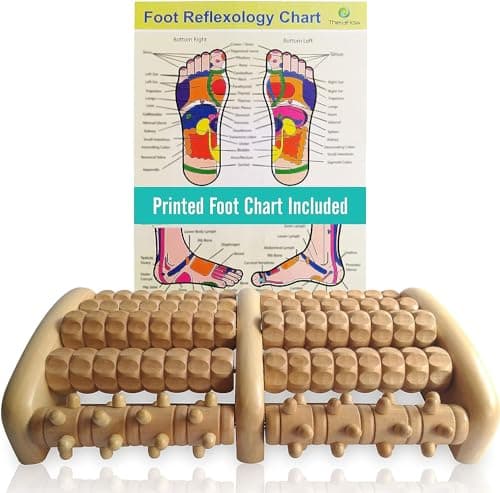
  • TheraFlow Large Dual Foot Massager Roller

    TheraFlow Large Dual Foot Massager Roller

    A sandal unloads the arch; it does not work the tissue. Rolling the arch and the calf is the part of plantar fasciitis care that actually changes anything, and this is the twenty-dollar tool the orthopedic guidance effectively describes — the pick we rank first for heel pain.

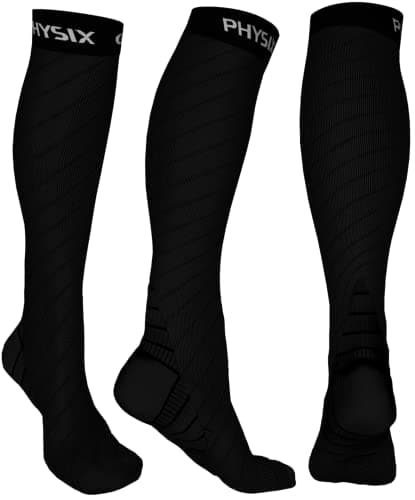
  • Physix Gear Compression Socks (20-30 mmHg)

    Physix Gear Compression Socks (20-30 mmHg)

    If your feet and calves ache because you are on them for ten hours, graduated compression during the shift does more than any sandal you put on afterwards. Same pair we rank in our boots-versus-socks comparison.

#ad · Live prices from the Amazon Product API, as of Oct 3, 2026. Where fit or size varies by tub, body or machine we link a search instead of guessing, and where we have no verified price we show none. We may earn a commission.

How we picked

We did not lab-test this gear

Everyone in this category says they tested twenty products. We have not lab-tested any of these, and we say so. What we did instead: compiled the published specifications, pulled the numbers from the manufacturer manuals, ran the cost-to-run and cost-per-unit math where there was math to run, and scored each product against a published rubric. The scores are judgments from documented research — not measurements we took, because we do not have a lab and we will not pretend we do. Where a number came from someone else's work, we name them in Sources.

Questions

Frequently asked

Do recovery shoes actually work?
They do something real and narrower than the marketing suggests. A thick, contoured platform takes load off the underside of the foot and holds the heel still, which is why standing in them after a long day feels better than standing barefoot on a hard floor. What we could not find is any controlled trial showing recovery footwear speeds muscle recovery or reduces delayed-onset soreness. The good evidence here is about foot pain, not muscle recovery.
Are recovery slides good for plantar fasciitis?
The arch-supported ones can genuinely help, and a 2025 randomized trial of 66 people found that adding arch-supportive, shock-absorbing sandals to eight weeks of physical therapy improved first-step pain significantly more than therapy alone. But Cleveland Clinic is explicit that flat sandals and flip-flops without built-in arch support are the wrong choice, so the shape of the footbed decides whether a slide helps or hurts. Pair it with the stretching and calf work that actually changes the tissue.
Can I wear recovery shoes all day?
For a few hours, yes — that is what they are for. As everyday footwear, no: the podiatric surgeon writing Brown University Health's guidance says plainly that recovery sandals may not be the best choice for everyday wear, because work floors need closed toes and uneven ground needs stability and ankle support. If you want recovery cushioning for a full shift, buy the closed, laced version rather than wearing a slide for twelve hours.
What is the difference between a recovery slide and a normal slide?
Footbed shape and platform thickness. A recovery slide has a molded arch, a cupped heel and roughly two centimeters of foam engineered to return to shape; a normal slide is a flat pad of soft foam. They look similar on a shelf and feel completely different after an hour on your feet — and only one of them matches what the clinical advice asks for.
Do I need the closed recovery shoe, or is the slide enough?
For most people the slide is enough, which is why it is ranked first: you put it on when your shoes come off and you shuffle around the house in it. The closed, laced shoe earns its higher price only if you need the cushioning while you are moving — a long shift on your feet, a commute, a day of walking — because laces keep the foot centered on soft foam in a way a strap cannot.
Can you run or train in recovery shoes?
No. The foam is soft and unstable by design and the outsoles are not built for lateral load or repeated impact; a recovery shoe is for the hours between sessions. The closed models are walking and standing shoes, not running shoes, and the manufacturers position them that way.
What size should I buy?
Check the model's sizing convention before anything else. OOFOS slides are sold in whole sizes only, so half-size feet have to pick a side; the closed OOFOS offers half sizes from 5 to 15; Birkenstock sells EU numbering with US conversions in two widths; and Crocs recommends sizing down on the Mellow because it runs roomy. Because every size and color is a separate Amazon listing, the price you see belongs to that one variant — use the search link if your size is not the one we linked.

Keep reading

Receipts

Sources

We do not run a testing lab, and we do not pretend to. Where a measured number came from someone else's work, we name them and link them. Where we could not verify something, we say so on the page rather than quietly leaving it out. Read our full method.