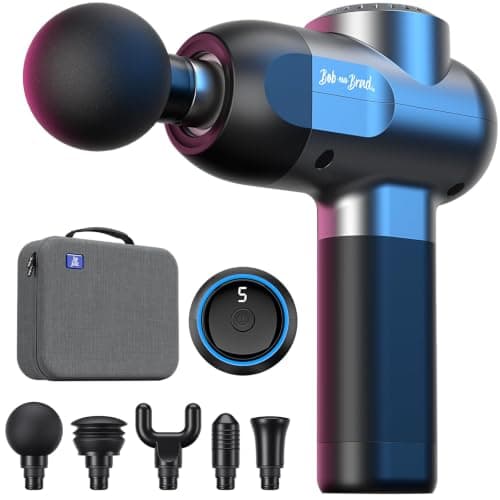
Yes, with one hard rule: work the muscles, never the bone. Shin splints — medial tibial stress syndrome — is pain along the inner edge of the tibia, and the tissue that hurts is the bone and the sheath over it, not a muscle knot. A massage gun cannot treat that. What it can do is reduce tension in the calf and in the muscles running alongside the shin, which is often where the load pulling on that bone edge comes from. If you want one gun for the job, the Bob and Brad C2 is light enough to aim at your own lower leg and controllable enough at low speed to be safe near the tibia.
Before anything else: the treatment with actual evidence behind it is load management. Shin splints are an overuse injury, and they come from doing more running, more hard surface, or more intensity than the tissue had adapted to. AAOS, Cleveland Clinic and the NHS all describe the same core approach — reduce the aggravating load, let it settle, strengthen the calf, return gradually, and look at footwear and surface. A massage gun is a comfort and mobility tool sitting alongside that. It is not a substitute for backing off.
First: is it actually shin splints?
Shin splints produce a diffuse ache along several inches of the inner shin, worst at the start of a run, often easing as you warm up and returning afterwards. A tibial stress fracture is different and more serious: pain concentrated on one small spot you can cover with a fingertip, pain that gets worse as the run goes on, pain on hopping on that leg, and sometimes pain at night or at rest.
If that sounds like you, stop and see a clinician. Do not use a massage gun anywhere near it. Percussion over a stress fracture is actively harmful, and this is the one situation on this page with a bad outcome attached. Also seek advice for numbness, pins and needles, a tight swollen compartment that worsens predictably with exercise, or shin pain that has not improved after a few weeks of sensible rest.
Where to use it, and where not to
Yes:the calf complex — the gastrocnemius bellies in the upper calf and the soleus deeper and lower down. The muscle belly of the tibialis anterior, which sits in the soft channel on the outside of the shin bone, about an inch lateral to the sharp front edge. The peroneals down the outside of the lower leg. The arch and the plantar surface of the foot, which shares load with all of the above.
No:the tibia itself — the hard, sharp front edge and the flat inner surface where it hurts. The exact spot that is painful. Any area that is swollen, hot, bruised or numb. Percussion directly onto bone is on every manufacturer's do-not-use list, and the shin has less covering it than almost anywhere else on the body. The full map is in where not to use a massage gun.
How to use it, in practice
Head:a flat or large ball head for the calf, and the same flat head — not a bullet — for the tibialis anterior. The bullet head concentrates force into a small area, which is exactly wrong next to a bone edge. More on head selection in massage gun attachments.
Speed: the lowest or second-lowest setting. This is a small, thin muscle group over a bone, not a quad.
Pressure: the weight of the gun and no more. If you are pushing, you are doing it wrong, and the closer you are to the tibia the more that matters.
Time:60-90 seconds per muscle, moving continuously — do not park it on one spot. Two to three minutes per lower leg total is plenty.
When: after running rather than before, or on a rest day. A short, gentle pass before a run is fine as part of a warm-up that also includes actual movement, but it does not replace one.
Stop if: it is sharp rather than achy, if the pain is worse afterwards, or if it feels like it is on bone. General dosing guidance for everything else is in how often to use a massage gun.
What actually fixes shin splints
Reduce the load that caused it. Cut volume and intensity, swap some runs for cycling, swimming or a walking pad, and stay off hard cambered surfaces. Pain-free activity is the guide.
Strengthen the calf.Slow, heavy calf raises — both straight-leg and bent-knee, to cover the gastrocnemius and the soleus — are the most consistently recommended rehab exercise for this. Add tibialis raises and some hip work.
Return gradually. Add distance in small increments, and treat a flare as information rather than as a setback.
Check the inputs. Shoes past their life, a sudden switch in shoe type, a jump in weekly mileage, or a new surface are the usual suspects.
A gun supports all of that by making tight calves more comfortable between sessions. It is genuinely useful in that role and it is not a cure, and anyone telling you otherwise is selling one.
Three guns that suit this job
Scored on the things that matter when the target is a small muscle next to a bone: how controllable the gun is at its lowest speed, whether the heads suit small muscle bellies, how easily you can aim it at your own lower leg, and value. Prices are live and stamped with the date they were checked.