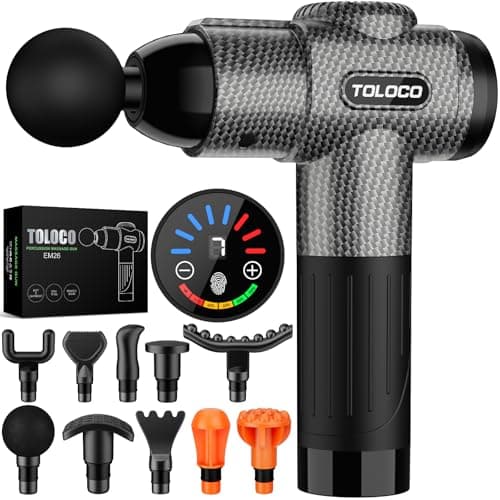
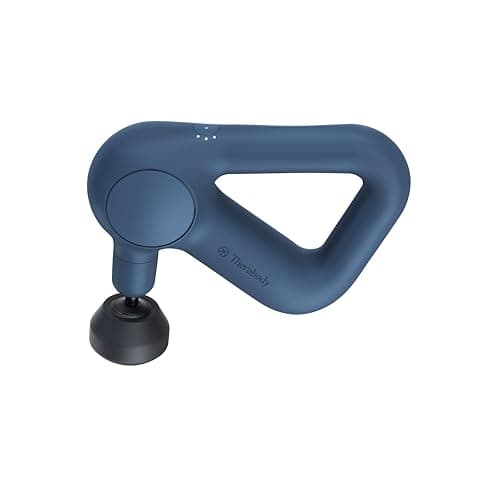
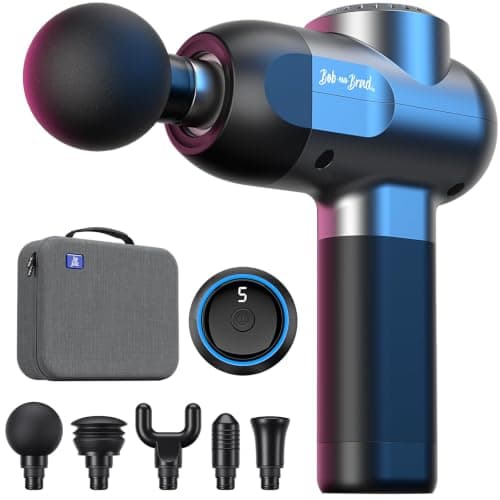
If you only ever use one head, make it the foam or rubber ball. It fits the shape of every large muscle, spreads the force over a wide enough area to be comfortable, and does ninety percent of what anyone needs a massage gun for. The second head worth learning is the flat head for denser, flatter areas, and the third is the fork for either side of the spine and the Achilles. Those three cover almost everything. The bullet — the pointed one — is the head people reach for first and the one most likely to cause a problem.
The reason this is confusing is that guns ship with anywhere from two to ten heads and almost no manufacturer explains the logic. There is one, and it is simple: the head determines how much of your body the force lands on. The same motor driving a broad foam ball is gentle; driving a pointed bullet it is concentrated into a coin-sized area and becomes several times more intense. Shape is the intensity control, far more than the speed dial is.
Below: what every common head is for, a lookup table for the body parts people actually ask about, the two heads that are mostly marketing, and the places no head belongs regardless of shape. If you have not bought a gun yet, our ranked list is at best massage guns, and the technique itself — pressure, speed, how long — is in how to use a massage gun.
What each head is actually for
Ball (foam or rubber). The default, and the one to leave fitted. A rounded head spreads the stroke across a wide contact patch, which makes it comfortable on large muscle groups — quads, hamstrings, glutes, calves, lats. Foam versions are softer and quieter; rubber versions transmit more. If a session does not have a specific reason to use something else, use this.
Flat head. A broad, hard disc for denser and flatter areas — pecs, the front of the shin, the IT band region, the upper back over muscle. It delivers more force per stroke than the foam ball because it does not deform, while still spreading the load enough to be safe over a wide area. The sensible step up in intensity.
Fork (U-shape, sometimes called the spine head). Two prongs that straddle a ridge so the force lands either side of it rather than on it. Its real jobs are the muscles running down either side of the spine — never the spine itself — and the Achilles tendon, where it works the soft tissue on both sides without hammering the tendon. Useful, narrow, and genuinely the only head for those two areas.
Bullet (cone, pointed).A single point for focal work: the sole of the foot, a specific trigger point in a thick muscle, between the metatarsals. It concentrates the entire output of the motor into a tiny area, which is why it should be used at the lowest speed, briefly, and never anywhere thin. More people hurt themselves with this head than with all the others combined, and the reason is that it looks like the "strong" one.
Wedge / spade / shovel. An angled blade for scraping along a muscle rather than hammering into it — the shoulder blade border, the IT band, the sole of the foot. Used as intended it is a sweeping tool, not a punching one. Honest assessment: real but specialist, and most people never miss it.
Cushion / air / soft tip. The gentlest head in most boxes, designed for bony or sensitive areas and for people who find the standard ball too intense. If a gun feels too harsh everywhere, try this before you conclude the gun is wrong.
Thumb head. A rounded, firm point imitating a thumb press — somewhere between the ball and the bullet in focus. It is a comfort alternative to the bullet for trigger-point work and a better default for anyone who wants focal pressure without a sharp point.
Which head for which body part
| Area | Use | Avoid |
|---|
| Quads, hamstrings, glutes | Ball, then flat if you want more | Bullet at high speed |
| Calves | Ball; fork for the Achilles itself | Bullet on the tendon |
| Upper back (either side of spine) | Fork, or ball on the muscle | Any head on the spine itself |
| Lower back | Ball, light pressure, muscle only | Flat or bullet over the kidneys |
| Neck and traps | Cushion or ball, lowest speed, back of the shoulder only | Front and sides of the neck entirely |
| Shoulders and rotator cuff | Ball on the meat; wedge along the shoulder-blade border | Bullet on the joint or the bony point |
| Feet (arch, plantar fascia) | Bullet or thumb, low speed, short bursts | Heel bone, high speed |
| Forearms and shins | Flat or cushion, light | Anything directly on bone |
Three rules that matter more than head choice
Never on bone, joints or the front of the neck. No attachment makes any of those safe. The carotid arteries run up the front and sides of the neck and there are documented case reports of arterial injury from percussive devices used there — we cover the full exclusion list in where not to use a massage gun, and it is worth reading before your first session rather than after.
The head is the intensity dial. Going from a foam ball to a bullet is a far bigger jump in intensity than going from speed one to speed five. If something is too intense, change the head before you change the speed.
Let the gun float. The device supplies the percussion; your job is to guide it slowly over the muscle, not to press it in. Leaning on it bogs the motor, which is both louder and less effective — the mechanics of that are in our quiet-gun ranking.
The two heads you can usually ignore
Guns that ship with eight or ten heads are padding the count, and the padding is usually near-duplicate balls in different hardnesses plus a second flat head in a different diameter. There is nothing wrong with them; they just are not the reason to buy one gun over another. Head count is a poor proxy for head usefulness. A gun with four well-chosen heads — ball, flat, fork, bullet — covers more real jobs than a gun with ten that is missing a fork.
What is worth checking before you buy: that the set includes a fork (the only head for spinal-adjacent muscle and the Achilles), that it includes something softer than the standard ball if you are sensitive or new to this, and that the heads are a standard push-fit rather than a proprietary mount — generic replacement sets are cheap, and proprietary mounts mean you are stuck with what came in the box.
Three guns judged on their heads
Picks below with live prices, scored only on the attachment set and how well it matches the jobs above. Full rankings on power and price live in best massage guns and best budget massage guns.