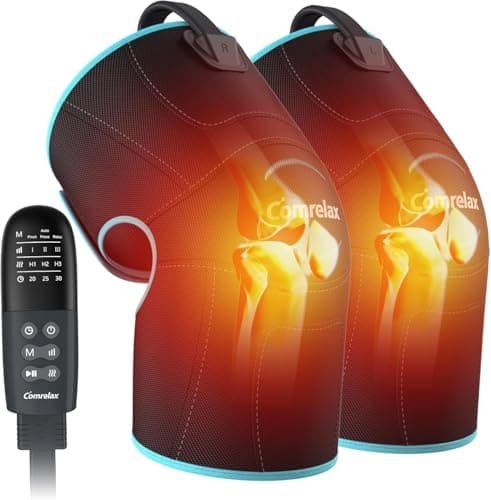
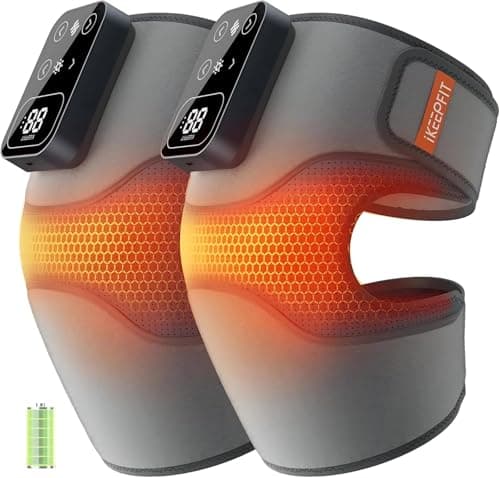
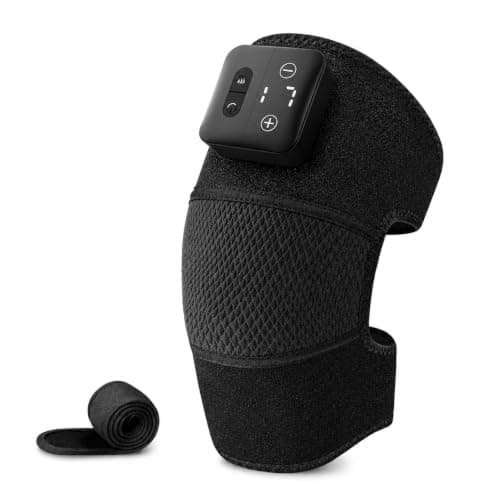
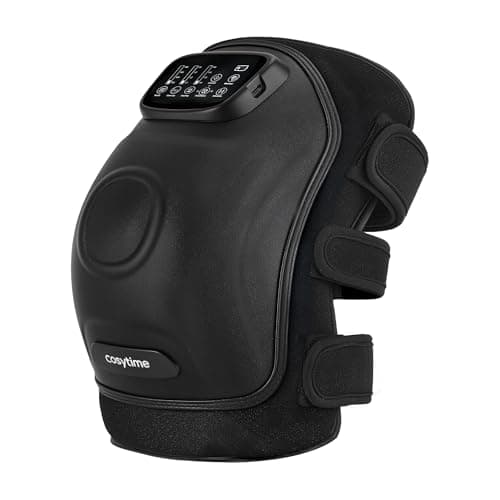
The knee is on the short list of places you must not put a massage gun. It is a joint: bone, ligament and tendon close under the skin, with very little muscle to absorb percussion. Which leaves a real gap, because knees ache — from running, from squats, from arthritis, from sitting still for forty years. A knee massager fills it with a completely different mechanism: a wrap that surrounds the joint and applies heat, air compression and gentle vibration instead of impact.
Be clear about what that does. Heat and compression around a joint feel good, ease stiffness, and make a knee more comfortable to move — a real, modest, short-term benefit that most people will notice. They do not repair cartilage, cure arthritis or fix a meniscus. Any listing implying otherwise is overselling, and this category oversells more than most: the red light therapy feature now on most units is not supported by the kind of evidence the packaging implies, and we have not scored it as a benefit.
Four picks below, ranked on the specs that decide whether one is worth owning: how many heat levels it offers and how hot it actually gets, whether it uses real air compression or only vibration, whether it is cordless and what the battery holds, and whether you get one wrap or a pair. If your problem is the muscle above or below the knee rather than the joint itself, that is a job for a massage gun on the quad and calf, or a foam roller.
Before you buy any of these, it is worth knowing which part of a knee massager has evidence behind it and which part is marketing: do knee massagers work separates the heat from the compression, the vibration and the red-light panels.
Air compression or vibration? They feel completely different
Two mechanisms share this category and the listings blur them deliberately. An air compression wrap contains inflatable bladders that squeeze the joint and release, and with enough separate bladders the squeeze travels — the small-scale version of what a compression boot does to a whole leg. A vibrationwrap has small motors that buzz. Compression feels like being firmly held and released; vibration feels like a phone against your knee. Neither is wrong, but they are not substitutes, and a listing that says "massage" without saying airbags almost always means vibration. If the squeezing sensation is what you are picturing, check the airbag count before you buy.
Heat levels, and when heat is the wrong answer
Heat is the feature that does the most work here — it eases stiffness, makes a joint more comfortable to bend, and is genuinely pleasant on a cold morning. More levels is better, because knees need different answers on different days. But there is a real limit worth knowing: heat is for stiff, chronic, achy knees. For an acutely swollen or inflamed knee — the day after a tweak, or a joint that is visibly puffy and warm to touch — adding heat is the opposite of what you want, and the conventional advice is cold, not warmth. A knee massager is a stiffness tool, not an injury tool.
What red light therapy is worth in a $60 wrap
Almost every unit in this category now advertises red light or infrared therapy, and it is the single most oversold feature on the market. The clinical research on photobiomodulation uses specific wavelengths at specific power densities for specific durations; the LEDs in a consumer knee wrap are not those parameters, and no manufacturer publishes the numbers that would let you check. We have deliberately not scored it on any pick above. Buy a wrap for its heat, its compression and its battery. If it also glows red, treat that as decoration you did not pay much for.
Fit, and the sizing trap
A knee massager only works if the heating element and airbags sit on the joint, and the most common complaint in this whole category is a strap that will not close around a larger leg or will not cinch tight enough on a smaller one. Check the stated circumference range before buying, not after. A wrap that is too loose leaves an air gap that kills the heat transfer; one that is too tight is uncomfortable within minutes and, worse, restricts circulation. It should feel snug and even, and you should be able to slide a finger under the edge.
Where this fits in a recovery routine
Knee massagers are a comfort tool, best used in the evening or before activity to loosen a stiff joint. They pair naturally with work on the muscles that cross the knee — a massage gun on the quads and calves, or a foam roller down the thigh — because tight quads and calves load the knee joint whether the joint itself is the problem or not. If the ache is lower down, the same heat-and-kneading idea exists for feet — we rank those in best foot massagers. If you have persistent knee pain, swelling that does not settle, instability, or pain that wakes you at night, none of this is the answer: see a clinician. This is general information, not medical advice.