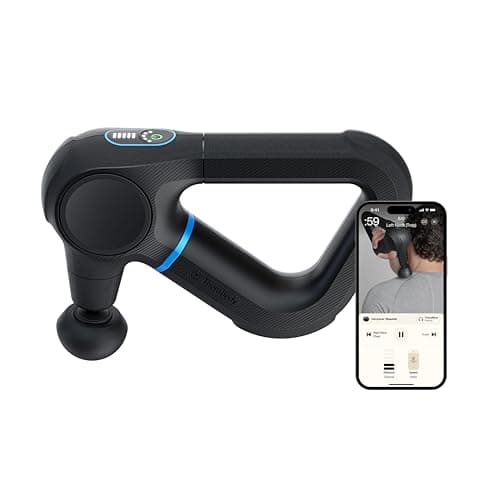
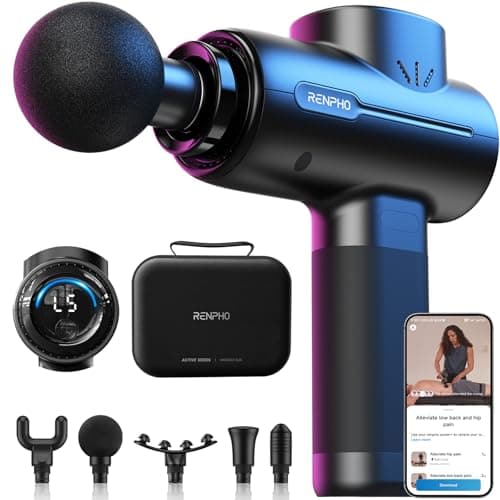
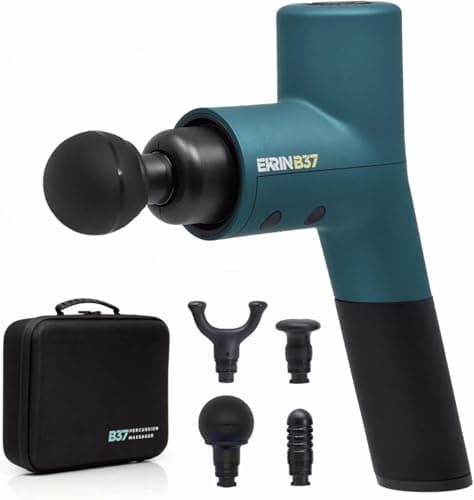
For deep-tissue work, buy the Ekrin Athletics B37v2. A rated 12 mm amplitude with a 56 lb stall force is the best combination of the two numbers that matter at any price here, and the angled handle means you can put that force into your own hamstrings and back without help. It is the right pick for anyone who presses hard and has been disappointed by a gun that stopped moving when they did. The budget pick is the Renpho Active+ — the cheapest gun on this site with a published stall force (50 lb) high enough to belong on this page at all.
“Deep tissue” is the most abused phrase in this category. Every listing claims it, because there is no standard to fail. There are, however, two published numbers that decide it, and ranking on them reorders the shelf:
Amplitude(also called stroke or travel) is how far the head moves on each cycle, in millimetres. Below about 10 mm a gun is a vibrator — it moves skin and fascia. Around 12 mm it reaches muscle. At 16 mm, which only Therabody's full-size models publish, it reaches muscle the way a thumb does.
Stall force is how much pressure the motor tolerates before the head stops moving, in pounds. This is the number that decides whether a gun feelscheap, and almost nobody shops on it. A gun with a claimed 12 mm stroke and a weak motor delivers 12 mm in the air and perhaps 4 mm in a loaded hamstring. That sensation — “it just buzzes on the surface” — is a stall-force problem, not an amplitude one, and it is why people conclude the category does not work.
Everything below publishes at least one of those numbers and holds up on both. Guns that publish neither are not on this page, however good they are at other jobs — you will find them in best massage guns and best budget massage guns.
One honest caveat before the picks. Deeper is not automatically better, and the published work on percussive therapy supports it for short-term soreness, perceived recovery and range of motion rather than for anything structural — we set that out in are massage guns worth it. If you have been told you have a disc problem, a nerve problem or a clotting disorder, the places you must not use one matter more than which one you buy: where not to use a massage gun.
The two numbers, and how to read a listing that hides them
Amplitude and stall force are the only two specifications on a massage gun listing that predict how it feels. Everything else — speed count, head count, battery, app, screen — is either marketing or convenience. A listing that gives you percussions per minute and no amplitude is telling you how fast a short stroke repeats, which is the specification that sounds most impressive and means least.
When a brand does not publish either number, assume both are modest. Serious brands publish them because they win on them; the ones that stay quiet are not being coy about good news. Two picks here publish both figures, two publish neither but are from brands whose build quality is independently evident, and the cards say which is which.
Why stroke depth without stall force is useless
Here is the mechanism. The head is driven by a motor through a reciprocating arm. When you press into tissue, you add load to that arm. A motor with headroom keeps the arm moving its full distance; a motor without it shortens the stroke and eventually stops. Stall force is the measured point where it stops.
Practically: if a gun bogs down, your options are to press less hard — which defeats the purpose — or to buy a gun with more headroom. There is no technique that fixes a weak motor. This is the entire reason a 12 mm / 56 lb gun outranks a 16 mm gun on this page for most readers: you will reliably get the 12 mm, and you will only sometimes get the 16 mm.
Amplitude is not the same as pain tolerance
A deeper stroke on a bonier or more sensitive area is worse, not better. The 16 mm gun is the right tool for a glute, a quad or a lat, and the wrong one for a calf on a lean runner or anything near the neck. If most of what you treat is the latter, a shallower, smoother gun is the correct purchase and the money is better spent elsewhere — the smoother end of the shelf is in best quiet massage guns, and neck and shoulders is its own ranking for exactly this reason.
Heads: the only two that matter for deep work
The ball for large muscle groups and the bullet or cone for a specific trigger point, used briefly and carefully. The flat head is for bone-adjacent areas, the fork is for the spinal erectors and should never straddle the spine itself, and the rest are packaging. We go through the full set in massage gun attachments.
The cheaper tools that do deep work better
Two of them, and this page would be dishonest without naming them. A massage ball under your own bodyweight applies far more sustained pressure to a single point than any gun — your bodyweight is a bigger number than 56 lb. And a dense foam roller covers more tissue per minute than a gun ever will, for a fraction of the price. The gun wins on precision, on speed and on being usable on a shoulder you cannot get your weight onto. It does not win on depth, and we put the two head to head in foam roller vs massage gun.