The best massage chairs, ranked on track type and roller depth
Five full-body chairs compared on the specs that decide the massage: how far the track travels, whether the rollers move in and out, who the chair physically fits, and what the warranty covers. Plus the honest case for spending a tenth as much.
We earn a commission when you buy through our Amazon links, at no extra cost to you. It never changes a verdict, and we say so when the cheaper product is the better buy. How this works.
A massage chair is the most expensive thing on this site and the easiest to buy on the wrong information. Listings compete on roller counts, program counts and airbag counts, and none of those predict whether the massage reaches the part of you that hurts. Four things do: the track (how far the mechanism travels down your body), the roller dimension (whether the heads move in and out, not just up and down), body fit (the height and weight the chair is actually built for), and the warranty behind 130 to 200 pounds of motorized furniture.
Start with the track, because it is the one spec that cannot be fixed later. A fixed-roller chair kneads a set area of your back and nothing else. An S-track follows the curve of your spine. An SL-track continues past the hips into the glutes and upper thighs — and if your complaint is lower back or hip tightness, that extension is the difference between a chair that helps and a vibrating armchair. Then look at roller dimension: 2D rollers move up, down and across; 3D rollers also protrude, so you can set depth; 4D varies the rhythm of that protrusion. 3D is the step that most people can feel. 4D is refinement. We rank on those, publish what the manufacturers publish, and say plainly where a cheaper product does the same job — including the case, below, for buying a chair pad for a tenth of the money.
The cheapest chair we would buy, because it is the cheapest with a real SL-track. The mechanism travels neck to hips rather than kneading one patch of your back, and it adds zero gravity, lower-back heat, foot rollers and a calf stretch at the entry price. The 240 lb user limit is the catch.
The chair to buy if you intend to use it for years. 3D rollers on an SL-track, 26 air cells, body scan, three-stage zero gravity and — the part nobody shops for and everybody needs — a published three-year warranty with the first year covering labor. The best engineering-per-dollar on this page.
The cheapest 3D SL-track chair we can find from a brand with a track record, with 5 airbag pressure levels, roller width adjustment and fixed-point mode. Good value. The listing also advertises heart-rate and blood-pressure monitoring, which we would ignore completely.
The flagship, and the one genuinely clever thing on it is not the 4D mechanism — it is the 8-inch wall clearance. A 4D SL-track chair with 22 programs and voice control that reclines in a space-saving arc, so it can live in an apartment. Priced accordingly.
The cheapest full chair here and the only one with FIXED rollers rather than a track — 14 of them, 8 across the back, plus 10 airbags, heat and a 165-degree zero-gravity recline. It is a comfortable heated recliner that massages a set area. Its stated fit tops out at 5 feet 9.
#ad · Live prices from the Amazon Product API, as of October 19, 2026. Where we have no verified live price, we show none — a gap beats a number that has rotted.
In detail
The picks, in full
01
Best overall value
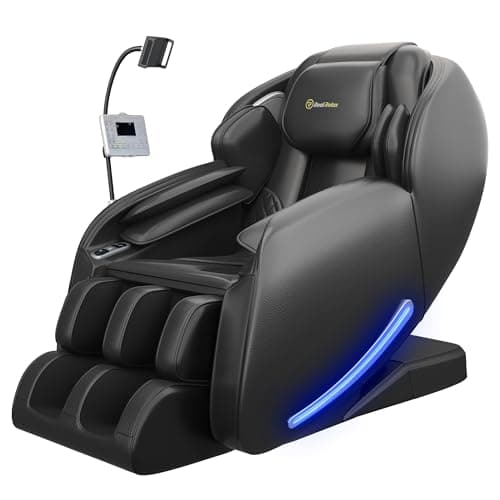
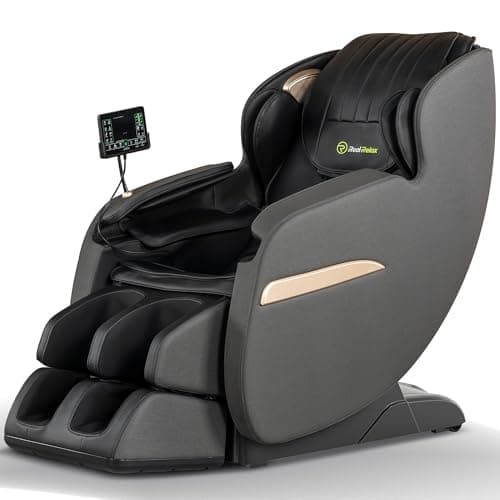
Real Relax SL-Track Full Body Massage Chair
SL-track, neck to hips8 auto modes, 3 intensity levelsZero gravity + lower back heat240 lb user limit
7.4/10
The cheapest chair we would buy, because it is the cheapest with a real SL-track. The mechanism travels neck to hips rather than kneading one patch of your back, and it adds zero gravity, lower-back heat, foot rollers and a calf stretch at the entry price. The 240 lb user limit is the catch.
Track
8
Roller depth
5
Body fit
6
Features
8
Value
10
Pros
+A genuine SL-track at the bottom of the market — the single most important spec, and the one entry chairs usually skip
+Airbag coverage across shoulders, arms, calves and feet, plus foot rollers with three intensity levels
+Lower-back heating and a 6.5-inch calf stretch, both features that normally appear a tier up
+Child lock and a dedicated pause button, which matter more than they sound on a chair this heavy
Cons
−Rated for users up to 240 lb — the lowest capacity here and a hard limit, not a guideline
−2D rollers only: you cannot set how deep the heads press, just how hard the mode is
−Ships in two separate boxes that can arrive on different days, which catches people out
−Real Relax does not publish a warranty term as clearly as Osaki does
Don't buy this if…
…you are over about 240 lb, or you want to dial roller depth — this is a well-specified 2D chair, and the ceiling on a 2D chair is real.
The reason this chair wins is that it refuses the compromise everyone else makes at this price. Entry chairs almost always save money on the mechanism — fixed rollers, or an S-track that stops at the lumbar — and then spend it on airbags and program counts you will not notice. Real Relax put the money in the track. It travels from your neck to your hips, which is where most people's complaint actually lives.
Two things to go in knowing. The 240 lb user rating is the lowest on this page, and on a motorized recliner that number is about frame and motor life rather than caution. And the rollers are 2D: you get intensity settings, not depth settings. If you want to press the heads further into your back, the Real Relax 3D below is the same brand's answer, and the Osaki OS-3D Champ II is the better-built version of that answer.
3D rollers, SL-style track26 air cells + body scan12 auto + 6 manual modes3-year warranty (1 yr parts & labor)
8.2/10
The chair to buy if you intend to use it for years. 3D rollers on an SL-track, 26 air cells, body scan, three-stage zero gravity and — the part nobody shops for and everybody needs — a published three-year warranty with the first year covering labor. The best engineering-per-dollar on this page.
Track
9
Roller depth
8
Body fit
8
Features
8
Value
8
Pros
+3D mechanism on an SL track: depth control plus neck-to-thigh travel, the combination that actually changes the massage
+Published three-year warranty — parts and labor for year one, parts for two more — which is rare and valuable on a 178 lb machine
+Automatic body scan sizes the stroke to your spine instead of applying one fixed pattern
+Six manual modes mean you can work only the neck or only the lumbar, rather than sitting through a program
Cons
−71 inches long and 178 lb — the longest chair here, and a genuine furniture decision in a small room
−Costs roughly twice the entry pick for an improvement most people would call large but not transformative
−No voice control or app, which the flagship below has
Don't buy this if…
…space is tight. At 71 inches it needs a wall it can own, and no feature on it compensates for a room it does not fit.
Osaki is one of the few brands in this category that publishes a warranty you can read before you buy, and on a product with motors, gearboxes and a control board inside a 178 lb frame, that is not a footnote — it is the single best predictor of what the chair costs you over five years. Three years of parts, with labor covered for the first, is the most substantive commitment on this page.
The hardware earns it too. A 3D mechanism on an SL track with a real body scan is the configuration that makes a chair feel like a treatment rather than a novelty: the rollers follow your spine, protrude as far as you tell them to, and continue past the hips. Twenty-six air cells is a lot of coverage, and the six manual modes mean you can treat one area instead of enduring a fifteen-minute program. If you want the full four-figure experience without the flagship premium, this is it.
3D SL-track, neck to thigh5 airbag pressure levelsRoller width + fixed-point modesBluetooth phone controller
8.0/10
The cheapest 3D SL-track chair we can find from a brand with a track record, with 5 airbag pressure levels, roller width adjustment and fixed-point mode. Good value. The listing also advertises heart-rate and blood-pressure monitoring, which we would ignore completely.
Track
9
Roller depth
8
Body fit
7
Features
7
Value
9
Pros
+3D rollers with adjustable width and a fixed-point mode — you can park the heads on one knot
+Five airbag pressure levels rather than the three on the entry chair
+Lower-back heating and reflexology foot rollers carried over from the cheaper model
+Included back pad lets you soften the pressure without changing the program, which is a smart touch
Cons
−The advertised heart-rate and blood-pressure monitoring is not something we would trust or buy for — a chair is not a blood-pressure cuff
−152 lb and 57.5 inches long, a real two-person delivery and placement job
−LED breathing lights and app features pad the feature list without improving the massage
−Warranty terms are less clearly published than Osaki's
Don't buy this if…
…you are shopping on the health-monitoring claim. Strip it out and this is a fair-value 3D chair; keep it in and you are paying attention to the wrong thing.
Moving from 2D to 3D rollers is the upgrade most owners say they can feel, and this is the cheapest route to it that we would recommend. You get depth control, roller-width adjustment and a fixed-point mode that holds the heads on a single spot — the closest a chair comes to what a massage gun does to one knot, except you do not have to hold it.
We are deducting for the listing rather than the chair. Advertising blood-pressure monitoring in a massage chair is the kind of claim that should make you read the rest of the specification more carefully, not less. Treat the health-monitoring line as marketing, judge the chair on its track and rollers, and it is a sound buy at the mid tier.
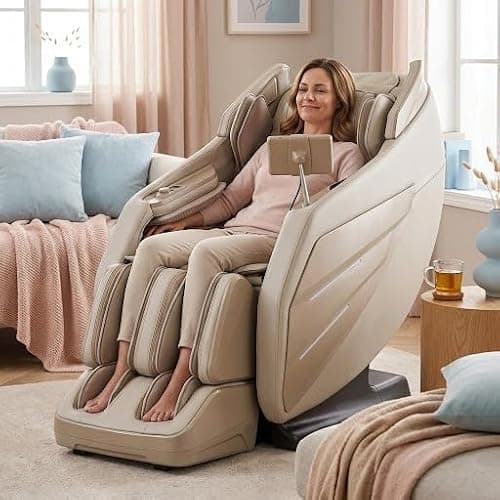
4D mechanism, SL-track to glutes22 auto programs + body scan8 in wall clearance to reclineVoice control, 2-stage zero gravity
8.4/10
The flagship, and the one genuinely clever thing on it is not the 4D mechanism — it is the 8-inch wall clearance. A 4D SL-track chair with 22 programs and voice control that reclines in a space-saving arc, so it can live in an apartment. Priced accordingly.
Track
9
Roller depth
10
Body fit
8
Features
10
Value
5
Pros
+4D rollers vary the rhythm and depth of the stroke, which is the most lifelike massage available in a chair
+Needs only about 8 inches behind it to recline — the spec that makes a flagship chair possible in a normal room
+22 auto programs with body scan, plus air compression with heat across shoulders, arms, waist and legs
+Voice control and a vertical touchscreen remote, so you are not hunting a handset mid-session
Cons
−By far the most expensive pick here, for a difference over good 3D that most people describe as refinement
−199 lb and 61 inches — the heaviest chair on the page
−4D, 22 programs and voice control are all features you will settle into using three or four of
Don't buy this if…
…you are not certain you will use it several times a week for years. At this price the per-session cost only makes sense with a genuine habit behind it.
The 4D mechanism is the headline and the wall clearance is the reason to care. Most four-figure chairs need one to two feet behind them to recline, which quietly rules them out of the rooms people actually live in. Reclining in about eight inches means this chair can sit against a wall in an apartment, and that is a harder engineering problem than adding programs.
Be honest with yourself about the rest. Going from 3D to 4D adds variation in the rhythm of the stroke; it is lovely and it is refinement, not a different category of relief. The same is true of 22 programs and voice control. If you will use the chair daily for five years, the premium amortizes fine. If you are buying it because it is the best one, the Osaki OS-3D Champ II above delivers most of the experience with the same warranty-backed engineering.
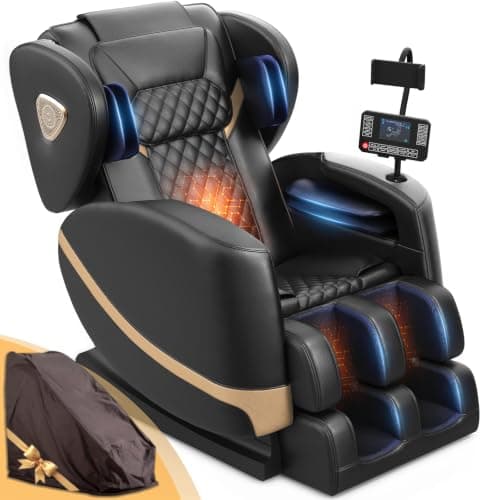
14 fixed rollers (8 back, 4 feet, 2 hip)10 airbags, waist + foot heat165-degree zero gravityFits 4 ft 9 to 5 ft 9
4.8/10
The cheapest full chair here and the only one with FIXED rollers rather than a track — 14 of them, 8 across the back, plus 10 airbags, heat and a 165-degree zero-gravity recline. It is a comfortable heated recliner that massages a set area. Its stated fit tops out at 5 feet 9.
Track
3
Roller depth
3
Body fit
4
Features
7
Value
7
Pros
+Lowest price of any full chair here, in a 125 lb frame that is the easiest of the five to move and place
+Heat in both the waist and the foot area, which is the feature owners of cheap chairs miss most
+Smart touchscreen built into the chair rather than a remote to lose, plus a Bluetooth speaker
+Footrest extends 4.7 inches and the frame uses FSC-certified wood — real detail at this price
Cons
−Fixed rollers, not an SL-track: the mechanism does not travel your whole back, which is the compromise this price buys
−FURNIMAT states a fit range of 4 ft 9 to 5 ft 9 — taller users are outside the design, not merely less comfortable
−Shallow-to-deep shiatsu only; no roller depth control of any kind
−Needs a 26-inch doorway minimum and arrives in two boxes
Don't buy this if…
…you are taller than about 5 ft 9, or your pain is in your lower back and glutes. A fixed-roller chair cannot reach what an SL-track reaches, and no number of airbags changes that.
We include this because it is the chair people land on when they search for the cheapest full-size option, and we want to be clear about what it is. Fourteen fixed rollers is a lot of rollers in a fixed arrangement — the mechanism does not travel, so you are massaged where the rollers are and nowhere else. With heat in the waist and feet and a 165-degree recline, it is a genuinely pleasant heated recliner that also kneads your upper back.
What it is not is a substitute for a tracked chair, and the published fit range of 4 ft 9 to 5 ft 9 is the honest tell. If you are inside that range, want heat and recline, and the four-figure chairs are out of reach, it is defensible. If you are taller, or the problem is your lower back, spend up to the SL-track entry pick — or spend far less on a chair pad, which costs a fraction and moves between the chairs you already own.
The four specs that decide what a massage chair can do
Chair listings lead with roller counts, program counts and airbag counts. None of those tell you where the massage reaches or how long the chair lasts. These four do, and every chair here publishes them.
Track type. The most important spec in the category and the one that cannot be upgraded. Fixed rollers knead a set region of your back. An S-track follows the curve of your spine. An SL-track continues past the hips into the glutes and upper thighs. If your complaint is lower back or hip tightness — which it usually is — SL is the spec to insist on, and it is available at the entry price now, so there is no reason to accept fixed rollers unless height and budget force it.
Roller dimension: 2D, 3D or 4D. 2D rollers move up, down and side to side. 3D rollers also protrude, so you can set how deep they press. 4D varies the rhythm of that protrusion to feel more like hands. The jump most owners can feel is 2D to 3D; 4D is refinement at a premium. More dimensions is not more reach — a 4D fixed-roller chair would still miss your glutes.
Body fit: height range and weight capacity. A massage chair is sized equipment, not furniture that adapts. Capacities on this page start at 240 lb, and one chair publishes a height range of 4 ft 9 to 5 ft 9. Outside those numbers the rollers land in the wrong places and the frame wears faster. Check both before anything else, because no feature compensates for a chair that does not fit you.
Warranty, and whether it covers labor. You are buying 125 to 199 lb of motors, gearboxes and a control board. A failure is a service call, not a return shipment. Osaki publishes three years with labor in year one; marketplace brands are typically vaguer. On a four-figure purchase, a published term with labor included is worth real money, and it is the spec buyers check last.
The five chairs, side by side
Every figure below is the manufacturer's published number for the listing we link. We have not tested these chairs and we are not going to pretend otherwise — there is no massage chair lab here. Prices move constantly at this end of the market, so they live in the table above rather than typed into this one.
Chair
Track
Rollers
Size / weight
Published fit
Real Relax SL-Track
SL, neck to hips
2D, 3 intensities
52 x 27 x 43 in, 132 lb
Up to 240 lb
Osaki OS-3D Champ II
SL-style, neck to thighs
3D + body scan
71 x 29.5 x 47 in, 178 lb
Extendable footrest
Real Relax 2026 3D
3D SL, neck to thigh
3D, width + fixed point
57.5 x 28.5 x 42.5 in, 152 lb
Not published
Osaki Titan Ion 4D
SL, neck to glutes
4D, 22 programs
61 x 29 x 49 in, 199 lb
Spring-loaded footrest
FURNIMAT Zero Gravity
None — 14 fixed rollers
Fixed, shallow to deep
50 x 27 x 41.8 in, 125 lb
4 ft 9 to 5 ft 9
Most people should buy a chair pad instead, and we will say so
This is the uncomfortable part of a massage chair roundup. A chair pad — a shiatsu mat that straps to a chair you already own — costs roughly a tenth of the cheapest chair here, weighs a few pounds, moves between rooms, and delivers kneading and heat to your back and neck. For a large share of the people searching for a massage chair, that is the correct purchase, and we rank them separately in best back massagers.
A full chair earns its price in three situations and not many others. First, when you want your legs, feet and glutes treated, which no pad can do — the foot rollers, calf airbags and SL-track extension are the real functional gap. Second, when zero-gravity recline is the point: getting your legs above your heart changes how the whole session feels, and a pad strapped to a dining chair cannot approximate it. Third, when several people in a household will use it regularly, which is what makes the per-session cost sensible. If none of those three describe you, buy the pad and spend the difference on something you will use more.
Delivery, space and the two-box problem
Nobody plans for this part and everybody deals with it. These chairs weigh 125 to 199 lb and ship in two boxes, which can arrive on different days. Doorways matter — FURNIMAT specifies a 26-inch minimum, and the others are comparable. Recline clearance matters more: most chairs need one to two feet of space behind them to lie back, which is why the Osaki Titan Ion's roughly 8-inch clearance is a genuinely useful spec rather than a marketing line. Measure the wall, the doorway and the path between them before you order, and plan on a second pair of hands for placement.
What a chair does, and what it does not
A good chair will relax tight muscles, feel excellent, and make you more likely to spend twenty minutes doing something restorative. That is worth a lot. What it will not do is treat a structural problem, replace a clinician, or monitor your health — and if a listing advertises blood-pressure readings, treat the whole specification with more suspicion, not less. For a specific knot in a specific muscle, a massage gun at a fraction of the price is the more precise tool; the two are complements, and the gun is the one to own first. If you have a diagnosed back condition, are pregnant, have had recent surgery, or have a pacemaker or implanted device, check with a clinician before using a chair at all.
One more honest comparison before you spend: if the goal is whole-limb recovery rather than a back massage, pneumatic compression bootscost a fraction of a chair and treat legs far more thoroughly than any chair's calf airbags do. Different job, much better value — and worth ruling out before a four-figure purchase.
How we picked
We did not lab-test this gear
Everyone in this category says they tested twenty products. We have not lab-tested any of these, and we say so. What we did instead: compiled the published specifications, pulled the numbers from the manufacturer manuals, ran the cost-to-run and cost-per-unit math where there was math to run, and scored each product against a published rubric. The scores are judgments from documented research — not measurements we took, because we do not have a lab and we will not pretend we do. Where a number came from someone else's work, we name them in Sources.
Questions
Frequently asked
What is the best massage chair overall?+
For value, the Real Relax SL-Track — it is the cheapest chair here with a genuine neck-to-hips SL-track, which is the spec that matters most. If you intend to use a chair for years, the Osaki OS-3D Champ II is the better buy: 3D rollers on an SL track plus a published three-year warranty with labor covered in year one. Check the 240 lb limit on the entry chair before you choose it.
What is the difference between an S-track and an SL-track massage chair?+
An S-track follows the S-curve of your spine from neck to lower back. An SL-track continues past the hips into the glutes and upper thighs — the 'L' is that extension. If your complaint is lower back, hip or glute tightness, SL reaches it and S does not. Fixed-roller chairs, which have no track at all, massage only the region the rollers occupy.
Is a 4D massage chair worth it over 3D?+
For most buyers, no. The jump people reliably notice is 2D to 3D, because 3D rollers protrude so you can set depth. 4D varies the rhythm of that protrusion to feel more hand-like — genuinely nicer, and refinement rather than a new capability. Spend the difference on a better track or a published warranty first.
How much does a good massage chair cost?+
The market splits into clear tiers. An entry tier buys a fixed-roller heated recliner. A step up buys a real SL-track with 2D rollers — this is the cheapest point we would actually recommend. The mid tier adds 3D rollers, body scan and, from the better brands, a published warranty. The flagship tier buys 4D rollers, voice control and clever space-saving recline. Live prices for every pick are in the table above; we do not type numbers into prose because they move weekly.
Should I buy a massage chair or a massage chair pad?+
A pad, unless you specifically want your legs, feet and glutes treated, want zero-gravity recline, or several people will use it regularly. A pad costs roughly a tenth as much, weighs a few pounds, straps to a chair you own and delivers kneading and heat to your back and neck. We rank them in best back massagers. The full chair earns its price on leg and glute coverage and on recline, not on the back massage itself.
How much space does a massage chair need?+
Two measurements. The footprint — 50 to 71 inches long across this list — and the clearance behind it to recline, which is typically one to two feet. The Osaki Titan Ion is the exception at around 8 inches, which is what makes a flagship chair viable in an apartment. Also check your doorway: FURNIMAT specifies a 26-inch minimum and the others are similar, and these chairs arrive in two heavy boxes.
Can a massage chair measure your blood pressure?+
Not in any way we would rely on. One listing on this page advertises heart-rate and blood-pressure monitoring; we treat that as marketing and recommend you ignore it when comparing chairs. Judge a chair on its track, roller dimension, fit and warranty, and measure blood pressure with a validated cuff.
Are massage chairs safe for everyone?+
No. If you are pregnant, have had recent surgery, have a diagnosed spinal condition, osteoporosis, a blood-clotting disorder, or a pacemaker or other implanted device, check with a clinician before using one. Also respect the published height and weight limits — a chair used outside its stated fit range puts rollers in the wrong places and wears the frame faster. Nothing here is medical advice.
We do not run a testing lab, and we do not pretend to. Where a measured number came from someone else's work, we name them and link them. Where we could not verify something, we say so on the page rather than quietly leaving it out. Read our full method.