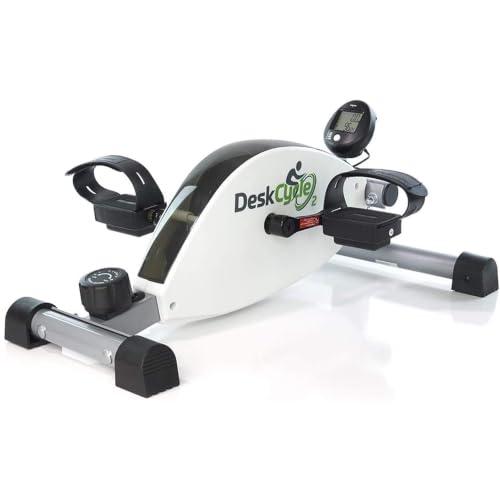
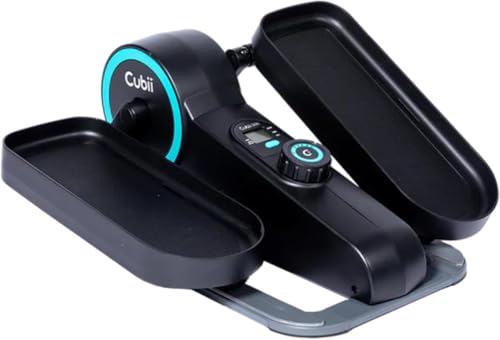
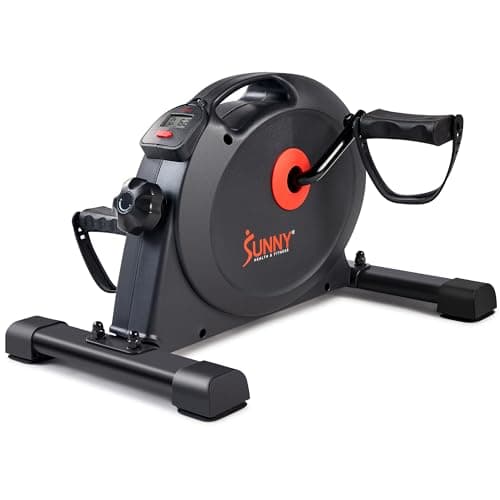
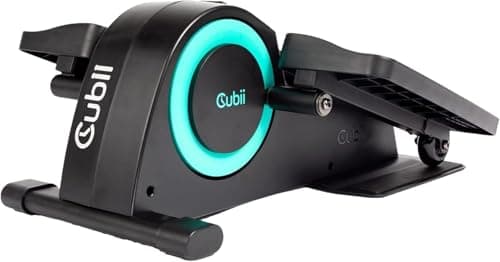
The under-desk elliptical to buy is the Cubii JR1. Its elliptical stride keeps your knees moving in a flat oval rather than a tight circle, it has eight levels of magnetic resistance to progress through, and at 25.4 lb it stays where you put it instead of walking away from you mid-stride — which makes it the right buy for someone who wants to pedal every working day and actually get fitter. If your desk is low and the knee clearance is the problem, the DeskCycle 2 is built for exactly that, with an adjustable 9 to 10 inch pedal height. The budget pick is the Sunny Health & Fitness mini pedal exerciser — the cheapest thing here that does the job, with a stepless resistance dial that goes genuinely light.
Two things decide whether one of these machines earns its floor space, and neither is on the front of the box.
Pedal height is the whole ballgame. Your knees rise by roughly the pedal height plus the stride arc, and if that number is bigger than the gap between your thighs and the underside of your desk, you will bang your knees and stop using the machine inside a week. Measure from the floor to the underside of your desktop, subtract your seated thigh height, and shop against what is left. This is why a flat elliptical oval beats a circular pedal stroke under a desk — a crank sends your knee up and over the top of the circle, while an elliptical path keeps the motion long and low. It is also why the one machine here with an adjustable pedal height is on the page at all.
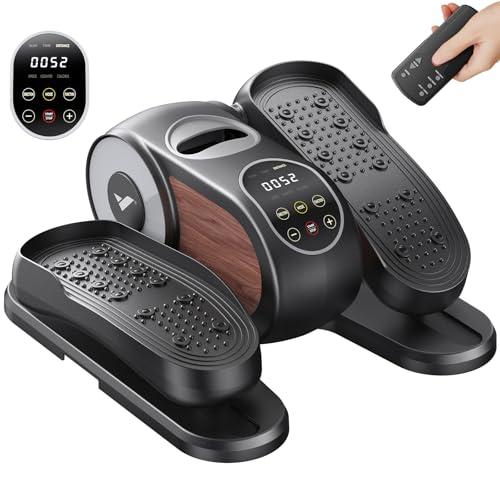
Half of this shelf is motorized, and the listings do not make that obvious. A self-powered unit works like a bike: you push, resistance opposes you, and the effort is yours. An electric unit has a motor that moves the pedals — and your legs — at a speed you select from a remote. That is passive movement. It is genuinely useful for circulation, stiffness and getting a leg moving again after surgery or during a long illness, and it is not exercise in the sense of making you fitter. We have ranked one motorized unit here, last, and labeled it plainly, because for some readers it is exactly the right purchase and for most it is not what they think they are buying.
Ranked below on pedal height and stride shape first, resistance second, and stability third. A note on expectations: pedaling gently at a desk is movement, not training. It breaks up sitting, it is kind to knees and hips, and nothing at this price will substitute for the strength work in best resistance bands for seniors or the real cardio machines in best home cardio machines. The standing ellipticals, which are a different product entirely, are ranked in best ellipticals.
Measure before you buy: the two-minute check
Sit at the desk you intend to use. Measure from the floor to the underside of the desktop, then measure the top of your thigh while seated. The difference is your available clearance, and you want the machine's pedal height plus a couple of inches of stride arc to fit inside it with room to spare. Pedal heights on this page run from roughly 9 to 10 inches, and one unit adjusts within that range. If the number does not fit, the answer is a lower machine or a higher desk, not optimism — knees that knock the desktop are the single commonest reason these machines end up in a closet. A height-adjustable desk removes the problem entirely.
Elliptical oval or circular crank
Both motions are low impact; they are not the same shape. An elliptical path is a long, flat oval, so the knee travels forward and back more than it travels up — which is why it feels gentler on knees and hips and why it needs less vertical room at the top of the stroke. A circular crank is a bike pedal stroke: shorter front to back, taller at the top, and better at loading the quads hard if that is what you want. For people shopping this shelf because of arthritic knees, a replacement or general stiffness, the oval is the safer default, which is why the two Cubii units rank on stride shape above the DeskCycle even though the DeskCycle wins outright on clearance.
Self-powered or motorized, and why it matters more than price
A self-powered machine turns because you push it. That is exercise: your muscles do the work, your heart rate rises, and over weeks you get fitter. A motorized machine turns because a motor turns it, and your legs come along for the ride. That is passive range-of-motion work, and it has real uses — keeping a joint moving, reducing stiffness, getting blood moving in a leg that has been still all day. What it does not do is improve fitness or build muscle, because nothing is loading the muscle. Listings for both types use the same words — “elliptical”, “leg exerciser”, “for seniors” — so the tell is the spec sheet: a speed control and a remote mean a motor; resistance levels or a tension dial mean you are the engine. If you are post-operative, have circulation or clotting concerns, or any doubt at all, ask a clinician which one you should be using.
Resistance: numbered levels against a stepless dial
Numbered magnetic levels (eight, on two picks here) let you repeat a setting exactly and raise it deliberately, which is what progress looks like when the whole session is gentle. A stepless dial cannot be repeated exactly, but it goes lower than level one on a numbered machine — and for rehab, or for a first week back, that is a genuine advantage rather than a compromise. One machine here publishes no level count at all, and we say so on the card instead of guessing a number.
Stability is a weight question
A light unit on a hard floor slides away from you, usually diagonally, usually at the exact moment you stop paying attention. The fix is mass or a wall: the heaviest pick here is 25.4 lb and stays put on carpet, while the lightest are best braced against a wall, a desk leg or a heavy chair. A thin mat under the unit helps on tile and laminate — the ones we rate are in best exercise mats. Check any published maximum user weight before you buy; two listings here do not publish one, and we have not load-tested any of these machines.
What to expect, honestly
Pedaling at a desk is movement rather than training. Done most working days it breaks up long sitting, keeps knees and hips moving, and is genuinely easier to sustain than a plan that needs you to change clothes. What it will not do is replace walking, make a meaningful difference to body weight on its own, or substitute for strengthening work — the adult guidance is 150 minutes of moderate activity a week plus two strengthening sessions, and this is a way to accumulate some of the first part. If you want the walking version of the same idea, the pads are in best walking pads under $200, and if a seated machine is what you need for joint reasons, best exercise equipment for bad knees covers the fuller picture.
How we picked
Every product here was confirmed live and purchasable through the Amazon Creators API before it went on the page, and every figure above is the manufacturer's own published specification taken from the listing — pedal heights, level counts and speed counts included. Where a listing publishes no figure, the card says so rather than filling the gap. Prices render from our live price layer with the date of the last check, never typed into prose. We have not lab-tested these machines; we do not own a lab and will not pretend otherwise.