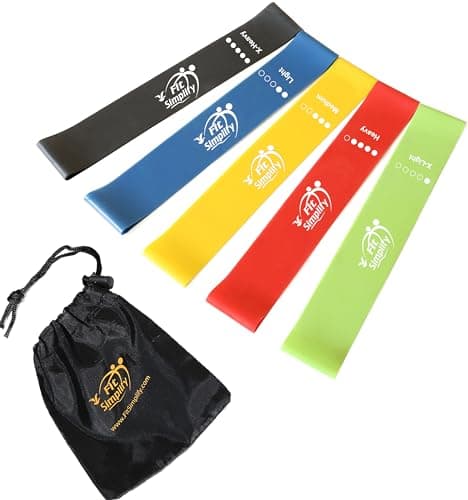
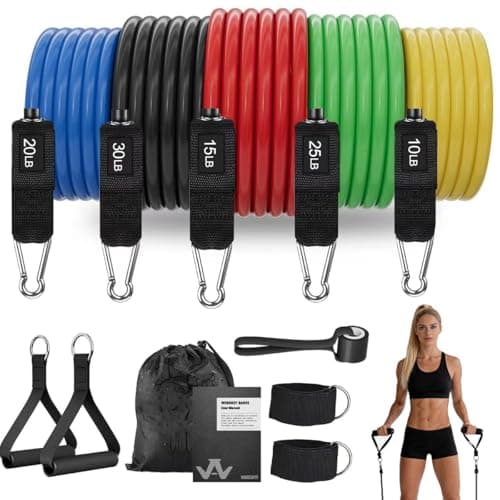
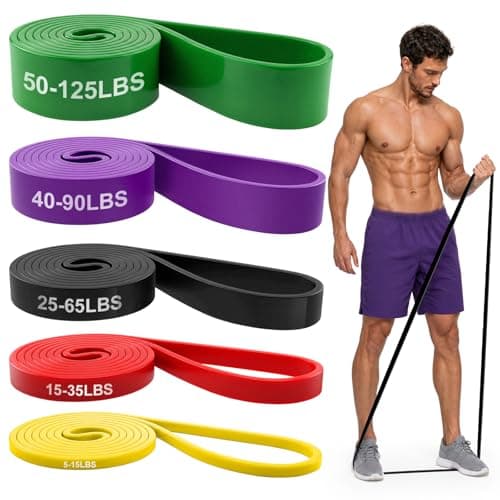
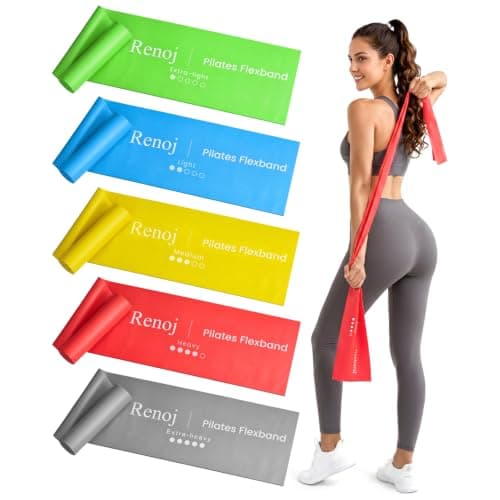
For physical-therapy work, buy the Renoj Pilates Flexbands. They are flat bands rather than tubes, they start light at a rated 5 lb, they step up in manageable jumps to 30 lb each, and they are latex-free TPE — which matters in a clinical setting in a way it does not in a garage. They are the right first purchase for shoulder, knee and hip rehab homework. The budget pick is the Fit Simplify loop set — the cheapest thing here that does the job, and the right buy if your programme is glute, hip and knee work done lying down or standing.
Almost every “best resistance bands” list is written for someone trying to build muscle at home, and it optimises for the wrong thing: total load. A 150 lb stacked tube set is useless to you in week two after a rotator-cuff problem. What a rehab programme asks for is the opposite — a band light enough that you can do thirty clean repetitions with good form, and a set whose next band up is only slightly harder, so you can progress without jumping from “easy” to “impossible”.
So the ranking here is on three things. How low the lightest band goes, because starting too heavy is the single commonest way home rehab goes wrong. How small the increments are, because progression is the entire point of a band set rather than a single band. And material: natural latex is stronger and cheaper, but latex-free TPE is the right answer if you or anyone in the house has a latex sensitivity, and two of the picks here are TPE.
A hard line before the list: what to do with the band is your clinician's call, not ours. We can tell you which set has the most useful range of light loads. We cannot tell you which exercise, how many reps, how often, or when to progress — and a page that tries to is doing you harm, not a favour. If you do not have a programme, the general-population strength guidance from the CDC in our sources is the right starting frame; if you are rehabilitating an injury, get the programme first and buy the bands to fit it.
Flat bands, loops and tubes do different jobs
Flat bands (the Renoj Flexbands) are the format most clinics hand out. They are long, you can wrap them around a hand, a foot, a door handle or a chair leg, and they apply load smoothly across a full range of motion. That versatility is why they win here: a shoulder external rotation, a seated row, a hamstring stretch and an ankle inversion all come from the same piece of rubber.
Mini loops (Fit Simplify) are short closed circles, and they are the right tool for hip and glute work — clamshells, lateral walks, bridges — plus knee-adjacent strengthening where the band sits just above the knees. They are cheap, almost indestructible, and useless for anything you need to anchor at chest height.
Tube sets with handles (WHATAFIT) are the gym answer, and they earn their place in rehab only once you are strong enough to need real load — rows, presses, pulls anchored to a door. The handles are genuinely easier on a painful grip than wrapping a flat band around your palm, which is the one rehab-specific argument for them. We cover the format question in detail in loop bands vs tube bands.
The numbers on the band are not pounds in your hand
Every band set on the market prints a resistance rating, and every one of them is approximate. The load a band applies depends on how far it is stretched, so a “15 lb” band delivers almost nothing at rest and well past 15 lb at full extension. This is not a defect — it is why bands suit rehab, because resistance builds as you move into the range where a joint is usually strongest.
What it means practically: ignore the printed number and use the colour ladder. Find the band where you can complete your prescribed repetitions with the last two or three feeling genuinely hard but clean, and move up a colour when that stops being true. A set exists so you have the next colour ready.
How long they last, and when to throw one away
Bands are consumables. Check for nicks, cloudy patches or any loss of snap before each use, and bin a band the moment you find one — a band that fails mid-repetition fails suddenly and at face height. Keep them out of direct sun, away from radiators and off rough concrete. Latex bands degrade faster with heat and UV; TPE handles both slightly better and is more prone to permanent stretch.
What bands cannot do, said plainly
Bands will not rebuild strength on their own past a point. They are excellent for early loading, for high-repetition tendon work, for grooving a movement pattern and for travel — and they top out. When your programme progresses past what a band can load, the next step is light dumbbells, and the honest version of that argument is in dumbbells vs resistance bands. If the goal is specifically muscle growth rather than rehab, we lay out what the research supports in do resistance bands build muscle.
And if the reason you are here is a knee rather than a shoulder, the equipment question is broader than bands — we rank the whole set in best exercise equipment for bad knees.