A massage gun is a motor that drives a padded head into your muscle somewhere between thirty and fifty times a second. That is all it is, and the honest summary of what that does is short: it reliably makes tight muscle feel looser and sore muscle feel less sore for a while, it buys you a short-term gain in range of motion, and there is little evidence that it speeds up the physiological repair of anything. The side effects are mostly the ordinary consequences of pressing a vibrating object into tissue too hard or for too long, plus a short list of rare, serious injuries that come almost entirely from using the gun where it should never go.
This page is the ledger. We cover the benefits that trials support, the claims that they do not, the everyday side effects, the documented injuries and who should not use a gun at all — with the sources linked at the bottom, because "studies show" without a citation is exactly the kind of thing this category is full of. If your question is the narrower "should I buy one," that is are massage guns worth it?; if you already own one and want the technique, it is how to use a massage gun.
The benefits the evidence supports
Range of motion, in the short term.This is the best-supported effect. A 2023 systematic review in the sports-medicine literature covering 13 studies and 255 adults found flexibility improvements at every body region tested after percussive treatment — with the honest caveat that a bout of static stretching was as effective as a single session of percussion for the same gain. A separate trial in 16 healthy men found that five minutes of percussion on the calf increased ankle dorsiflexion range of motion by 5.4 degrees — about 18% — with no change in the muscle's maximum force output, which is the useful part: you get the mobility of stretching without the temporary strength loss that long static stretching can cause before exercise.
Perceived soreness. The same review found that repeated percussive treatments reduced reports of musculoskeletal pain, and a 2025 randomized controlled trial in 30 active college men found that percussion applied straight after a soreness-inducing workout and again 24 hours later left them reporting less pain and showing more knee range of motion at 48 hours than a static-stretching group — with a 40-minute protocol outperforming a 25-minute one. Note the word perceived: what most of these trials measure is how sore people say they feel and how far they can move. That is a real benefit; it is just not the same claim as "recovers faster."
Warm-up.Because a short bout raises range of motion without denting force output, a brief pass over the muscles you are about to train is a reasonable pre-workout use, and the review found some evidence of improved explosive performance after treatment. The Cleveland Clinic lists increased blood flow, relieved muscle tightness and improved post-exercise soreness among the plausible benefits, and "stress relief" — which is a polite way of saying it feels nice, which counts.
The claims the evidence does not support
Faster recovery, as a settled fact. Feeling less sore is not the same as the muscle having repaired faster. The closest thing to a recovery effect in the literature is that same 2025 trial, whose 40-minute group also jumped higher at 48 hours than the stretching group — one small study of 30 young men, using a lab protocol far longer than anyone uses at home, and not yet replicated. Nothing shows percussion accelerating the underlying physiology — the inflammatory response, protein synthesis — and the systematic review itself notes that the evidence base is small and mixed. The honest case for a massage gun is comfort and mobility.
Breaking up scar tissue, "releasing" fascia, removing lactic acid. These are marketing. Lactate clears from muscle on its own soon after exercise; fascia does not remodel under a hand-held motor; and there is no mechanism by which a vibrating pad breaks anything up. What percussion does is change how the nervous system perceives the tissue for a while, which is why it feels looser. That is enough of a reason to use one; it does not need the mythology.
Treating injuries. A gun does not treat a strain, a tendinopathy, plantar fasciitis, sciatica or shin splints, and HSS is blunt that if you have just hurt yourself and have significant pain or swelling, you should not be using one. We cover the two most-searched of those separately in massage guns for plantar fasciitis and massage guns for sciatica.
The everyday side effects
Used on muscle, at a sensible speed, for a couple of minutes, the ordinary side effects are minor and self-limiting: bruising if you press too hard, soreness the next day from over-treating one spot, skin redness or irritation from friction, and a dull kickback painif the head wanders onto bone — the Cleveland Clinic's example is the nape of the neck. Every one of those is a dosing error, not a property of the tool, and the fix is the same each time: lighter, shorter, keep it moving, and stay on the muscle belly. The Cleveland Clinic's ceiling is no more than a couple of minutes on any one muscle group; HSS suggests starting with 10- to 15-second passes and letting pain be the signal to stop.
The serious injuries that have been documented
These are rare, they are case reports rather than trials, and almost all of them involve the gun being used somewhere it should not be. They are worth knowing about precisely because the marketing never mentions them.
Vertebral artery dissection. A 2022 case report describes a 27-year-old woman who developed a tear in the vertebral artery — one of the arteries supplying the brain — after three weeks of using a handheld massage gun on her neck; she recovered without lasting deficit, and the authors note that product warnings against neck use are routinely contradicted by the marketing imagery. A 2025 report in a neurosurgical journal describes a 65-year-old man who suffered the same dissection with a cerebellar stroke after using a percussion device on his neck, and its literature review lists the other injuries that have been reported after percussive devices: rhabdomyolysis (muscle breakdown severe enough to threaten the kidneys), a hemothorax, and an eye injury (lens subluxation). The authors add that no study has measured the forces these devices put through tissue, which is a polite way of saying nobody knows the safe limits.
The pattern across those reports is not subtle: the neck, the trunk near organs, the face, and prolonged sessions on one spot. Keep the gun on the large muscles of the limbs, back and shoulders, keep sessions short, and the documented serious risks essentially disappear from the picture. Our where not to use a massage gun page has the full map.
Who should not use one, or should ask first
HSS advises speaking to a doctor before adding a percussion device to a routine if you have a pre-existing condition — its examples are osteoporosis and diabetes — or are on medication; the Cleveland Clinic says the same for anyone with an underlying condition or an active injury. The common-sense list that follows from the case reports and from the physiology: anyone on blood thinners or with a bleeding disorder (bruising becomes bleeding), anyone with a known clot or a history of one (never percuss a leg with a suspected DVT), anyone with a recent fracture, surgery, or a fresh sprain or strain with swelling, anyone pregnant using it on the abdomen or lower back, and anyone with numbness or nerve symptoms in the area. None of these are reasons a massage gun is dangerous in general; they are reasons this particular body, today, should ask before pressing a motor into it.
If you do buy one: what actually matters
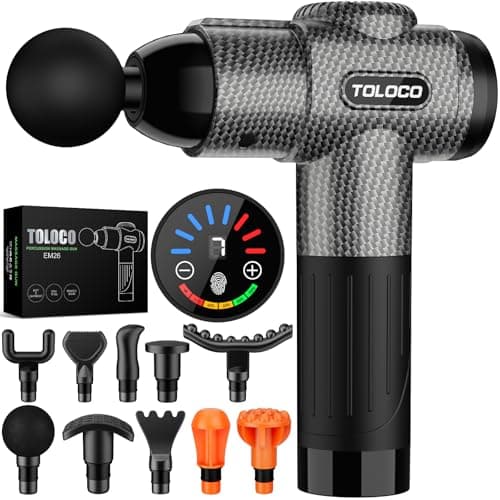
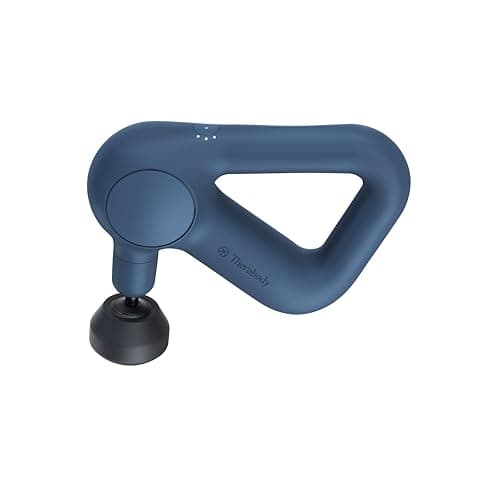
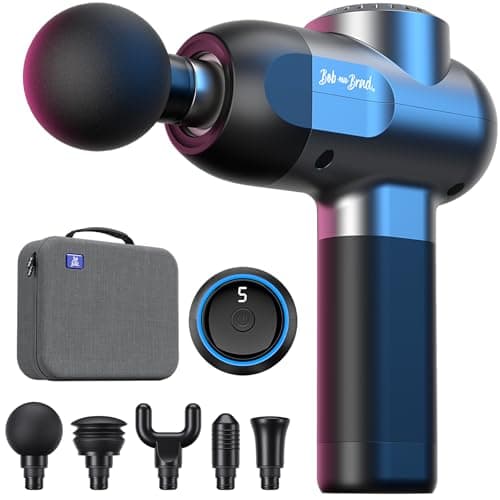
Given all of the above, the qualities that make a massage gun safer and more useful are not the ones on the box. A low, controllable bottom speed matters more than a high top speed, because the benefits arrive at moderate intensity and the side effects arrive at high. A light body matters because a heavy gun gets pressed harder than it should and sessions get cut short. Quiet matters because a gun you can use in front of the television is a gun that gets used for the two minutes a day that help, rather than the twenty minutes on a Sunday that hurt. Stroke depth and stall force — the headline specs — matter mainly to large, muscular users who want depth on dense legs; for everyone else they are the specs most likely to be over-used. The three below are the guns from our main ranking that best fit that description, at three prices.
The dose that gets the benefits without the side effects
The trial protocols range from five minutes on one calf to 25- and 40-minute whole-body lab sessions; the case reports of harm involve the wrong location, or prolonged work on one spot. The clinical guidance sits between: the Cleveland Clinic caps it at a couple of minutes on any one muscle group, and HSS suggests light 10- to 15-second passes, three to five sweeps per area. The practical dose that follows is 30 to 60 seconds per muscle before training as a warm-up, one to two minutes per muscle afterwards for soreness, on a low-to-medium speed, keeping the head moving — a whole-body session of ten to fifteen minutes spread across many muscles, never fifteen minutes on one. Our how often to use a massage gun guide sets out the full dosing schedule.
When to stop and see someone
Stop if the skin reddens or the area hurts more afterward than before — you pressed too hard or too long. Stop and see a clinician if there is numbness, tingling or weakness after a session, if a bruise is large or spreading, if you develop dark urine or severe muscle pain and weakness after an intense session (the presentation of rhabdomyolysis), or — after any use anywhere near the neck — if you develop a headache, neck pain, dizziness or vision changes in the following days. The vertebral artery case reports both presented that way, and both authors urge clinicians to ask about massage-gun use; you can save them the trouble by mentioning it.
The honest summary
A massage gun is a good tool for feeling less tight and less sore, and for loosening up before you train, with a side-effect profile that is trivial when it is used on muscle for a couple of minutes at a time and genuinely serious when it is used on the neck or for long sessions on one spot. It is not a recovery accelerator, an injury treatment or a scar-tissue breaker, whatever the box says. Bought for what it actually does and used for two minutes rather than twenty, it earns its place. Whether it earns its price is the question we take up in are massage guns worth it?