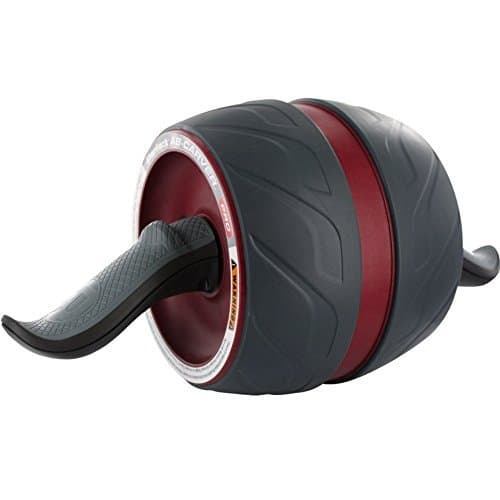
Verdict:if you are going to do rollouts, the Ab Carver Pro is worth the premium over a plain wheel — the internal spring assists the hardest part of the movement, the wide tread lets you steer the rollout, and it ships with the knee pad you would otherwise buy separately. It is also roughly double or triple the price of a bare wheel that performs the identical exercise, so if you already train rollouts confidently, or you suspect the wheel will live under the bed after a fortnight, buy the cheap one. And if you have a history of low-back trouble, this is the wrong first core purchase entirely, whichever wheel you pick.
Method, stated plainly: we did not lab-test this wheeland we are not clinicians. We compiled the manufacturer's published specifications from its retail listings, read the peer-reviewed EMG literature on ab-wheel and rollout exercises rather than quoting a press release, and reasoned about what the spring can and cannot do mechanically. That is the basis for everything below, and the full approach is on how we review. Where a number is not published, we say so instead of inventing one.
This wheel is also the winner of our best ab rollers roundup, and the score below is the same one it earned there. A review that quietly re-rates the product it already ranks is just marketing with extra words, so what you get here instead is depth: how the spring works, what the evidence actually supports, how to roll out without hurting yourself, and the three kinds of buyer who should skip it.
What the spring actually does
The rollout has two halves, and they are not equally hard. Rolling out is a controlled lowering: gravity is helping, and your job is to resist it. Rolling back is concentric work at the worst possible leverage, with your arms extended and your bodyweight hanging off a braced trunk. That return is where rollouts fall apart — people either collapse flat, or they cheat the movement by yanking with the hip flexors and letting the lower back sag.
A spring in the hub stores a little energy as you roll out and gives some of it back on the return. That is a real, mechanically sensible assist, and it is aimed at exactly the right phase. It is also deliberately modest: it shortens the gap between “I cannot do a rollout” and “I can do five clean ones,” without removing the exercise. If you want a wheel that genuinely does the work for you, the strong-rebound designs in our ab roller roundup are the honest answer, and we say there which one that is.
What the research says about ab wheels, including the part that disagrees
This is where most reviews of this product quote one study and stop. The literature does not actually agree, and the disagreement is more useful to you than either result alone.
On one side: the widely cited study commissioned by the American Council on Exercise and run at the University of Wisconsin–La Crosse put 16 participants through eight abdominal devices and nine bodyweight exercises with EMG electrodes on the upper and lower rectus abdominis, the external obliques and the rectus femoris. Its headline finding was that none of the exercises produced greater muscle activation than a traditional crunch, and the ab wheel specifically showed significantly lower upper-rectus activation than the crunch.
On the other side: Escamilla and colleagues, publishing in Physical Therapy in 2006, found the opposite ranking for a roll-out device. In their EMG analysis, upper and lower rectus abdominis, internal oblique and latissimus dorsi activity were highest for the Power Wheel in its pike, knee-up and roll-out variations, alongside the hanging knee-up and an inclined reverse crunch.
Both are real studies, and they are not measuring the same thing. The devices differ — a Power Wheel with foot straps is not a hand-held ab wheel — and so do the protocols. More importantly, the ACE researchers flagged their own caveat: their baseline crunch elicited an unusually high 68.4% of maximum voluntary contraction, which they said may partly explain why so little else beat it. Their own conclusion is the honest takeaway for a buyer: peak EMG activation is not the same as a better exercise.
So buy a wheel for the reason that survives both papers. A rollout is a loaded anti-extension movement with a long lever and an obvious progression — knees closer, range longer, eventually from the feet — which is more than a floor crunch offers once you can do thirty of them. That is the case for owning one. “It activates the most muscle” is not.
Technique, and the mistake that hurts people
The rollout is trained, not attempted. Start on your knees with the knee pad or a folded mat under you, hands on the grips, hips slightly tucked so your lower back is flat rather than arched. Roll out only as far as you can go while keeping that flat back, pause, and pull the wheel back by bracing your midsection rather than hauling with your arms. Two or three sets of five controlled reps is a real session; a wobbly set of twenty is not.
The mistake that causes trouble is letting the lower back sag as you extend. At that point the movement stops being an anti-extension exercise and becomes a lumbar-extension exercise under load, which is precisely what you do not want. If your hips drop and your back arches, you have gone past your current range — shorten it. A useful cue: stop the rollout at the point where you could still reverse it slowly, and add an inch a week.
On who should not be doing this at all: ACE notes plainly that even a traditional floor crunch “is not appropriate for everybody, especially people with low-back pain.” A loaded rollout deserves more caution, not less. If you have a history of disc problems, current back pain, or you are pregnant or recently post-partum, get individual advice before buying a wheel. This is general information, not medical advice.
Who should skip it
- Anyone who wants the cheapest workable wheel. A plain wheel trains the identical movement for a fraction of the price. The budget pick in our ab roller roundupis there for exactly this buyer, and we do not pretend the Carver's spring is transformative.
- Anyone who cannot yet hold a solid plank.If a 30-second front plank makes your lower back ache, the wheel is a progression away, not a starting point. Build there first — the bodyweight route costs nothing.
- Anyone with low-back or disc history.Covered above, and worth repeating: this is the one category where the honest answer is often “ask a clinician, not a review site.”
- Anyone buying core equipment as their first purchase. An ab wheel is a finisher. If you are equipping a room from nothing, the money goes further on the essentials in home gym for beginners and on adjustable dumbbells or resistance bands.
Where it fits, and what it does not replace
An ab wheel is a five-minute finisher at the end of a session, two or three times a week. It does not replace the compound lifts that load your trunk hardest, it does not burn visible abs into existence, and it does not substitute for the recovery work that lets you train again tomorrow — a wheel costs less than almost anything on this site, which is exactly why it gets bought instead of used. If you are assembling a sensible kit rather than collecting gadgets, our recovery gear starter kit puts the whole picture in buy order, and types of home gym equipment explains which categories genuinely earn floor space.