If you have ever lain on your side on a foam roller and dragged it down the outside of your thigh, you know two things: it hurts more than anything else you roll, and it never seems to get better. Both are explained by the same fact. The iliotibial band is not a muscle. It is a thick sheet of fascia running from the hip to just below the knee, and the anatomical study that reshaped how clinicians think about it found it anchored to the thigh bone along its length by fibrous strands, over a layer of richly innervated and vascularized fat. You are not rolling a tight muscle loose. You are pressing a fixed band into a pad of nerve endings.
This page is the long version of a warning that appears on every roller roundup on this site — in best foam rollers for runners especially. It covers what the IT band is and does, what IT band syndrome actually is, why rolling the band itself hurts and does not help, what to roll and strengthen instead, and — after all of that — the three tools from our rankings that suit the replacement routine. If you are looking for the general technique, that is how to foam roll.
What the IT band is, and what the 2006 study changed
The iliotibial band — or tract — is the thickened lateral part of the fascia lata, the sleeve of connective tissue around the thigh. Two muscles feed into it at the top: the tensor fasciae latae (TFL) at the front of the hip and the gluteus maximus at the back. For decades the textbook story was that the band "snaps" back and forth over the bony bump on the outside of the knee as the knee bends, causing friction, inflammation and a bursitis — and that stretching or rolling it would loosen it and stop the rubbing.
In 2006 Fairclough and colleagues dissected fifteen cadavers, scanned six volunteers and studied two athletes with acute IT band syndrome, and found that story did not hold. The band was anchored to the femur in every specimen, which means it cannot roll forward and back over the epicondyle; there was no bursa in any cadaver, volunteer or patient; and the tissue that got compressed as the knee flexed to about 30 degrees was the fat layer under the band, a layer full of nerves and blood vessels. Their conclusion: IT band syndrome is a compression problem of that fat pad, not a friction problem of the band, and the treatment logic should shift from stretching the band — which its femoral attachments prevent — toward the hip muscles that drive tension into it from above.
Why rolling the band hurts and does not help
Put those two findings together. The band is fixed to bone, so a roller cannot lengthen it — HSS's physical therapist James Gallegro puts it simply: fascia is by design quite resistant to stretching, it is meant to transfer load; muscles can be stretched, fascia not so much. And the thing between the roller and the bone is a nerve-rich fat layer, so pressing hard on it is exactly as pleasant as it sounds. HSS's advice is in the headline of its own article: IT band pain? Don't roll it. What rolling the band directly does produce is a few minutes of altered sensation, some bruising for the enthusiastic, and no change to the thing that hurts.
A fair note on the evidence: a 2017 cadaver study did find that the band-and-TFL complex elongates slightly under a simulated clinical stretch, so "cannot be stretched at all" overstates it. But the elongation was measured in cadaver tissue under a simulated stretch, with the TFL attached, and none of it argues for a roller. The practical conclusion is the same either way: the tissue that changes under load is the muscle, so that is where the work goes.
What IT band syndrome actually is
The Cleveland Clinic describes the pain as sitting at the outside of the knee — the lateral epicondyle — and at the outside of the hip, the greater trochanter. The AAOS adds stiffness, aching and burning on the outside of the knee and hip, clicking or popping there, and discomfort that can radiate along the leg. It is overwhelmingly a runner's and cyclist's problem, and the risk factors both sources list are about load and mechanics, not tightness: an abrupt increase in training volume, running downhill or on cambered roads, worn footwear, insufficient rest, foot pronation, leg length differences and — the one that matters most for what follows — weak hip abductors and glutes.
The good news is the timeline. The Cleveland Clinic says about 50 to 90% of people improve within four to eight weeks with nonsurgical treatment, some within two to six. What that treatment is — rest, ice, anti-inflammatories, adjusting training, and physical therapy focused on stretching and strengthening the hip and knee muscles — is notable for what it is not: nobody with a clinic is prescribing you a foam roller for the band itself.
What to roll instead, and what to strengthen
The useful rolling targets are the muscles that feed tension into the band. The tensor fasciae latae, a small muscle at the front-outside of the hip just below the bony point of the pelvis, is the one HSS names first, along with the gluteus maximus. Add the gluteus medius at the side of the hip and the vastus lateralis— the outer quad, which sits under and in front of the band and is what most people are actually hitting when they roll the "IT band" and it feels productive. Roll those, slowly, thirty to sixty seconds each, a few times a week; the outside of the thigh gets rolled in the sense that the outer quad does, with the roller angled toward the front rather than straight on the band.
Then do the part that fixes it. Both clinical sources point to weak hips as a cause and hip strengthening as the treatment, and the 2006 anatomy points the same way: side-lying leg raises, clamshells, banded lateral walks, single-leg bridges, and single-leg balance work, progressed over the same four to eight weeks the condition takes to settle. Rolling makes the muscles feel better for a few hours; strengthening changes how much tension they put through the band on every stride. The roller is the warm-up for the exercises, not the treatment.
What to roll with
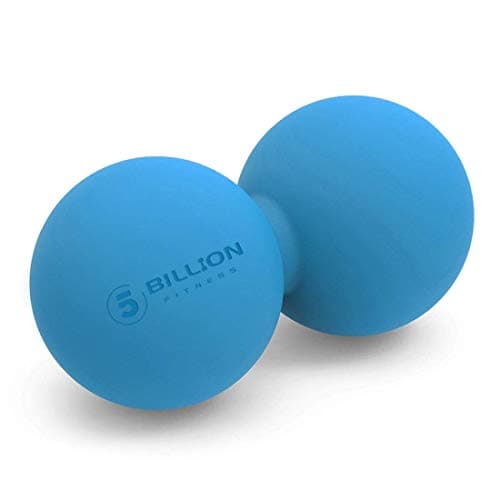
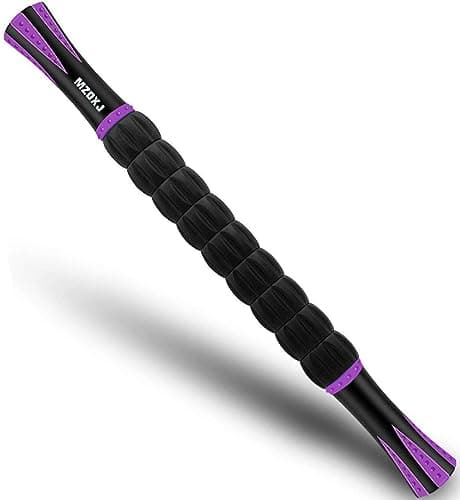
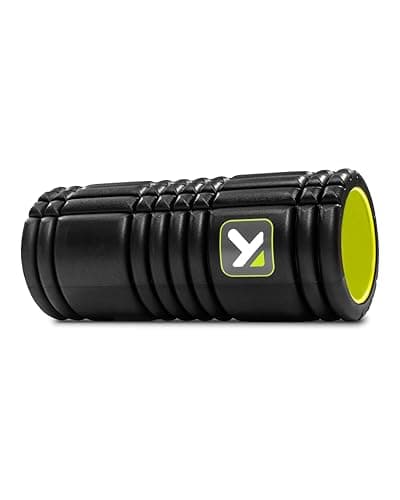
The TFL and the glute medius are small, deep and tucked against bone, and a full-size roller skates over them; a firm ball you can lie on and pin precisely is the right tool. The outer quad and the glute max are big and respond to a roller. And for the seated, controlled version of the outer-quad work — useful on a day the leg is irritable — a stick lets you set the pressure with your hands. The three below are the tools from our roller, ball and stick rankings that fit that routine.
A replacement routine, in five minutes
Roller on the outer quad, angled toward the front of the thigh, forty-five seconds a side. Roller on the glute max, sitting on it with the ankle crossed over the knee, forty-five seconds a side. Ball on the TFL, lying on your side just below the point of the hip, thirty seconds a side — this one is tender, so ease in. Ball on the glute medius, sitting on it and leaning toward that hip, thirty seconds. Then the strength work: two sets each of side-lying leg raises, clamshells and a single-leg bridge, and a banded lateral walk if you own a loop band. That is the whole thing, and the strength half is the half that matters.
When it is not the IT band
Lateral knee pain is not always IT band syndrome. A lateral meniscus tear, patellofemoral pain, a lateral collateral ligament sprain and a stress reaction in the tibia can all present on the outside of the knee, and hip pain at the greater trochanter can be a gluteal tendinopathy or a bursitis rather than the band. The AAOS advice is to see a doctor for persistent knee or hip pain related to running or repetitive activity that does not improve with rest. Swelling, locking, giving way, or pain that came on with a twist or a fall are reasons to skip the roller and get an examination. If the pain is new and sharp, it is not a rolling problem yet.
The honest summary
Rolling the IT band is the most persistent piece of gym folklore because it feels like it should work — the tissue is tight-feeling and the pressure is intense. The anatomy says the band is anchored to bone over a bed of nerves, the clinicians say do not roll it, and the treatment that resolves IT band syndrome in most people within a couple of months is load management and hip strength. Roll the muscles that feed the band, do the exercises, fix the training error that started it, and leave the band alone. Our do foam rollers work? page sets out what rolling can and cannot do more broadly.