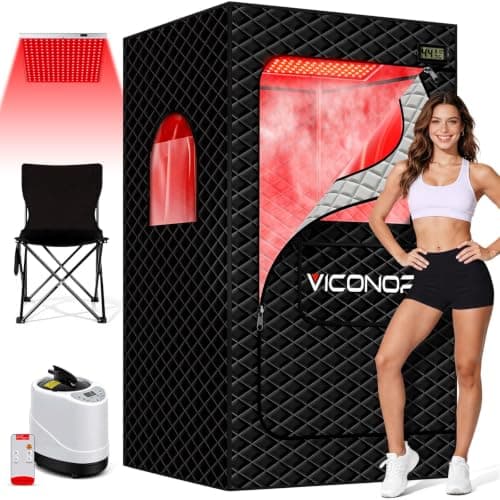
Yes — for one specific buyer. If what you want is a hot, sweaty, genuinely relaxing twenty minutes available at home whenever you feel like it, a portable sauna delivers that for a few hundred dollars and about a dime a session, and the Viconor Portable Infrared Sauna Box is the one we would buy. If what you want is the research-backed cardiovascular effect of a Finnish sauna, a portable unit is the wrong product and no amount of shopping fixes that. Everything that follows is the gap between those two sentences.
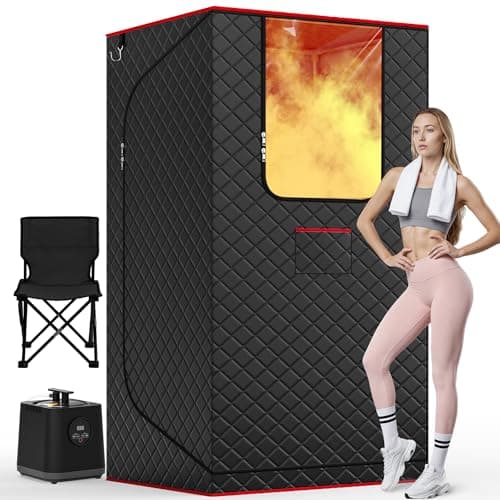
The question is asked so often because the category is full of units that look like scientific equipment and are sold with language borrowed from studies done on something else. So let us be specific about what you are buying: a fabric or framed enclosure with heating panels or a small water boiler, that you sit in with your head outside. Your body heats. Your head breathes room air. That design choice is why it is cheap, why it is safe to use alone, why it folds away — and why it cannot reproduce a walk-in sauna, where the heat is in the air you breathe.
Judged as what it is rather than what the listing implies, it is one of the better pieces of recovery gear per dollar on this site. Judged as a medical device, it fails, and so does every other unit in the category. We go through the research caveats properly in sauna benefits.
What a portable sauna actually delivers
Three things, and they are real. Heat on demand — no drive, no gym hours, no waiting for a public sauna to be free. Deep post-session warmth, the thing people actually mean when they say a sauna helps them recover, and the thing that makes an evening session a reliable wind-down. And sweat, which is pleasant and which some people find genuinely useful psychologically at the end of a hard training day.
What it does not deliver is the research. The sauna studies people cite — the ones linking frequent sauna bathing to cardiovascular outcomes — were run on traditional hot-air saunas at temperatures a head-out tent does not reach, with the whole body in the heat. That design difference is not a technicality; it is the exposure. A portable sauna is a comfort-and-relaxation purchase with a side of post-workout warmth, and anyone selling it to you as preventive cardiology is overreaching.
The arithmetic, honestly
Run your own numbers, not ours. The purchase is a few hundred dollars once. The running cost is small and calculable: portable saunas commonly draw 800 to 1,500 watts, so divide the wattage by 1,000, multiply by the fraction of an hour you run it, and multiply by your electricity rate. A 1,000 W unit for 30 minutes is 0.5 kWh — about a dime at the US residential average of a shade under 19 cents per kWh.
Then compare against what you would otherwise pay. A gym membership bought primarily for sauna access, a spa day, or the drive to either: if the sauna is the reason you are paying for something, the home unit usually clears its cost inside a year. If you already pay for a gym you use for other reasons and it has a sauna, the honest answer is that you are buying convenience, not savings, and convenience is a legitimate thing to buy — just price it as what it is.
Who should not buy one
- Anyone chasing the cardiovascular research. Covered above. The exposure is different; buy a gym membership with a real sauna instead.
- Anyone who will not do the cleanup, if they are buying steam. A steam tent is wet after every session. Infrared is not. This is the most common reason a portable sauna ends up folded in a closet, and it is avoidable by choosing the right type — see infrared vs steam.
- Anyone with a cardiovascular condition, uncontrolled blood pressure, or who is pregnant, without asking a clinician first. Heat stress is still heat stress in a tent, and the relevant caution does not care that the unit was inexpensive.
- Anyone who wants it mainly to lose weight. The number on the scale after a session is water, and it comes back with your next drink.
What to look for, in the order that matters
Heat type first. Infrared is dry, breathes easier and leaves nothing to clean; steam is the humid classic and leaves condensation everywhere. This decides your experience more than any other spec, so decide it before you compare prices.
Interior dimensions second. Check them against your height and how you like to sit. Tall users are consistently the ones who regret a single-person tent, and the two-person options exist for exactly that reason.
Wall construction third. Multi-layer walls hold heat; thin ones bleed it, which means the heater works continuously and the temperature never settles.
Then the extras. Red-light panels, heat levels, chairs, arm ports, low-EMF claims on infrared units. These are real differentiators between two comparable units and a bad reason to pick a worse one.
Three that are worth the money
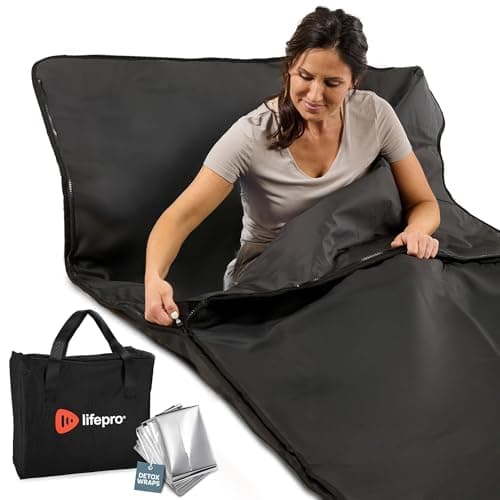
Picks below, with live prices. All three are drawn from the full rankings in best portable saunas and best sauna blankets — this page ranks them on a narrower question: does the thing justify its price for a first-time buyer?