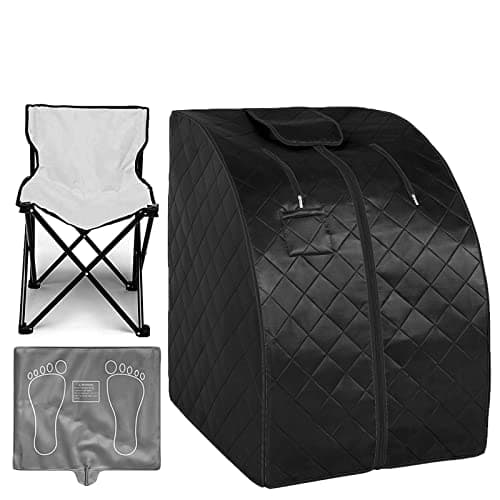
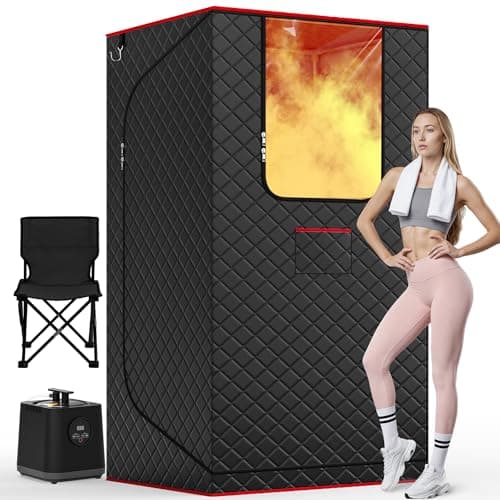
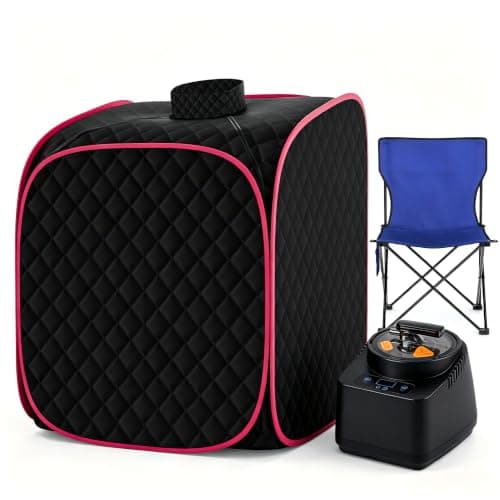
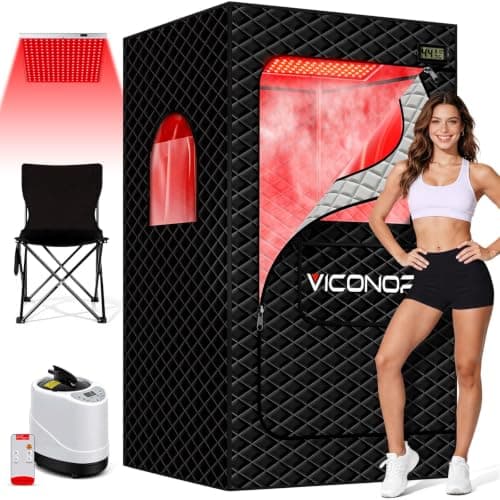
For most people putting a sauna inside a house or an apartment, the answer is infrared, and the reason has nothing to do with heat. Infrared warms your body directly instead of boiling the air, so you breathe cool air while your skin heats, and when you finish there is nothing to dry out. Steam is the heat most people picture and genuinely nicer to sit in if you like humidity — it just arrives with a water tank to fill and a wet tent to wipe down every single session. Our pick for the typical buyer is the Viconor Portable Infrared Sauna Box, which is the infrared option with a rigid frame and red-light panels; if you specifically want the wet sweat, the Manastin Portable Steam Sauna is the one to get.
That is the verdict. The rest of this page is why, because the two heat types are not two flavors of the same thing — they are different physics, and the difference shows up in four places: what your lungs experience, how hot the air actually gets, what you have to do afterward, and how long you wait before you can get in.
One honest framing note before the table. Everything below is about portable, head-out units — the tents and boxes you set up in a spare room and fold away. Your head stays in room air in both types, so neither reproduces a walk-in Finnish sauna, and the heart-health research people cite for saunas was done on hot-air rooms at far higher temperatures with the whole body inside. We covered that caveat in sauna benefits and it applies to both sides of this comparison equally. If you want the lie-down version of infrared instead of a box, read sauna blanket vs portable sauna next.
Infrared vs steam, side by side
| What you are comparing | Infrared | Steam |
|---|
| How the heat reaches you | Radiant panels warm your body directly | A boiler fills the tent with hot vapor, and the air warms you |
| Air you breathe | Relatively cool and dry | Hot and saturated |
| Humidity | None | Effectively 100% inside the tent |
| Cleanup after a session | Nothing — close it and walk away | Wipe the interior, air the tent, empty the steamer |
| Consumables | None | Water, every session |
| Typical power draw | Roughly 800-1,500 W, same class as steam | Roughly 800-1,500 W, same class as infrared |
| Suits a carpeted or unventilated room | Yes | No |
| Reproduces a traditional sauna | No (and it does not try to) | Closer in feel, but still head-out and cooler |
Specifications above are the manufacturer-published figures from the listings linked in Sources, plus the wattage band portable saunas are generally sold in. We have not measured temperature, humidity or power draw ourselves, and we are not going to imply we did.
The running cost is a tie, and it is small
People assume steam costs more to run because boiling water sounds expensive. In practice both types are electric resistance heaters in roughly the same power band — commonly 800 to 1,500 watts — so the arithmetic is identical. Take the unit wattage, divide by 1,000, multiply by the fraction of an hour you run it, and multiply by your electricity rate. A 1,000 W unit for 30 minutes is 0.5 kWh, which at the US residential average of a shade under 19 cents per kWh is about a dime. We will not print a monthly total, because it depends on your wattage, your session length and your rate — but the honest headline is that neither heat type costs meaningful money to run, so running cost should not decide this.
What should decide it, in order
- The room. Carpet, no window, shared wall, or a finished basement you care about? Infrared. Steam has to be ventilated somewhere, and a sealed room means the moisture ends up in the plaster.
- Your tolerance for hot air. If humid, hard-to-breathe heat is what you enjoy, steam is not substitutable. If it is the part of a steam room you endure, infrared removes it while keeping the sweat.
- Whether you will do the cleanup. The honest predictor of whether a home sauna still gets used in six months is not how good the heat is. It is whether using it creates a chore. Infrared creates none.
- Storage. A fabric tent of either type folds; the rigid infrared box does not. If the sauna has to disappear between sessions, that narrows the list faster than heat type does.
Three claims to ignore while shopping
"Infrared detoxifies / burns more calories." Sweat is thermoregulation. The weight you lose in a session is water, and it returns with your next drink. Neither heat type has an established detox mechanism, and listings that lead with one are telling you how they market, not how they heat.
"Steam is the real sauna." A traditional Finnish sauna is a hot, relatively dry air room — closer to neither of these than people assume. Both portable types are their own thing.
Temperature numbers on the listing. An infrared unit quoting a high internal air temperature is quoting a figure that does not describe your experience, because infrared is not meant to heat the air. Compare infrared units on panel coverage and build, and steam units on wall thickness and steamer control, rather than comparing the two on one number.
Low-EMF, and when it matters
Infrared listings often advertise a low-EMF design, the same spec that shows up on sauna blankets. It refers to the electromagnetic field from the heating elements, which sit close to your body in a small enclosure. If it is a concern for you, it is a published spec you can shop on; if it is not, it does not need to be. Steam units have no equivalent claim because the heat source is a water boiler sitting outside the tent.
The combination most people actually end up with
Worth saying plainly: the heat type matters far less to recovery than what you pair it with. If the goal is post-session recovery rather than relaxation, the bigger lever is contrast — heat then cold — which we work through in sauna vs cold plunge, and the cold half starts at best cold plunge tubs. If you are still deciding between a tent of any kind and the lie-down alternative, the blanket versus portable sauna comparison is the one to read before this one.