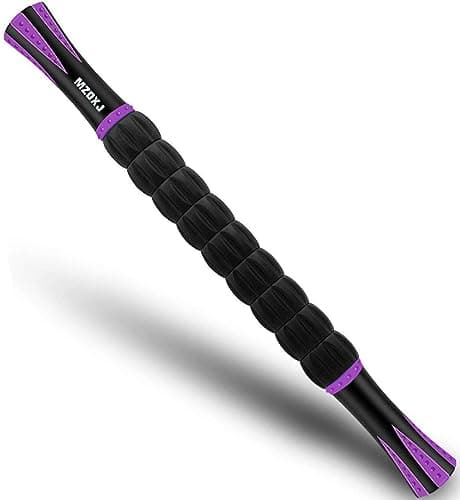
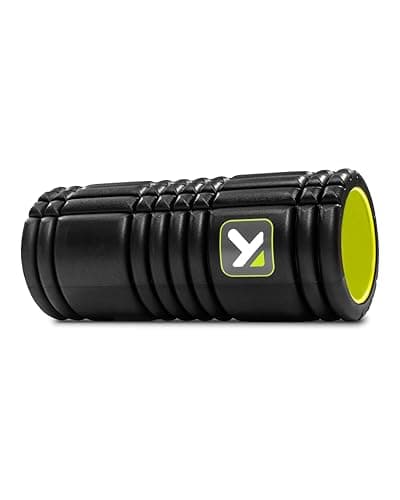
These two tools apply the same principle — sustained mechanical pressure along a muscle — through opposite ergonomics. A foam roller sits on the floor and you press into it with your body weight. A massage stick is a handheld bar you press into the muscle with your arms. That single difference decides everything else: how much pressure you can generate, how much tissue you cover per minute, which body parts you can reach, and where you can use them.
The short answer: buy the roller first. It covers more tissue per minute, it does your back, and it costs about the same. Buy the stick second, or first only if your use case is specifically legs-while-seated, travel, or working on someone else. Most people who keep up a rolling habit end up owning both, and use them in different places.
The four differences that matter
- Pressure source. Roller: your body weight, which is a lot and is adjustable by how much of it you commit. Stick: your arms, which is less, and tires.
- Coverage per minute. Roller wins comfortably — a long roller can do both calves or both quads simultaneously. A stick does one muscle at a time.
- Your own back. Roller only. You cannot use a stick on your own back with any leverage, and this is the single most decisive point in the comparison.
- Where you can use it. Stick wins outright: a bench, a chair, a car, a hotel bed, the side of a track. A roller needs floor space and somewhere to put it.
Where the stick genuinely wins
Four situations, and they are not edge cases. Travel: a stick fits in a carry-on; a roller does not. Seated use: if getting down to the floor and back up is hard — through injury, stiffness, age, or simply being at work — a stick lets you do calves and quads from a chair. Precision: arm pressure is more controllable than body weight, so a stick is better for creeping up on a very tender spot. And working on someone else, where a stick is the only practical choice of the two.
Where the roller genuinely wins
Everything involving your back — thoracic extension, lats, and the glutes that drive so much lower-back complaint. Everything involving speed, because body weight does the work and you simply move. And anything requiring real pressure: a heavy, muscular leg can absorb more force than most people can generate through their arms for ten minutes. If you have one tool and a floor, the roller is the more complete instrument. The full ranking is in best foam rollers, and the stick equivalent is in best massage sticks.
Technique is identical, and that surprises people
Whichever you use: roll slowly, about an inch per second, along the length of the muscle. Pause on a tender spot with steady pressure for 20 to 30 seconds rather than sawing back and forth over it. Keep the pressure at a "good hurt" you can breathe through and never at a level that makes you hold your breath. Stay on muscle bellies and off bone, joints and the spine. Two to three minutes per muscle group is the useful dose for either tool. Detail in how to foam roll.
Where the massage gun fits into this
A massage gun is the third option and sits closer to the stick: handheld, targeted, portable, arm-controlled. It buys speed and reach on a specific knot, and costs ten to thirty times what a stick does. If you are choosing among all three on a budget, the honest order for most people is roller, then stick or ball, then gun — and we make that case in full in foam roller vs massage gun.
The verdict
Buy the roller. Add the stick when you start traveling with your training, when the floor becomes inconvenient, or when you want something at the office. Together they cost less than a single mid-range massage gun and cover more ground than either does alone — which is why most people who keep up the habit own both and keep them in different rooms.
How we picked
Everyone in this category says they tested twenty products. We have not lab-tested any of these, and we say so. What we did instead: compiled the published specifications, pulled the numbers from the manufacturer manuals, ran the cost-to-run and cost-per-unit math where there was math to run, and scored each product against a published rubric. The scores are judgments from documented research — not measurements we took, because we do not have a lab and we will not pretend we do. Where a number came from someone else's work, we name them in Sources.