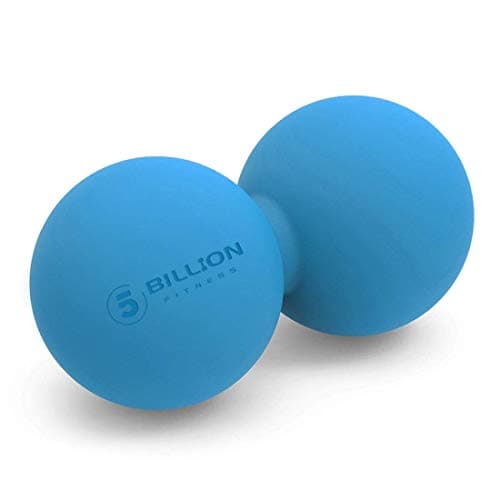
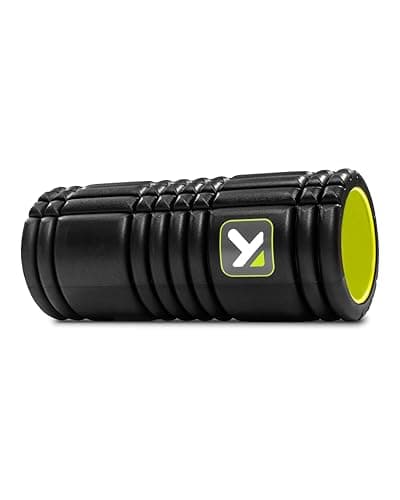
These are not really competitors, and treating them as a versus question is what leads people to buy the wrong one. A foam roller is a broad tool: a long cylinder that spreads your body weight over a wide contact patch and lets you cover big, flat muscle groups — quads, hamstrings, calves, lats, upper back — quickly. A massage ball is a narrow tool: a small sphere that concentrates the same body weight onto one point, so it reaches into places a cylinder physically cannot touch — the sole of a foot, deep in a glute, under a shoulder blade, along the arch of a hip.
Put crudely: the roller covers ground, the ball gets into corners. The pressure difference follows straight from geometry. Load 180lb onto twelve inches of roller contact and the pressure is moderate and tolerable. Load the same 180lb onto a lacrosse ball and the pressure at that point is enormous — which is precisely why a ball can feel brutal on a glute and why it works where a roller just slides past.
Below: a straight head-to-head, then a body-part map telling you which tool wins where, then an honest answer to which one to buy first. If you want the ranked lists instead, see best foam rollers and best massage balls. And if you are weighing either of these against a powered device, that comparison lives at foam roller vs massage gun.
Head to head
| | Foam roller | Massage ball |
|---|
| Contact area | Wide — spreads load over inches of muscle | Tiny — concentrates load on one point |
| Pressure at the tissue | Moderate, tolerable, easy to modulate | Very high — intense, sometimes too intense |
| Best at | Quads, hamstrings, calves, IT band, lats, upper back | Feet, glutes, piriformis, pecs, forearms, under shoulder blades |
| Coverage speed | Fast — a whole quad in 30 seconds | Slow — one point at a time |
| Portability | Bulky; travel rollers exist but compromise | Fits in a jacket pocket or a laptop bag |
| Typical price | $15-$75 | $7-$30 |
| Learning curve | Low — hard to do badly | Moderate — easy to press too hard, too long |
| Works against a wall? | Awkwardly | Yes — the standard way to do upper body |
The body-part map
This is the part that actually decides your purchase. For almost every area of the body one of the two tools is clearly better, and it is not a close call.
- Quads, hamstrings, calves — roller. Long, thick, flat muscle groups. The roller covers the whole length in seconds and the moderate pressure is exactly right. A ball here is unnecessarily punishing and takes five times as long.
- IT band and outer thigh — roller. Long structure, and one you should treat with moderate pressure rather than jabbing at. Broad contact wins.
- Upper back and lats — roller, with one exception. A roller across the thoracic spine (perpendicular, arms crossed) is one of the most useful things you can do for a desk-bound back. But for the knot under a shoulder blade, only a ball against a wall reaches it.
- Glutes and piriformis — ball, clearly. The glutes are thick and deep; a roller spreads its load over so much surface that it barely reaches them. Sit on a ball with the ankle crossed over the opposite knee and you will find the spot within seconds.
- Feet and plantar fascia — ball only. A roller cannot meaningfully contact the sole of a foot. This is the single clearest ball-only use case, and the reason so many people with morning heel pain own one.
- Pecs, front of shoulder, forearms — ball. Small, awkwardly-angled areas you work against a wall or a table edge. A roller has no way in.
- Lower back — neither, directly. Do not roll or ball the lumbar spine itself. Use a peanut-shaped ball placed either side of the spine, which straddles the vertebrae rather than pressing on them, or work the glutes and hip flexors that are usually the real cause.
Why the ball hurts more (and what to do about it)
The intensity difference is pure physics, not toughness. Pressure is force divided by area, so shrinking the contact area from a roller's several square inches to a ball's fraction of one multiplies the pressure at the tissue enormously — with the same body on top. That is a feature when you need to reach deep glute tissue and a bug when you drive it into something small and unsuspecting.
The two controls that matter: how much body weight you put on it (work against a wall instead of the floor, and you can dial the load down to almost nothing), and how long you stay on one spot. Thirty to sixty seconds on a tender point is plenty. If you are gritting your teeth, wincing or holding your breath, you are past useful and into bruising. Softer balls exist for exactly this reason, and a beginner is better served by one than by the hardest lacrosse ball on the shelf.
So which do you buy first?
Buy the foam roller first if you are starting from nothing and train legs at all. It covers the largest muscle groups, it is nearly impossible to use badly, and the areas it handles — quads, hamstrings, calves, upper back — are where most training-related tightness actually lives. It is the higher-value first purchase for almost everyone.
Buy the massage ball first if your problem is specific and small: heel or arch pain, a deep glute ache, a knot under one shoulder blade, or tight forearms from climbing or keyboard work. A roller will not solve any of those, no matter how good it is. Buy it first, too, if you travel constantly — a ball lives in a bag, and a roller does not.
Realistically the answer for most people is both, in that order, and the total spend is small: a good roller and a good ball together cost less than one mid-range massage gun. There is a third tool worth knowing about too — the massage stick, which gives you roller-style coverage with hand-controlled pressure and no floor work, useful if getting down onto the ground is the obstacle. For technique on either, start with how to foam roll.